Program Design (Cambridge (CIE) A Level Computer Science): Exam Questions

Exam code: 9618

1 hour15 questions
1
2 marks

A program includes the following assignment statement:

Result ← STR_TO_NUM(x) / STR_TO_NUM(y)

When the program evaluates the expression in the statement, it performs a calculation.

Variable Result is of type real and variables x and y are of type string.

Two checks are required before the calculation is performed:

  1. The two strings represent valid numeric values.

  2. The numeric value of string y is not zero.

The designer considers implementing the checks and calculation as a module (a procedure or a function). One reason for this is that the same checks and calculations are performed at several places in the program.

Give another reason why this is a suitable approach and state what is avoided by this approach.

2a
5 marks

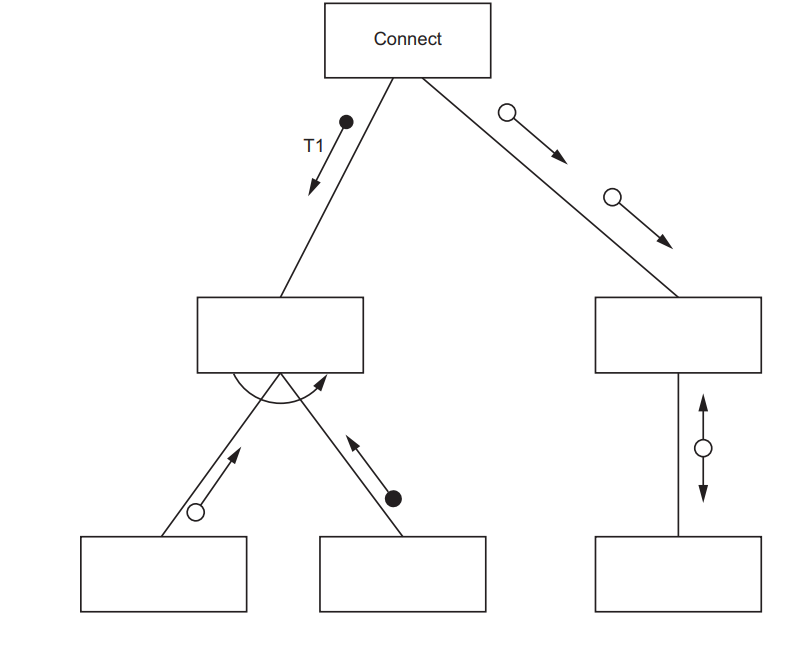
A program contains six modules with headers as follows:

Pseudocode module header

PROCEDURE Connect()

FUNCTION Activate(H1 : STRING, Code : INTEGER) RETURNS BOOLEAN

FUNCTION Sync(T1 : BOOLEAN, S2 : REAL) RETURNS INTEGER

PROCEDURE Initialise(BYREF ID : INTEGER, BYVAL CC : INTEGER)

FUNCTION Reset(RA : STRING) RETURNS INTEGER

FUNCTION Enable(SA : INTEGER) RETURNS BOOLEAN

Module Connect() will call either Activate() or Sync(). This is decided at run-time.

Complete the structure chart for these modules.

Flowchart with a "Connect" box at the top branching into six boxes. Arrows indicate connections and movements labelled T1, with filled and unfilled circles.
2b
2 marks

Explain the meaning of the curved arrow symbol used in the diagram in part (a).

3a
3 marks

A coffee shop runs a computerised loyalty card system.

Customers are issued with a loyalty card with their name together with a unique customer ID.

Loyalty points are added to their card each time they spend money at the shop.

The following information is stored for each customer: ID, name, home address, email address, mobile phone number, date of birth, number of points, date of last visit and amount of money spent at last visit.

A new module will generate a personalised email message to each loyalty card customer who has not visited the coffee shop in the last three months. The message will include a unique voucher code which can be used to authorise a discount if the customer goes to the shop within the next two weeks.

It is decided to adopt a formal program development life cycle model for the development of the new module.

The analysis of the new module is complete and the project moves on to the design stage. During this stage all the necessary algorithms and module designs will be defined.

State three other items that will be defined for the new module during the design stage.

3b
3 marks

Part of the coffee shop program contains three program modules as follows:

Module Init() has no parameters and returns a Boolean.

Module Reset() takes a string as a parameter and returns an Integer.

Module Check() repeatedly calls Init() followed by Reset().

Draw a structure chart to represent the relationship between the three modules, including all parameters and return values.

4
4 marks

A coffee shop owner wants to introduce a computerised loyalty card system.

A programmer discusses the details of the system with the shop owner.

The shop will give each customer a loyalty card that displays a unique customer ID as a bar code. A customer will be able to present their card each time they make a purchase. The system will scan the bar code, calculate points, and add them to the customer’s total. When the customer next makes a purchase and presents their card, they will have the option to exchange points for a discount.

The designer decides that this activity will be handled by a new module. Decomposition will be used to break the problem of designing the new module down into sub-problems (sub-modules).

Identify four sub-modules that could be used in the design of the new module and describe their use.

5
2 marks

A fitness club has a computerised membership system. The fitness club offers a number of different exercise classes.

The following information is stored for each club member: name, home address, email address, mobile phone number, date of birth and the exercise(s) they are interested in.

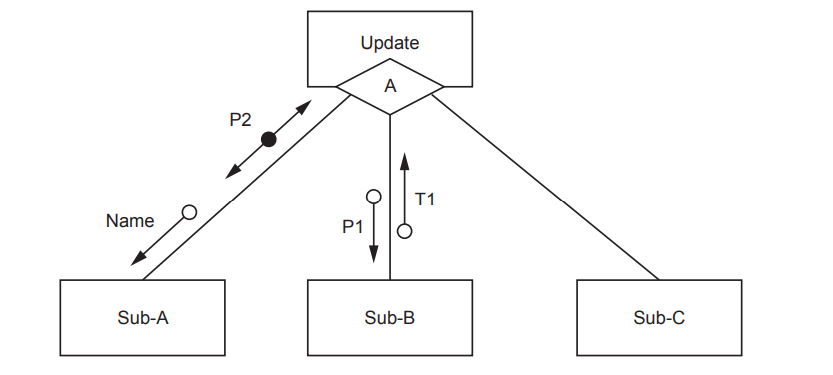
The structure chart illustrates part of the membership program:

Flowchart with decision diamond labelled "Update," arrows to boxes "Sub-A," "Sub-B," and "Sub-C," with annotations "Name," "P1," "P2," and "T1."

Data item notes:

  • Name contains the name of a club member

  • P1 and T1 are of type real.

Explain the meaning of the diamond symbol (labelled with the letter A) in the chart.

6
6 marks

A fitness club has a computerised membership system.

The system stores information for each club member: name, home address, email address, mobile phone number, date of birth and exercise preferences.

Many classes are full, and the club creates a waiting list for each class. The club adds details of members who want to join a class that is full to the waiting list for that class.

When the system identifies that a space is available in one of the classes, a new module will send a text message to each member who is on the waiting list.

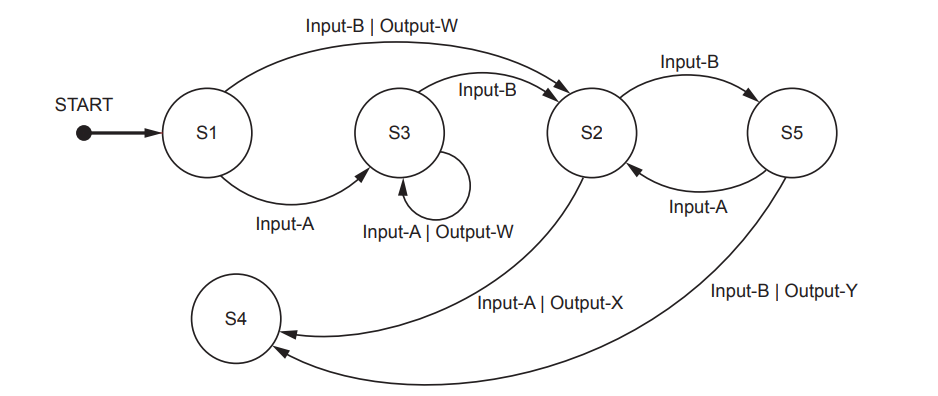
A different part of the program is represented by the following state‑transition diagram.

Flowchart depicting states S1 to S5 with transitions based on various inputs and outputs. Arrows indicate processes from start to multiple endpoints.

(i) Complete the table to show the inputs, outputs and next states.

Assume that the current state for each row is given by the ‘Next state’ on the previous row. For example, the first Input‑A is made when in state S1.

If there is no output for a given transition, then the output cell should contain ‘none’.

The first two rows have been completed.

Input

Output

Next state

S1

Input‑A

none

S3

Output‑W

none

Input‑B

Input‑A

S4

(5)

(ii) Identify the input sequence that will cause the minimum number of state changes in the transition from S1 to S4.

(1)

7
2 marks

A teacher is designing a program to process pseudocode projects written by her students.

Each student project is stored in a text file.

The process is split into a number of stages. Each stage performs a different task and creates a new file.

For example:

File name

Comment

MichaelAday_src.txt

Student project file produced by student Michael Aday

MichaelAday_S1.txt

File produced by stage 1

MichaelAday_S2.txt

File produced by stage 2

Suggest a reason why the teacher’s program has been split into a number of stages and give the benefit of producing a different file from each stage.

8
6 marks

Seven program modules form part of a program. A description of the relationship between the modules is summarised below. Any return values are stated in the description.

Module name

Description

Mod-A

calls Mod-B followed by Mod-C

Mod-B

• called with parameters Par1 and Par2
• calls either Mod-D or Mod-E, determined when the program runs
• returns a Boolean value

Mod-C

• called with parameters Par1 and Par3
• Par3 is passed by reference
• repeatedly calls Mod-F followed by Mod-G

Mod-D

called with parameter Par2

Mod-E

• called with parameter Par3
• returns an integer value

Mod-F

called with parameter Par3

Mod-G

• called with parameter Par3
• Par3 is passed by reference

Parameters in the table are as follows:

  • Par1 and Par3 are of type string.

  • Par2 is of type integer.

Draw a structure chart to show the relationship between the seven modules and the parameters passed between them.

9
5 marks

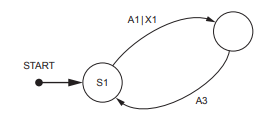
An algorithm is represented by a state-transition diagram.

The table shows the inputs, outputs and states for the algorithm:

Current state

Input

Output

Next state

S1

A1

X1

S2

S2

A3

none

S1

S2

A2

X4

S5

S5

A1

X1

S5

S5

A4

X2

S2

S5

A3

none

S3

S1

A9

X9

S3

S3

A9

X9

S4

Complete the state-transition diagram to represent the information given in the table.

Flowchart with two circles, one labelled S1 and the other unlabelled, arrows indicate transitions with labels A1|X1, A3; a start point leads to S1.
10
2 marks

A company installs parcel collection lockers in shops. A customer collects a parcel by scanning a code at the locker.

The behaviour of the locker software is documented using a state-transition diagram.

The table shows the inputs, outputs and states for the software:

Current state

Input

Output

Next state

S1

Scan-Code

Show-Menu

S2

S2

Press-Open

Open-Door

S3

S2

Press-Cancel

none

S1

S2

Scan-Code

Show-Error

S2

S3

Close-Door

Lock-Door

S1

S3

Timeout

Show-Alert

S4

Complete the table with reference to the information above.

Answer

The number of different inputs

The final or halting state

11
3 marks

The entry gate of a car park is controlled by a program. A driver presses a button to receive a ticket, and the gate opens when the ticket is taken.

The behaviour of the program is documented using a state-transition diagram.

The table shows the inputs, outputs and states for the program:

Current state

Input

Output

Next state

S1

Press-Button

Print-Ticket

S2

S2

Take-Ticket

Open-Gate

S3

S2

Timeout

none

S1

S3

Car-Detected

none

S4

S3

Timeout

Close-Gate

S1

S4

Car-Gone

Close-Gate

S1

S4

Timeout

Sound-Alarm

S5

The current state is S1. The following inputs occur, in this order:

  1. Press-Button

  2. Take-Ticket

  3. Timeout

  4. Press-Button

  5. Timeout

Give the number of outputs that are produced, the outputs in the order they are produced, and the current state after the last input.

12
5 marks

An electric vehicle charging point is controlled by a program.

The behaviour of the program is documented using a state-transition diagram.

The table shows the inputs, outputs and states for the program:

Current state

Input

Output

Next state

S1

Plug-In

Show-Ready

S2

S2

Start-Charge

Begin-Power

S3

S2

Unplug

none

S1

S3

Stop-Charge

End-Power

S2

S3

Full-Battery

Show-Full

S4

S3

Fault-Found

Show-Error

S5

S4

Unplug

Show-Total

S1

S5

Reset

none

S1

One driver uses the charging point. Complete the table below to show the inputs, outputs and next states.

Assume that the current state for each row is given by the Next state on the previous row. For example, the first Plug-In is made when the program is in state S1.

If there is no output for a given transition, the output cell should contain none.

The first two rows have been completed.

Input

Output

Next state

S1

Plug-In

Show-Ready

S2

Start-Charge

End-Power

S3

Full-Battery

S1

13
2 marks

A program controls a ticket machine at a railway station. The program is built from four modules.

A structure chart has been produced during the design stage. The table summarises the relationship between the modules that the chart shows. Any return values are stated in the description.

Module name

Description

Sell

calls GetZone followed by PrintTicket

GetZone

• has no parameters
• returns an integer value

PrintTicket

• called with parameter Zone, of type integer
• repeatedly calls PrintLine

PrintLine

• called with parameter Text, of type string

(a) Identify the module that would be implemented as a function.

(b) The structure chart uses a curved arrow symbol to show iteration. Identify the module that this symbol is applied to.

14
3 marks

A weather station program is built from three modules.

A structure chart has been produced during the design stage. The table summarises the relationship between the modules that the chart shows. Any return values are stated in the description.

Module name

Description

Record

• has no parameters
• calls ReadTemp followed by StoreTemp

ReadTemp

• called with parameter SensorID, of type integer
• returns a real value

StoreTemp

• called with parameter Saved, of type Boolean
• Saved is passed by reference
• does not return a value

Write the pseudocode module headers for ReadTemp and StoreTemp.

15
6 marks

A parcel delivery company uses a program to sort parcels. The program is built from five modules.

A structure chart has been produced during the design stage. The table summarises the relationship between the modules that the chart shows. Any return values are stated in the description.

Module name

Description

Dispatch

• has no parameters
• calls CountParcels once and stores the value returned
• then calls Weigh once for each parcel, numbered 1 to the value returned by CountParcels
• after each call to Weigh, calls either Express or Standard, decided when the program runs
• calls Express when the value returned by Weigh is greater than 2000, otherwise calls Standard
• does not return a value

CountParcels

• has no parameters
• returns an integer value, which is the number of parcels waiting

Weigh

• called with parameter ParcelNum, of type integer
• returns an integer value, which is the mass of that parcel in grams

Express

• called with parameter ParcelNum, of type integer
• does not return a value

Standard

• called with parameter ParcelNum, of type integer
• does not return a value

Write the equivalent pseudocode for module Dispatch.

Do not write the pseudocode for the other four modules.