Drag Forces (AQA AS Physics): Revision Note
Exam code: 7407

Drag forces
Drag forces are forces that oppose the motion of an object moving through a fluid (gas or liquid)
Examples of drag forces are friction and air resistance
Drag forces:
are always in the opposite direction to the motion of the object
never speed an object up or start them moving
slow down an object or keeps them moving at a constant speed
convert kinetic energy into heat and sound
Lift is an upwards force on an object moving through a fluid
It is perpendicular to the fluid flow
For example, as an aeroplane moves through the air, it pushes down on the air to change its direction
This causes an equal and opposite reaction upwards on the wings (lift) due to Newton's third law

A key component of drag forces is it increases with the speed of the object
This is shown in the diagram below:

Worked Example
A car of mass 800 kg has a horizontal driving force of 3 kN acting on it. Its acceleration is 2.0 m s-2. What is the frictional force acting on the car?

[2]
Answer:
Step 1: Calculate the resultant force from Newton's second law
[1 mark]
Step 2: Calculate the frictional force
[1 mark]
Air resistance
Air resistance is an example of a drag force that objects experience when moving through the air
At a walking pace, a person rarely experiences the effects of air resistance
However, a person swimming at the same pace uses up much more energy - this is because air is 800 times less dense than water
Air resistance increases with the speed of an object, such as a vehicle
However, there are other factors that also affect the maximum speed, such as:
cross-sectional area
shape
altitude
temperature
humidity
Air resistance must be carefully considered in vehicle design, for example in racing cars, bicycles and aeroplanes:
Racing cars have a streamlined design with a curve, angled front to experience less air resistance and travel faster
Aeroplanes travel at high altitudes where there is less air resistance (since the air is less dense)
However, they also travel through a variety of extreme temperatures and at very high speeds
Therefore, aeroplane design is focused on producing the fastest, but also smoothest, journey possible
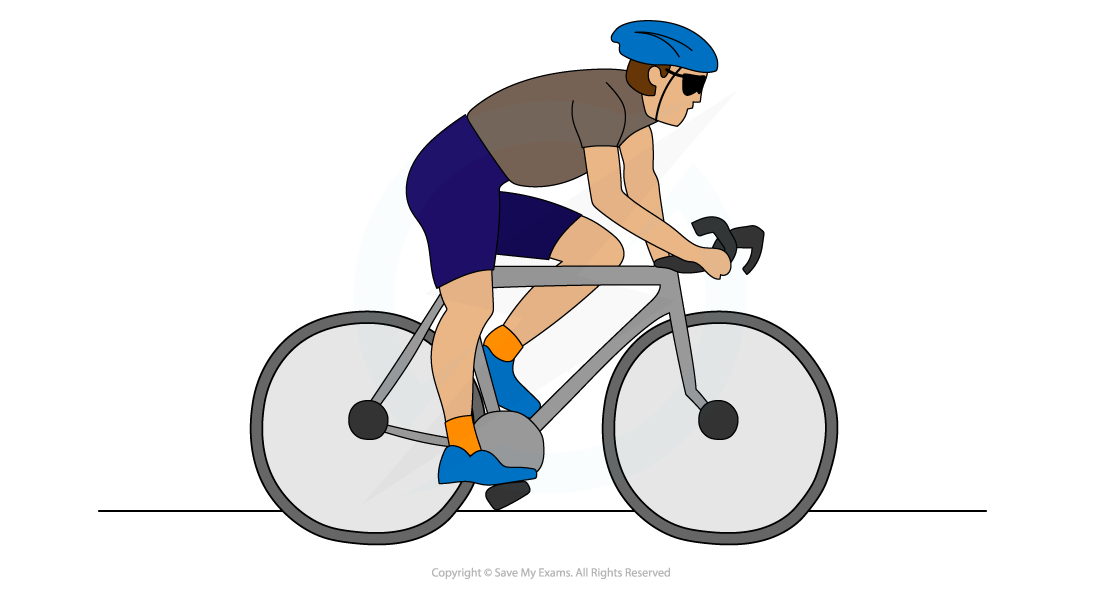
A racing cyclist adopts a more streamlined posture to reduce the effects of air resistance
Also, the bicycle, clothing and helmet are designed to allow them to go as fast as possible
Air resistance and projectile motion
Air resistance decreases the horizontal component of the velocity of a projectile
This means both its range and maximum height is decreased compared to no air resistance

The angle and speed of release of a projectile is varied to produce either a longer flight path or cover a larger distance, depending on the situation
For sports such as the long jump or javelin, an optimum angle against air resistance is used to produce the greatest distance
For gymnastics or a ski jumper, the initial vertical velocity is made as large as possible to reach a greater height and longer flight path
The perfect angle and speed for a projectile can be difficult to achieve
For example, a footballer tries to kick a ball as high as possible but also with great speed to score a goal from a long distance

Examiner Tips and Tricks
If a question considers air resistance to be ‘negligible’ this means in that question, air resistance is taken to be so small it will not make a difference to the motion of the body. You can take this to mean there are no drag forces acting on the body.

Unlock more, it's free!
Join the 100,000+ Students that ❤️ Save My Exams
the (exam) results speak for themselves:

Was this revision note helpful?
Build on this topic