Kinetic & Gravitational Potential Energy (AQA AS Physics): Revision Note
Exam code: 7407

Kinetic & gravitational potential energy
Kinetic energy
Kinetic energy is the energy an object has due to its motion (or velocity)
The faster an object is moving, the greater its kinetic energy
When an object is falling, it is gaining kinetic energy since it is gaining speed
This energy is transferred from the gravitational potential energy it is losing
Kinetic energy can be calculated using the following equation:
Where:
= kinetic energy (J)
= mass (kg)
= velocity (m s–1)

Worked Example
A body travelling with a speed of 12 m s-1 has kinetic energy 1650 J. The speed of the body is increased to 45 m s-1.
Determine the body's new kinetic energy.
[2]
Answer:
Step 1: Calculate the mass of the body
The mass of the body will not change, so it can be calculated from its initial kinetic energy
[1 mark]
Step 2: Calculate the new kinetic energy
[1 mark]
Examiner Tips and Tricks
When using the kinetic energy equation, note that only the speed is squared, not the mass or the ½.
If a question asks about the ‘loss of kinetic energy’, remember not to include a negative sign since energy is a scalar quantity.
Gravitational potential energy
Gravitational potential energy is energy stored in a mass due to its position in a gravitational field
If a mass is lifted up, it will gain gravitational potential energy
If a mass falls, it will lose gravitational potential energy
The equation for gravitational potential energy for energy changes in a uniform gravitational field is:
Where:
= change in gravitational potential energy (J)
= mass (kg)
= gravitational field strength (9.81 N kg–1)
= change in height (m)

The potential energy on the Earth’s surface at ground level is usually taken to be equal to zero
However, any position can be taken as zero when calculating the change in gravitational potential energy
This equation is only relevant for energy changes in a uniform gravitational field (such as near the Earth’s surface)
Gravitational potential energy v height graphs
The two graphs below show how the gravitational potential energy changes with height for a ball being thrown up in the air and then falling down (ignoring air resistance)
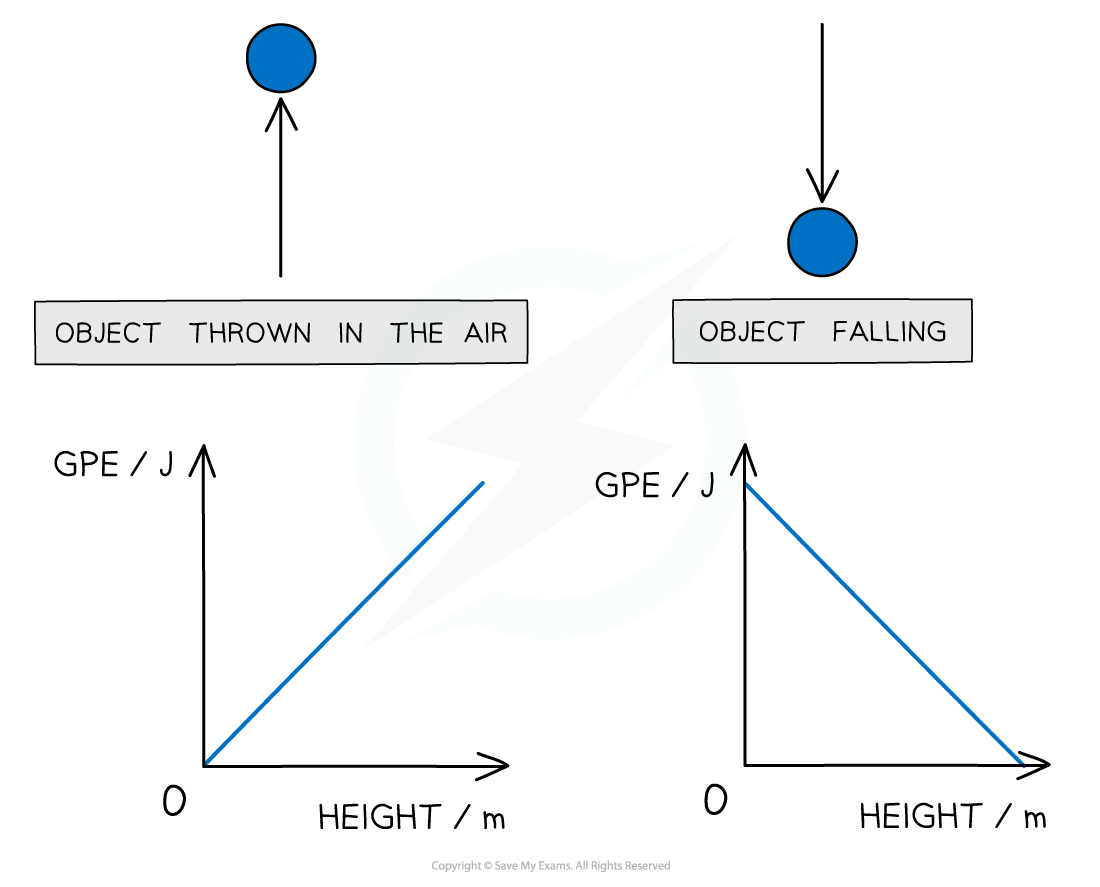
Since the graphs are straight lines, gravitational potential energy and height are said to have a linear relationship
These graphs would be identical for gravitational potential energy against time instead of height
Worked Example
To get to their apartment, a person has to climb five flights of stairs.
The height of each flight is 3.7 m and the person has a mass of 74 kg.
What is the approximate change in the person's gravitational potential energy during the climb?
A. 13 000 J B. 2700 J C. 1500 J D. 12 500 J
[1]
Answer:
Calculate the change in height:
Calculate the change in gravitational potential energy:
Therefore, the correct answer is A [1 mark]
Examiner Tips and Tricks
This equation only works for objects close to the Earth’s surface, where we can consider the gravitational field to be uniform.
At A level, you might have to consider examples where the gravitational field is not uniform, such as in space, where this equation will not be relevant.
Gravitational potential energy is often shortened to GPE for ease. In your equations, you should stick to the correct symbol, which is .

Unlock more, it's free!
Join the 100,000+ Students that ❤️ Save My Exams
the (exam) results speak for themselves:

Was this revision note helpful?
Build on this topic