Short Answer Questions (DP IB Biology: SL): Exam Questions

1 hour13 questions
1a
1 mark

A population of seed-eating finches lives on a small island. The finches vary in the depth of their beaks.

Identify one process during meiosis that increases the genetic variation in the finch population.

1b
2 marks

During a long drought, most of the plants that produce small, soft seeds died. The remaining food source was mainly large, hard seeds.

Over the following generations, the mean beak depth of the finch population increased.

Explain how the drought led to this change in the finch population.

1c
2 marks

In a kelp forest ecosystem, sea otters feed on sea urchins, and sea urchins graze on kelp. Sea otters are a keystone species.

Explain the likely effect on the kelp forest ecosystem if the sea otters were removed.

2a
1 mark

Neurons are specialised cells that carry nerve impulses. The table shows the speed of nerve impulses in two neurons of similar diameter.

Neuron

Speed of nerve impulse / m s−1

X

95

Y

2

Deduce, with a reason, which neuron is myelinated.

2b
2 marks

List two structures found in a neuron that are not found in a prokaryotic cell.

2c
3 marks

Acetylcholine is released from the presynaptic neuron at a synapse.

Describe how acetylcholine causes a nerve impulse to be generated in the postsynaptic neuron.

3a
1 mark

Lactose is a disaccharide found in milk. In the small intestine, lactose is digested to the monosaccharides glucose and galactose.

State the name of the bond that is broken when lactose is digested.

3b
2 marks

After absorption, glucose is carried in the blood to respiring tissues.

Describe how capillaries are adapted for the rapid exchange of glucose between the blood and tissue cells.

3c
2 marks

Outline how channel proteins make a cell membrane selectively permeable.

4a
1 mark

DNA and RNA are nucleic acids.

State the name of the base that pairs with cytosine in DNA.

4b
2 marks

The table shows the percentage of each base in two samples of nucleic acid, P and Q.

Sample

Adenine / %

Thymine / %

Uracil / %

Guanine / %

Cytosine / %

P

30

30

0

20

20

Q

24

0

32

27

17

Using the data, distinguish between sample P and sample Q.

4c
3 marks

In guinea pigs, the allele for black fur (B) is dominant to the allele for white fur (b).

Two guinea pigs with black fur were bred together. Some of their offspring had white fur.

Explain this result.

5a
1 mark

Lions (Panthera leo) and tigers (Panthera tigris) can mate in captivity to produce offspring called ligers. Male ligers are infertile.

Define the term species.

5b
2 marks

Scientists used a karyogram to compare the chromosomes of lions and tigers.

Describe how chromosomes are arranged in a karyogram.

6a
2 marks

Grey wolves (Canis lupus) were reintroduced to Yellowstone National Park in the USA in 1995, after being absent for about 70 years. Wolves are an apex predator and a keystone species.

Outline the importance of keystone species in an ecosystem.

6b
2 marks

Ecologists recorded more species of plants and birds along rivers in the park in the years after the wolves returned.

Suggest reasons why high biodiversity is important in an ecosystem.

6c
2 marks

Reintroducing wolves is an example of rewilding.

Outline two other methods used to restore natural processes in ecosystems by rewilding.

7a
2 marks

Water is transported from the roots to the leaves of a plant in xylem vessels.

Outline two adaptations of xylem vessels for the transport of water.

7b
3 marks

On a hot, dry day, the rate at which water moves up the stem of a sunflower plant increases.

Explain how the loss of water from the leaves causes water to move up the stem.

8a
2 marks

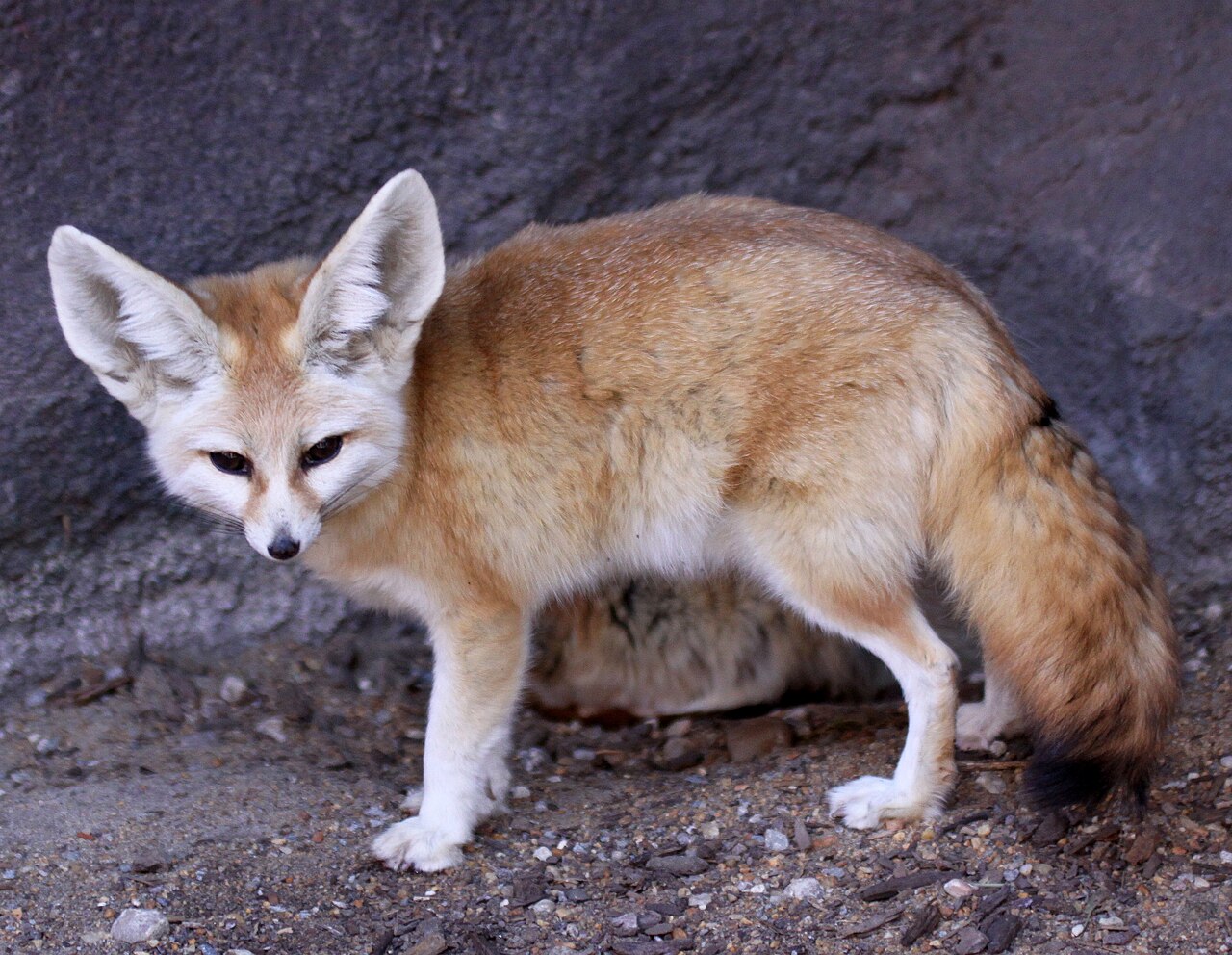
The fennec fox (Vulpes zerda) lives in the Sahara, a hot desert in North Africa.

State two abiotic factors that are typical of a hot desert biome.

8b
1 mark

Figure 1 shows a fennec fox.

Figure 1

Photograph of a fennec fox standing side-on, showing its very large ears, pale sandy fur and bushy tail

Photo: Drew Avery, CC BY 2.0, via Wikimedia Commons

Suggest one adaptation of the fennec fox that helps it to survive in a hot desert.

9a
2 marks

Energy is released when ATP is hydrolysed to ADP and phosphate.

State two processes in cells that use energy released from ATP.

9b
3 marks

Outline how human cells produce ATP when oxygen is available and when it is not.

10a
1 mark

A neuromuscular junction is a synapse between a motor neuron and a muscle fibre. In an electron micrograph of a neuromuscular junction, many small vesicles can be seen inside the end of the motor neuron, close to its membrane.

Deduce the substance contained in these vesicles.

10b
2 marks

Distinguish between the membrane of the motor neuron and the membrane of the muscle fibre at the neuromuscular junction by giving two differences.

10c
1 mark

The synaptic cleft at a neuromuscular junction is only about 50 nm wide.

Suggest an advantage of the cleft being so narrow.

11a
2 marks

In the DNA of a species of wheat, 23.0% of the bases are guanine.

Explain why the percentage of adenine is expected to be 27.0%.

11b
1 mark

A forensic scientist has only a very small sample of DNA from a crime scene.

State the name of the laboratory technique used to make many copies of the DNA.

11c
2 marks

Distinguish between the structure of a DNA nucleotide and an RNA nucleotide.

12a
2 marks

Explain how contraction of the external intercostal muscles causes air to enter the lungs.

12b
1 mark

State the name of one other muscle that contracts during inspiration.

12c
2 marks

Babies born very early may not yet produce enough surfactant in their lungs.

Outline the role of surfactant in the lungs.

13a
1 mark

Grass, rabbits, foxes and fungi are all part of a grassland ecosystem.

Define the term autotroph.

13b
2 marks

Describe the role of decomposers such as fungi in the grassland ecosystem.

13c
3 marks

Ecologists estimated the percentage of energy transferred from primary consumers to secondary consumers in two food chains.

Table 1

Food chain

Energy transferred from primary to secondary consumers / %

grass → rabbit → fox

2

algae → water flea → perch (a fish)

11

Suggest reasons for the difference in the efficiency of energy transfer between the two food chains.

13d
2 marks

In some tropical countries, large areas of rainforest have been cleared to create grazing land for cattle.

Suggest how this is contributing to climate change.