Role and status of women (DP IB History: SL): Revision Note

Summary
The Tunisian Revolution led to the strengthening of women’s political participation and legal protections
Reforms such as the gender parity electoral law and the 2014 constitution improved formal equality
Women played an active role in protests and civil society
However, social and economic inequalities persisted, particularly in rural areas
Overall, women’s status improved legally and politically, but practical equality remained limited
Increased political participation
Women played a visible and active role in the Tunisian Revolution, participating in protests, demonstrations, and civil society organisations
This marked a shift from the more restricted political environment under Ben Ali, where women's participation was limited and tightly controlled
After 2011, women became more involved in formal politics, joining political parties and standing as candidates in elections
In April 2011, Tunisia introduced a gender parity electoral law, requiring political parties to present candidate lists with equal numbers of men and women
This law applied to the October 2011 Constituent Assembly elections, representing a major step toward political equality
As a result, women won approximately 27% of seats in the Constituent Assembly (59 out of 217 seats), one of the highest levels of female representation in the region at the time
Women were present in different political parties, including the Ennahda Movement and secular parties such as Congress for the Republic and Ettakatol
However, many parties placed women lower on electoral lists
This reduced their chances of election and limited the full impact of the parity law
Despite increased representation, women remained underrepresented in senior leadership roles and key decision-making positions
Legal protections and rights
The 2014 constitution, adopted on the 26th January 2014, included strong commitments to gender equality and non-discrimination
It required the state to protect women’s rights and ensure equal opportunities in political, economic, and social life
Article 46 specifically committed the state to protecting and advancing women’s rights and achieving parity in elected assemblies
In 2017, Tunisia passed a comprehensive law on violence against women, which:
Criminalised domestic violence
Strengthened legal protections
Improved support for victims
These reforms reflected the influence of women’s rights organisations and civil society activism after the revolution
Tunisia was widely seen as a regional leader in women’s rights following these legal changes
However, enforcement of these laws remained inconsistent, particularly in rural and conservative areas, where traditional ideas remained dominant
Historiography
Mounira Charrad
States and Women’s Rights (2001)Tunisia possessed strong historical foundations for women’s rights, helping post-2011 reforms succeed.
Examiner Tips and Tricks
When analysing changes in Tunisian women's rights in an essay question, make sure to explain that, even though the 2014 constitution made steps toward improving women's rights, these changes were neither unanimous nor consistent.
Social and economic limitations
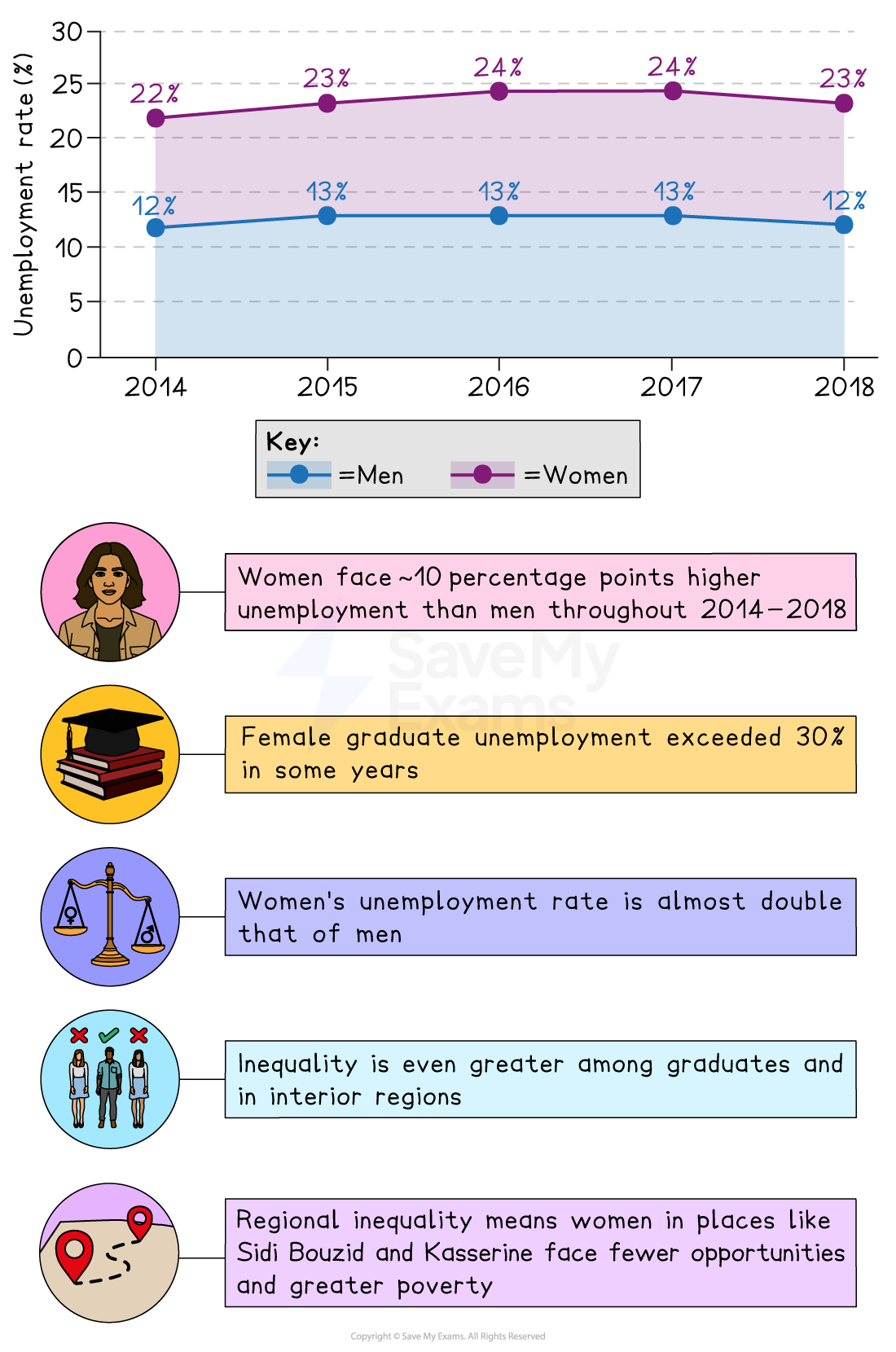
Despite legal and political progress, women continued to face significant economic challenges, including higher unemployment rates than men, particularly among graduates
Regional inequality remained a major issue, with women in interior regions such as Sidi Bouzid and Kasserine experiencing fewer opportunities and greater poverty due to poor economic structures in those areas
Social and cultural norms continued to limit women’s full participation in some areas, particularly outside major urban centres
Women remained underrepresented in senior political and economic leadership positions
Many women did not experience immediate improvements in living standards, contributing to continued dissatisfaction

Unlock more, it's free!
Join the 100,000+ Students that ❤️ Save My Exams
the (exam) results speak for themselves:

Was this revision note helpful?
