Repression and censorship by the Ben Ali regime (DP IB History: SL): Revision Note

Summary
This revision note will focus on the impact of the Ben Ali regime in Tunisia and how it led to protest movements
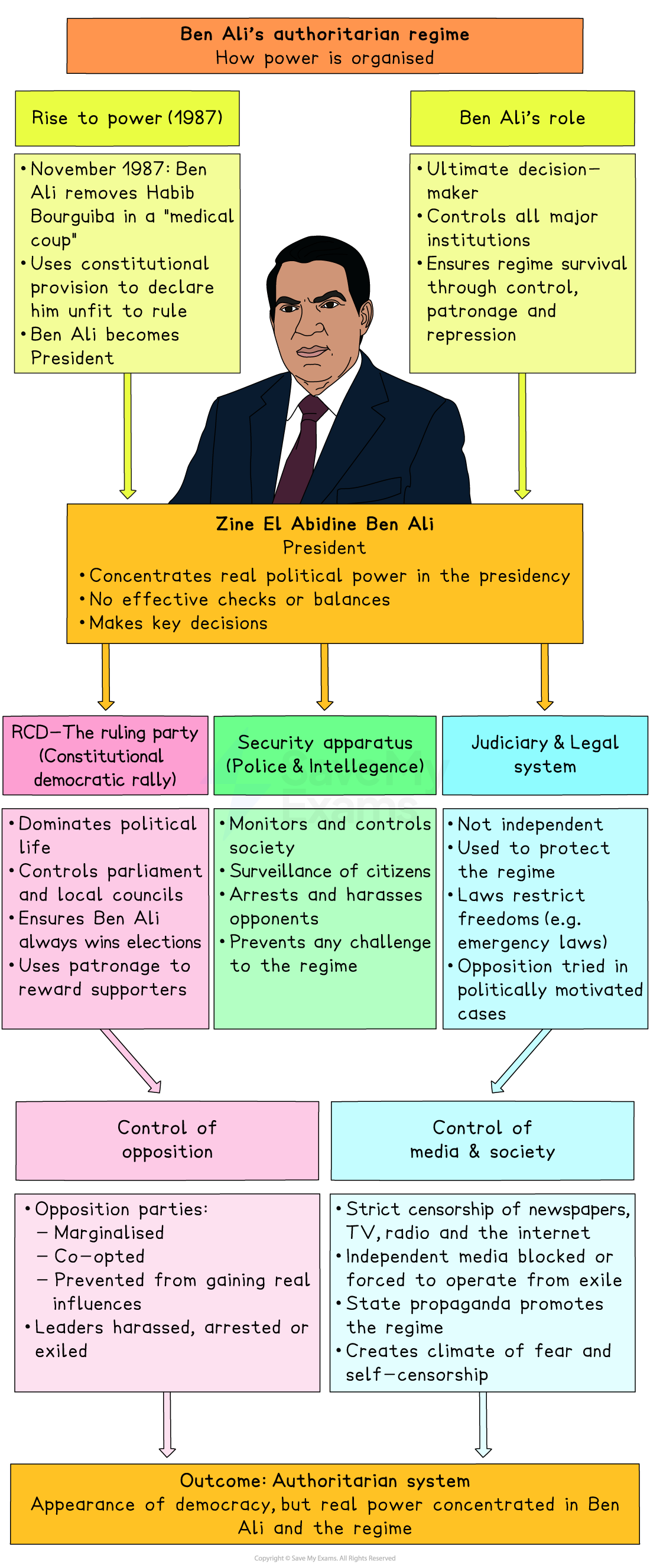
Ben Ali established a highly centralised authoritarian system after 1987, in which he manipulated elections and constitutional changes
The regime systematically suppressed opposition through mass arrests and the exile of leaders such as Rached Ghannouchi
The extensive security state used surveillance, informants, and human rights abuses to create a climate of fear that discouraged open dissent
Although repression maintained short-term stability, it intensified long-term grievances and contributed directly to the scale and speed of mobilisation during the Tunisian Revolution
Authoritarian political structure
Zine El Abidine Ben Ali came to power in November 1987
He had removed Habib Bourguiba in a bloodless “medical coup”, using a constitutional provision to declare him unfit to rule
He then assumed the presidency himself
Ben Ali rapidly established an authoritarian system in which real political power was concentrated in the presidency
Ways in which Ben Ali maintained control
Tunisia formally maintained a multi-party system, but the dominance of the Constitutional Democratic Rally (RCD) meant that political competition was largely symbolic
Opposition parties were either marginalised, co-opted, or prevented from gaining meaningful influence
Electoral processes were manipulated to reinforce regime legitimacy
This can be seen in the presidential election results
99.4% in 1999
94.5% in 2004
89.6% in 2009
This reflected controlled participation rather than genuine democratic choice
Constitutional changes, such as the 2002 referendum, which removed presidential term limits, further entrenched Ben Ali’s rule by allowing him to remain in power indefinitely
Historiography
Eva BellinThe Robustness of Authoritarianism in the Middle East (2004)
Authoritarian regimes survived through strong coercive apparatuses and security forces.
Suppression of political opposition
The Ben Ali regime adopted a zero-tolerance approach to opposition
In 1991, it banned the Ennahda Movement due to its perceived threat to state authority
Repression of the Ennahda Movement
The Islamist Ennahda Movement was regarded as the most significant political threat due to its organisational strength and popular support
The Ben Ali regime banned it in 1991
A decision he justified as protecting secularism and national security
There were large-scale crackdowns during the early 1990s
These resulted in thousands of members of the Ennahda Movement being arrested, imprisoned, or placed under surveillance
This demonstrated the regime’s willingness to use force to dismantle opposition networks
Estimates from Amnesty International suggest that up to 20,000 individuals were detained during this period
Many were denied fair trials or legal representation
This highlighted the systematic nature of political repression
The forced exile of key leaders such as Rached Ghannouchi weakened the movement’s internal organisation
It also demonstrated that high-profile dissent would not be tolerated within Tunisia
Case Study
Rached Ghannouchi
In 1991, Ghannouchi was forced into exile by the Ben Ali regime
Ghannouchi fled Tunisia in 1989 and eventually settled in London, where he remained for over two decades
This illustrates the regime’s strategy of removing influential leaders
While in exile, Ghannouchi continued to lead Ennahda from abroad, maintaining its organisational structure and international profile despite severe repression
Following the fall of Ben Ali in January 2011, Ghannouchi returned to Tunisia after 22 years in exile
This symbolised the collapse of the repressive system that had previously excluded opposition leaders
Suppression of secular opposition
Although Islamist groups were the primary target, secular opposition figures were also restricted
This was to prevent a legitimate democratic alternative to the regime from developing
Politicians such as Ahmed Nejib Chebbi were subjected to surveillance, restrictions on political activity, and limited access to the media
This reduced their ability to gain support or communicate effectively with the public
Legal opposition parties were allowed to exist but were deliberately weakened through state control
This ensured that political pluralism remained superficial rather than meaningful
Control of civil society and trade unions
Even organisations with strong grassroots connections, such as the Union Générale Tunisienne du Travail (UGTT), Tunisia's main national trade union, were closely monitored and infiltrated by the regime
This reflects the importance placed on controlling potential sources of mass mobilisation
While the UGTT retained some degree of independence, its leadership was often pressured or co-opted by the state
This limited its ability to organise sustained or nationwide resistance
This strategy of control by the regime ensured that opposition remained fragmented and unable to challenge the regime effectively in the short term
Censorship and control of expression
Control of traditional media
The regime of Ben Ali maintained tight control over newspapers, television, and radio through a combination of state ownership and legal restrictions
It ensured that media outlets were instruments of government messaging rather than independent sources of information
Tunisia's Radio Kalima was blocked and forced to operate from exile
Newspapers required official approval to operate and were subject to pre-publication censorship
This prevented the publication of material that was critical of:
The president
The ruling RCD
State institutions
State-controlled television and radio consistently promoted narratives of economic success, political stability, and modernisation
This created a disconnect between the official message and the lived experiences of many Tunisians
Internet censorship
During the 2000s, the regime expanded censorship into the digital sphere as internet access increased
The regime recognised the potential of online platforms to spread dissent and organise opposition
The state developed sophisticated filtering and surveillance systems, commonly referred to as “Ammar 404”
This blocked access to:
Opposition websites
Human rights organisations
Independent news sources
Online activity was closely monitored by security services
Email accounts and social media platforms subject to hacking or surveillance to identify and track dissidents
Repression of online activists
The imprisonment of bloggers such as Zouhair Yahyaoui in 2002 demonstrated the regime’s willingness to extend repression into digital spaces
Yahyaoui was arrested for publishing online criticism of the regime
He was sentenced to two years in prison,
This highlighted the lack of freedom of expression even in emerging online forums
Such cases served as a warning to other activists, reinforcing self-censorship and limiting the development of organised online opposition during the early 2000s
Limits of censorship
Despite extensive censorship, the regime was unable to fully control the flow of information
Many Tunisians accessed foreign media through satellite television and the internet
Channels such as Al Jazeera (Qatari news station) provided coverage of regional and international events
These exposed audiences to alternative political perspectives and examples of protest movements
This exposure contributed to growing awareness of corruption, repression, and inequality within Tunisia, undermining the credibility of state propaganda over time
Security state and climate of fear
Structure of the security apparatus
The regime of Zine El Abidine Ben Ali relied heavily on an extensive internal security apparatus controlled by the Ministry of the Interior (MOI)
The MOI coordinated police forces, intelligence agencies, and surveillance networks to maintain political control
Tunisia had one of the largest internal security forces in the region relative to its population
The security services operated with limited accountability, allowing them to act with impunity when suppressing dissent
Surveillance and informant networks
The widespread use of informants, often embedded within workplaces, universities, and neighbourhoods, created a pervasive atmosphere of suspicion
Individuals could not trust colleagues, friends, or even family members
This system of surveillance extended into everyday life, discouraging open discussion of politics and preventing the formation of organised opposition groups
The constant possibility of being reported to authorities reinforced self-censorship and political apathy among the population
Arbitrary arrests and preventive repression
Arbitrary arrests and preventive detention were commonly used to neutralise perceived threats before they could develop into organised opposition
Individuals suspected of dissent, including students, trade unionists, and Islamists, could be detained without formal charges or a fair trial, highlighting the absence of judicial independence
This use of pre-emptive repression limited the ability of opposition movements to coordinate or sustain protest activity
Torture and human rights violations
Reports by organisations such as Amnesty International and Human Rights Watch documented systematic human rights abuses within detention centres and prisons
Methods of torture included beatings, electric shocks, sleep deprivation, and prolonged stress positions, which were used to extract confessions or intimidate detainees
The routine nature of such abuses reinforced the perception that the state would use extreme measures to maintain control
Targeting of families and social pressure
The regime extended repression beyond individuals by targeting the families of activists
It would subject them to harassment, employment discrimination, and restrictions on movement
This strategy increased the personal cost of dissent, as individuals risked not only their own safety but also the well-being of their relatives
As a result, many potential opponents were deterred from engaging in political activity
Additional mechanisms of control
Emergency laws and broad security legislation provided legal justification for repression, allowing the regime to present its actions as necessary for maintaining order and combating extremism
For example, the 2003 anti-terrorism law introduced under Ben Ali gave authorities wide powers to arrest, detain, and prosecute individuals suspected of terrorism
In practice, it was frequently used to target political opponents, including members of the Ennahda Movement, even when there was little or no evidence of violent activity
After the September 11th attacks in the USA in 2001, the regime strengthened its security policies under the guise of counter-terrorism
This reduced international criticism and enabled continued repression
Surveillance also extended to digital communications, with emails and online activity monitored to identify emerging opposition networks
Historiography
Béatrice HibouThe Force of Obedience (2011)
Argues that Ben Ali maintained obedience through surveillance, repression, and fear rather than genuine legitimacy.
Impact on the emergence of protest
Repression under Ben Ali suppressed opposition in the short term but caused a long-term build-up of widespread grievances
The lack of political pluralism and suppression of groups such as the Ennahda Movement meant there were no legal outlets for dissent, increasing pressure for protest
The security state created fear that delayed mobilisation, but also deepened resentment toward the regime
Censorship undermined trust in the government as the gap between propaganda and reality became clearer
As a result, when protests began during the Tunisian Revolution in 2010, they spread rapidly due to accumulated anger and the sudden collapse of fear
Examiner Tips and Tricks
When analysing the impact of the Ben Ali regime on the Tunisian revolution, make sure to explain how it led to grievances and protests in the long term, rather than breakdown of fear which was a short term cause.

Unlock more, it's free!
Join the 100,000+ Students that ❤️ Save My Exams
the (exam) results speak for themselves:

Was this revision note helpful?
