Failed economic reform and unemployment (DP IB History: SL): Revision Note

Summary
Economic growth under Ben Ali masked structural weaknesses, as benefits were unevenly distributed and failed to address regional inequality
High unemployment, particularly among graduates, created frustration due to the gap between rising expectations and limited opportunities
Interior regions such as Sidi Bouzid and Gafsa experienced greater economic hardship, contributing to early unrest and protest activity
Corruption and crony capitalism concentrated wealth among the ruling elite, undermining trust in the regime
Economic insecurity, illustrated by the case of Mohamed Bouazizi, acted as a key trigger for protest and the outbreak of the Tunisian Revolution
Economic growth vs structural weaknesses
Tunisia’s annual GDP growth rate averaged around 4–5% under Ben Ali during much of the 2000s
However, the growth was unevenly distributed
It failed to address underlying structural weaknesses within the economy
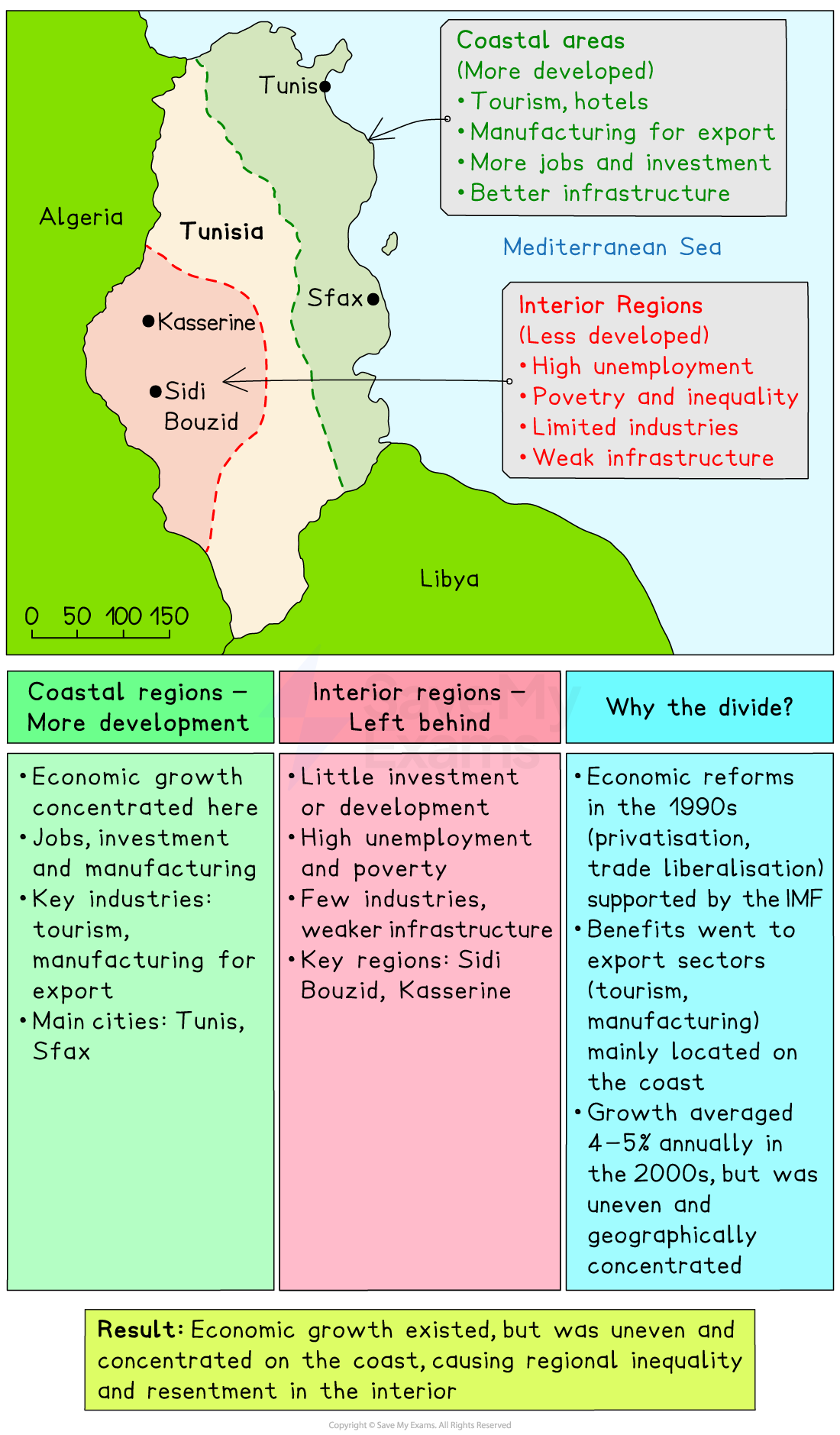
Economic reforms introduced from the 1990s, including privatisation and trade liberalisation was supported by institutions such as the International Monetary Fund (IMF)
The reforms aimed to modernise the economy
Most of the benefits went to industries that sold goods and services abroad, such as tourism and manufacturing
These industries were mainly based in coastal cities like Tunis and Sfax, so people living there gained more jobs and investment
As a result, economic development remained geographically concentrated, while interior regions such as Sidi Bouzid and Kasserine experienced persistent poverty
Rising unemployment and youth discontent
Despite economic growth, unemployment remained a major issue
Official unemployment rates were approximately 13 – 14% by 2010
Youth unemployment was significantly higher
For university graduates, it exceeded 30% in some estimates
This reflected a structural mismatch between the education system and labour market demands
The expansion of higher education during the 1990s and 2000s raised expectations of social mobility
However, the inability of the economy to provide skilled employment created frustration and a sense of injustice among educated youth
This group became a key driver of protest, as they were both politically aware and directly affected by the failure of economic reform
Regional inequalities
Economic policies prioritised coastal regions
Tourism, foreign investment, and infrastructure development were concentrate by the coast, reinforcing regional disparities
Interior regions such as Sidi Bouzid, Kasserine, and Gafsa faced higher unemployment rates, weaker public services, and fewer economic opportunities
This led to perceptions of state neglect and marginalisation
The 2008 protests in the Gafsa mining basin, were triggered by unemployment and corruption in hiring practices
They were an early sign of economic discontent and highlighted regional inequality as a source of unrest
Case Study
Gafsa mining basin protests 2008
Why did they start?
The protests were triggered by high unemployment and allegations of corruption in recruitment at the state-owned phosphate company, which was seen as favouring those with connections rather than merit
What happened?
Protests began in January 2008 in towns such as Redeyef and spread across the region, involving unemployed graduates, workers, and local communities
Demonstrations included strikes, sit-ins, and clashes with security forces, lasting for several months despite heavy repression
What was the reaction?
The regime of Zine El Abidine Ben Ali responded with arrests, trials, and imprisonment of activists, highlighting its reliance on repression rather than reform
Significance:
The protests exposed deep regional inequality and economic frustration, acting as an early warning sign of the wider unrest that later emerged during the Tunisian Revolution
Historiography
Safwan Masri
Tunisia: An Arab Anomaly (2017)Masri states that interior regions such as Sidi Bouzid symbolised decades of neglect and unequal development.
Corruption and crony capitalism
Economic reform was undermined by widespread corruption
Members of Ben Ali’s family, particularly the Trabelsi family, gained control over key sectors including:
Banking
Telecommunications
Real estate
Business success often depended on connections to the ruling elite
This discouraged competition and limited opportunities for independent entrepreneurs
A 2011 World Bank report later revealed that companies linked to the Ben Ali family accounted for a disproportionate share of private sector profits
This highlighted the concentration of wealth among a small elite
This system of crony capitalism increased public anger, as economic inequality was seen as the result of deliberate exploitation rather than structural challenges
“220 firms confiscated to the Ben Ali clan by the end of 2010 accounted for less than 1% of jobs but were capturing an astounding 21% of all private sector profits”
World Bank report (opens in a new tab) (source C)
Extract from the US Embassy in Tunis (2008 cable, released December 2010) Guardian article on US embassy cables (opens in a new tab)
“Many Tunisians are frustrated by the lack of political freedom and angered by First Family corruption, high unemployment and regional inequities”
Worked Example
'Analyse how the context of source C influences how it can be used to answer the inquiry question.'
Inquiry question - To what extent did economic inequality contribute to the Tunisian Revolution?
The context of source C increases its usefulness in answering the inquiry question because it is a report produced by the World Bank after the Tunisian Revolution, investigating corruption and economic inequality under the regime of Zine El Abidine Ben Ali. As an international economic organisation, the World Bank had access to economic data and statistical evidence, making the source valuable for understanding the extent of corruption and unequal distribution of wealth in Tunisia before 2011.
The source highlights how firms connected to the Ben Ali family controlled a disproportionate share of profits despite providing very few jobs, demonstrating how economic benefits were concentrated among elites while much of the population experienced unemployment and limited opportunity. This makes the source highly useful for explaining how economic inequality contributed to resentment and opposition toward the regime.
However, the context also limits the source because the World Bank mainly focuses on economic factors and may underemphasise other causes of the revolution, such as political repression, censorship, and police violence. In addition, the report was produced after the fall of Ben Ali, meaning it was written with hindsight and in a context where corruption within the regime had already been widely condemned.
Examiner Tips and Tricks
Make sure you analyse BOTH usefulness and limitations of a source. e.g.
“The context increases usefulness because…”
AND“However, the context also limits usefulness because…”
Economic insecurity
Due to the lack of formal employment opportunities, a significant proportion of the population relied on the informal economy, including street vending and small-scale trade,
This provided income but lacked legal protection and stability
Workers in this sector were vulnerable to harassment by local officials
Harassment included:
Fines
Confiscation of goods
Restrictions on trading activity
The case of Mohamed Bouazizi illustrates these conditions
His goods were confiscated by municipal authorities in Sidi Bouzid in December 2010, reflecting both economic hardship and bureaucratic abuse
The case of Mohamed Bouazizi
The case of Mohamed Bouazizi in December 2010 highlighted the economic grievances faced by many Tunisians
Especially those working in the informal economy who lacked job security and legal protection
Bouazizi, a 26-year-old street vendor in Sidi Bouzid, relied on selling fruit and vegetables to support his family
On the 17th December 2010, municipal officials confiscated his goods and allegedly humiliated him
Reports include that he was slapped by a local official
When Bouazizi attempted to file a complaint with local authorities, he was reportedly refused an audience
In response, he set himself on fire outside the governor’s office, transforming a personal act of desperation into a powerful symbol of wider social and economic injustice
His actions resonated across Tunisia because they reflected common experiences of unemployment, corruption, and state harassment
Protests began in Sidi Bouzid shortly after his self-immolation and quickly spread to other region
This demonstrates how localised economic grievances could escalate into national unrest
The case became a unifying symbol that linked economic hardship with political repression, helping to trigger the widespread protests that led to the Tunisian Revolution


Unlock more, it's free!
Join the 100,000+ Students that ❤️ Save My Exams
the (exam) results speak for themselves:

Was this revision note helpful?
