Types of Political Systems (DP IB Global Politics: SL): Revision Note

Democratic states
A democracy is a system of government in which political power is held by the people, usually exercised through free and fair elections
Democracy is promoted by many IGOs
They are considered the fairest and least corrupt form of government
Features of democracies
The government in a democracy is not permanent and is elected by citizens of the state
Citizens get to choose which political party or political leader will best represent their views
If a government’s political party or leader does not meet the expectations of citizens it can be replaced in the next election
Because citizens have power, democratic states generally have
Few human rights violations
Political, economic and social equality
Limited corruption because of government transparency and accountability
NGOs, civil society, other political parties, media and other actors are usually free to operate and monitor government actions
According to the UN, democracies
"...provide an environment that respects human rights (opens in a new tab) and fundamental freedoms, and in which the freely expressed will of people is exercised. People have a say in decisions and can hold decision-makers to account. Women and men have equal rights and all people are free from discrimination.”
https://www.un.org/en/global-issues/democracy (opens in a new tab)
Some disagree that democracy is an ideal system, as corruption and gender and racial inequality can be seen in many democratic states
Single-party states
In single-party states, one political party controls the government with little likelihood of this changing in the near future
Generally, single-party states are viewed unfavourably because citizens have no agency in choosing their political leaders
One party has complete control of the government and, to maintain that control, freedom of speech and assembly is often highly restricted
Features of single-party states
The government can use its influence to reinforce its own ideology and significance through education and media
Elections may occur to but are controlled by the party
Dissent and opposition to the government is silenced
The likelihood of fascism and dictatorship is increased
E.g. Russia and North Korea
Some argue that having one political party in charge of the government leads to continuity and stability
Singapore is often cited as an example of a single-party state that has high levels of economic development and stability
Fragile and failing states
Fragile states
A fragile state is one where the government struggles to maintain control over economic, political, social and judicial systems
Indications of a fragile state
Control over the police or armed forces is weak
Law and order are breaking down
Violent resistance groups are operating
Economic instability and decline
Citizens are increasingly emigrating to other countries
Loss of legitimacy
Widespread corruption
Public services including education and healthcare are in decline and citizens may be relying on NGOs or IGOs to provide basic necessities
Instances of human rights abuses are rising
Failed states
Failed states are the most extreme form of fragile state and share their key characteristics
However, in failed states, the government has lost control
Citizens are widely fleeing the state, and outside actors such as IGOs and states may be planning intervention
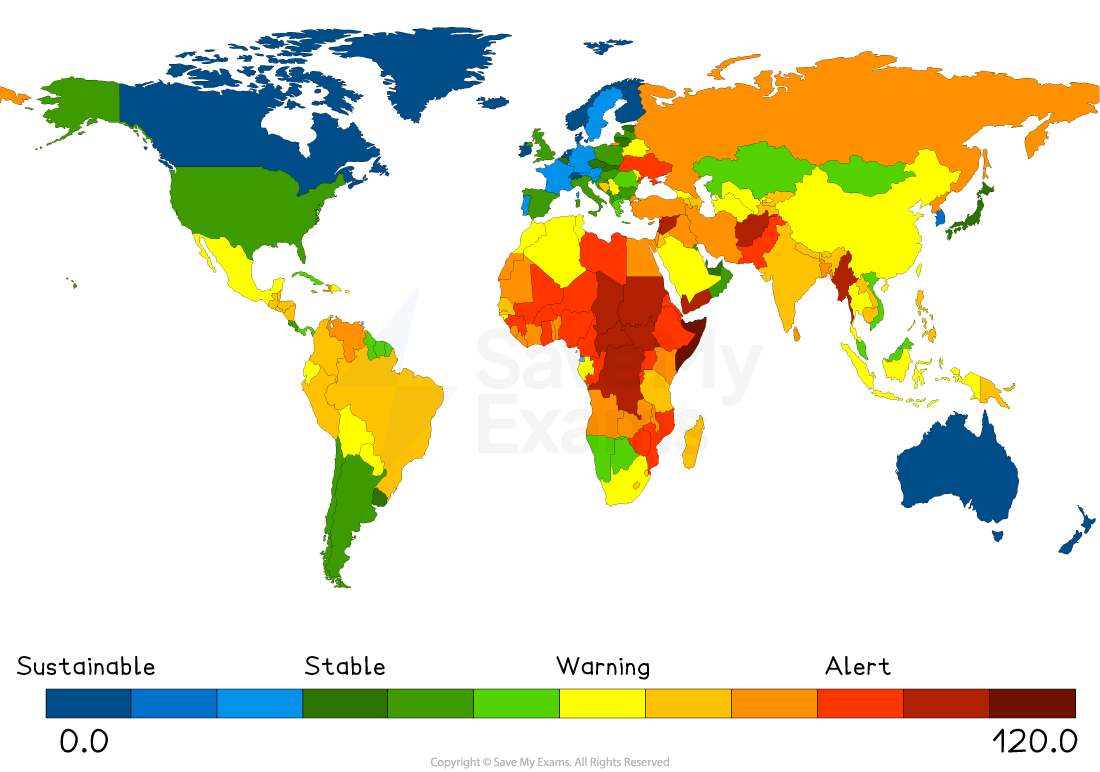
The following map indicates the stability of states according to the NGO Fragile States Index
Orange indicates a fragile state
Red indicates a failed state

Unlock more, it's free!
Join the 100,000+ Students that ❤️ Save My Exams
the (exam) results speak for themselves:

Was this revision note helpful?