Debates About Politicisation (DP IB Global Politics: SL): Revision Note

Political gains
Politicisation means that actors have motives other than helping people when supporting rights and justice
Actors who politicise rights and justice are focused on gaining or manipulating power, rather than rights and justice
In global politics it is not always easy to understand the true motives of actors involved in rights and justice but it should be recognised that, sometimes, it is for political gain
Examples of political gains
Scenario | Example |
|---|---|
|
|
|
|
|
|
Economic gains
Economic gain may be another reason why actors appear to support human rights
States that experience significant human rights abuses can be less attractive to tourists and TNCs
States may make attempts to appear to improve human right to secure loans and investment
Companies, universities and other institutions may include marginalised groups in advertising which is not representative of reality to attract more customers
Powerful states have been accused of leading invasions into other states because of human rights abuses, but economic gain appears to be a primary motive
Case Study
US Intervention in Venezuela
The United States’ military intervention in Venezuela in 2025–2026 was presented as an attempt to address human rights abuses and criminal activity under President Nicolás Maduro
However, critics argue that economic interests, particularly oil, were a key motivation

Background
Venezuela has faced a severe political and economic crisis, with reports of widespread human rights abuses, including repression, arbitrary arrests and declining rule of law
The US government claimed its actions targeted narcoterrorism and authoritarian leadership
The intervention
In January 2026, US forces launched military actions and captured President Maduro
This action was widely criticised internationally as a violation of state sovereignty and international law
Human rights justification
The US justified its involvement by pointing to serious human rights violations committed by the Venezuelan government
International organisations had also raised concerns about abuses and humanitarian conditions in the country
Economic motivations
Despite this, many analysts argue that economic gain - especially access to Venezuela’s oil reserves - was a major factor
The US quickly secured oil deals worth billions of dollars after the intervention
Critics claim the intervention was aimed at controlling oil resources rather than protecting human rights
Significance
This example highlights that:
states may justify intervention using human rights arguments
economic interests can play a central role in foreign policy decisions
powerful states may act in ways that challenge international law and sovereignty
Cultural relativism as an excuse to violate rights
Some actors politicise cultural relativism
Because of culture, some actors interpret cultural relativism as 'anything goes'
Some argue that people of one culture don’t all think the same way and therefore cultural relativism must accept that within one culture there are diverse and constantly changing views
Cultural relativism is sometimes used as an excuse to disregard the rights of marginalised or vulnerable groups
Some states claim that this is because of their cultural traditions - often seen in relation to the human rights of women, but other groups also face violations
Case Study
LGBTQ+ rights in Uganda and cultural relativism
Uganda provides a clear example of how cultural relativism can be politicised to justify restrictions on human rights
The government has used cultural arguments to defend laws that limit the rights of LGBTQ+ individuals
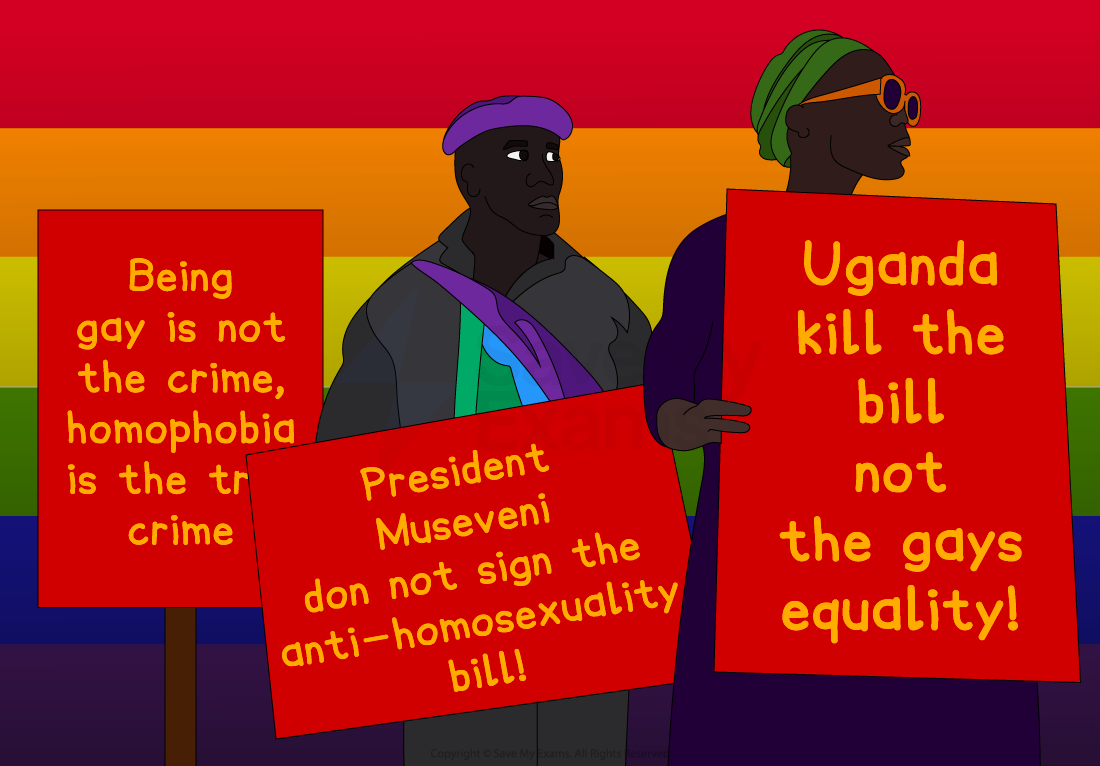
Use of cultural relativism
Ugandan political leaders have argued that homosexuality is culturally unacceptable, claiming this gives the state the right to restrict LGBTQ+ rights
This reflects an extreme interpretation of cultural relativism, where culture is used to justify limiting freedoms
Legal and social restrictions
Uganda has introduced strict laws against LGBTQ+ people, including severe prison sentences and, in some cases, the possibility of the death penalty
Same-sex marriage was banned in 2005, and discrimination, abuse and violence against LGBTQ+ individuals are often not punished by law
Authorities have also used media campaigns to spread negative views about the LGBTQ+ community
Not all Ugandans agree with these policies
Some citizens and activists have challenged discriminatory laws, showing that cultures are diverse and constantly changing, rather than fixed
International response
International organisations such as the United Nations and Amnesty International have condemned Uganda, arguing that cultural relativism is being used to justify human rights abuses
However, the African Union has not taken strong action, and similar laws exist in over 30 African states
Significance
This example demonstrates that:
cultural relativism can be used as an excuse to deny rights to vulnerable groups
cultures are not uniform, and internal disagreement exists
political actors may selectively interpret culture to support their policies
Although culture is sometimes given as an excuse to violate human rights, most cultural relativists refute this
Cultural relativism is not about denying people rights
It is about interpreting rights differently and taking into consideration cultural norms about how to treat people with dignity
Some cultural relativists may agree that norms regarding LGBTQ+ acceptance are Western in origin
However, most would not support the abuse of this community

Unlock more, it's free!
Join the 100,000+ Students that ❤️ Save My Exams
the (exam) results speak for themselves:

Was this revision note helpful?