Measuring Political Development (DP IB Global Politics: SL): Revision Note

How political development is measured
Political development refers to improvements in the quality of governance, democratic participation and the rule of law within a state
Measuring political development is more difficult than measuring economic output
Concepts such as trust, accountability and corruption are hard to quantify
Two of the most widely used tools for measuring political development are:
The Corruption Perceptions Index (CPI)
The Sustainable Governance Indicators (SGI)
Trust in public institutions is closely linked to levels of corruption
States with high corruption tend to have low public trust in government
Corruption and trust indices
Corruption is the abuse of power by individuals or officials for personal gain, often through bribery or dishonest actions
Corruption is often hidden and not easy to measure but has an enormous impact on all forms of development
High corruption indicates a low level of political development, in particular because it is the responsibility of the state to maintain justice
Trust indices indicate the trust people have in public institutions
They are closely related to levels of corruption
The Corruption Perceptions Index
Transparency International publishes the most widely accepted corruption index
As corruption itself cannot be easily measured, this index relies on surveys conducted by 13 global institutions, including:
the World Bank
the African Development Bank
the World Economic Forum
A score between 0-100 is applied to each state based on the public’s perception of corruption
Close to 0 means the country is highly corrupt
Close to 100 indicates the public do not see much evidence of corruption
2025 least corrupt states | 2025 most corrupt states |
|---|---|
|
|
The Government at a Glance Report
The Government at a Glance Report is produced by the Organisation for Economic Cooperation and Development (OECD)
It measures a variety of factors, including how much trust the public has in state governments
Key findings from 2025
Only 47% of the world’s governments are transparent with essential data
Only 37% of global citizens are confident that their government cares about long-term sustainable development
The greatest concern is economic instability and how state governments manage the economy
Sustainable governance indicators
The Sustainable Governance Indicators (SGIs) examines 41 states with democratic systems
It is produced by German civil society foundation the Bertelsmann Stiftung
It examines how well governments implement policies that encourage environmental and political stability and sustainability
It is based on the belief that sustainable development is impossible without good governance
How it works
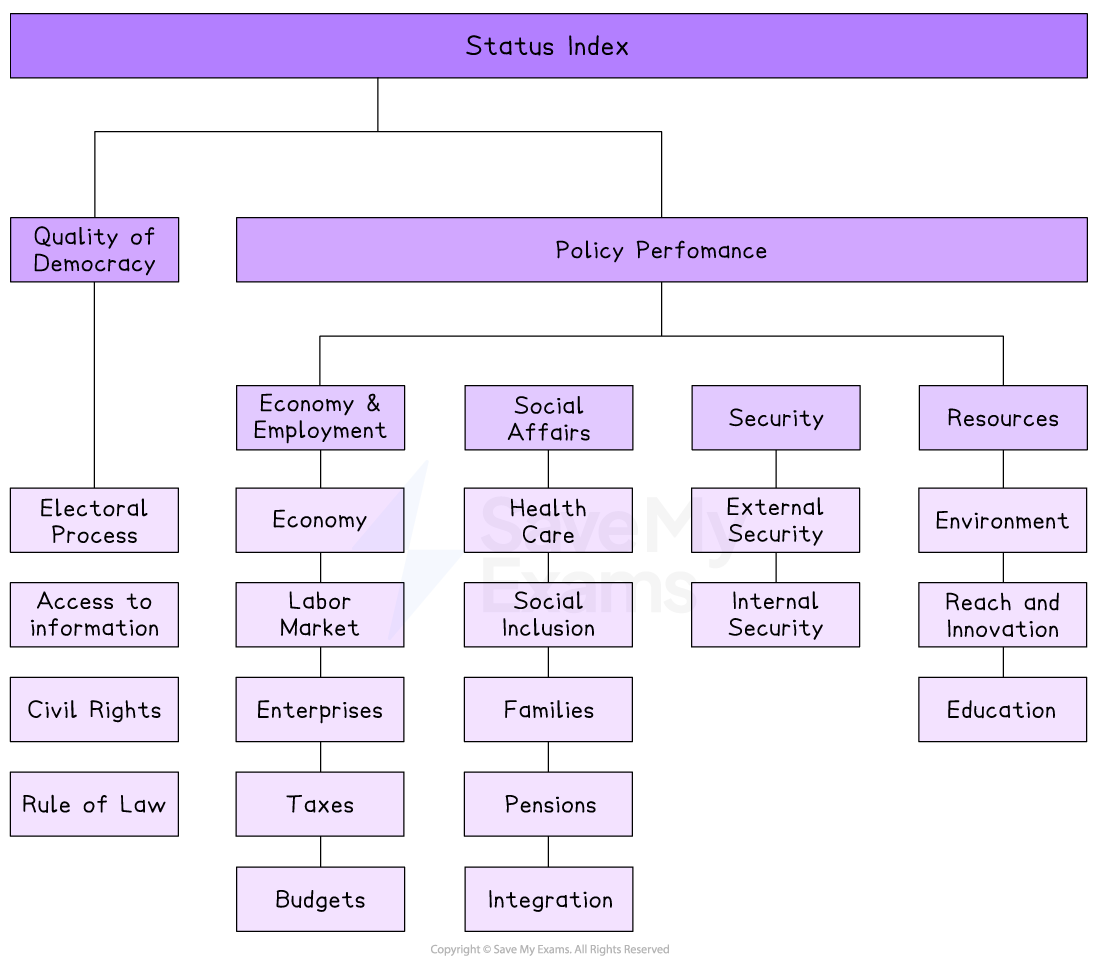
Experts in a variety of fields provide their own judgements of government policies in areas of
Economy and employment
Social affairs
Security
Resources
In addition the quality of government is considered, such as the electoral process, access to information, civil rights and the rule of law
Overall, this provides an overview of the status of multiple types of government policies
However, as only 41 countries are considered, it does not provide a comprehensive overview of global governance

Unlock more, it's free!
Join the 100,000+ Students that ❤️ Save My Exams
the (exam) results speak for themselves:

Was this revision note helpful?
