Links Between Economic, Social, Political and Environmental Development (DP IB Global Politics: SL): Revision Note

Interconnections in development
The four dimensions of development - economic, social, political and environmental - are often studied separately
In practice they are deeply interconnected
Progress in one area can drive progress in others
Equally, failure in one area can undermine development across the rest
Different actors and institutions prioritise different types of development
This leads to debate about which measures and pathways are most effective
Understanding these links is central to evaluating whether development is truly sustainable in the long term
Interconnected nature of measurements of development
Economic, social, political and environmental development are sometimes considered individually
In reality they are all interconnected and interdependent
The three pillars of sustainability
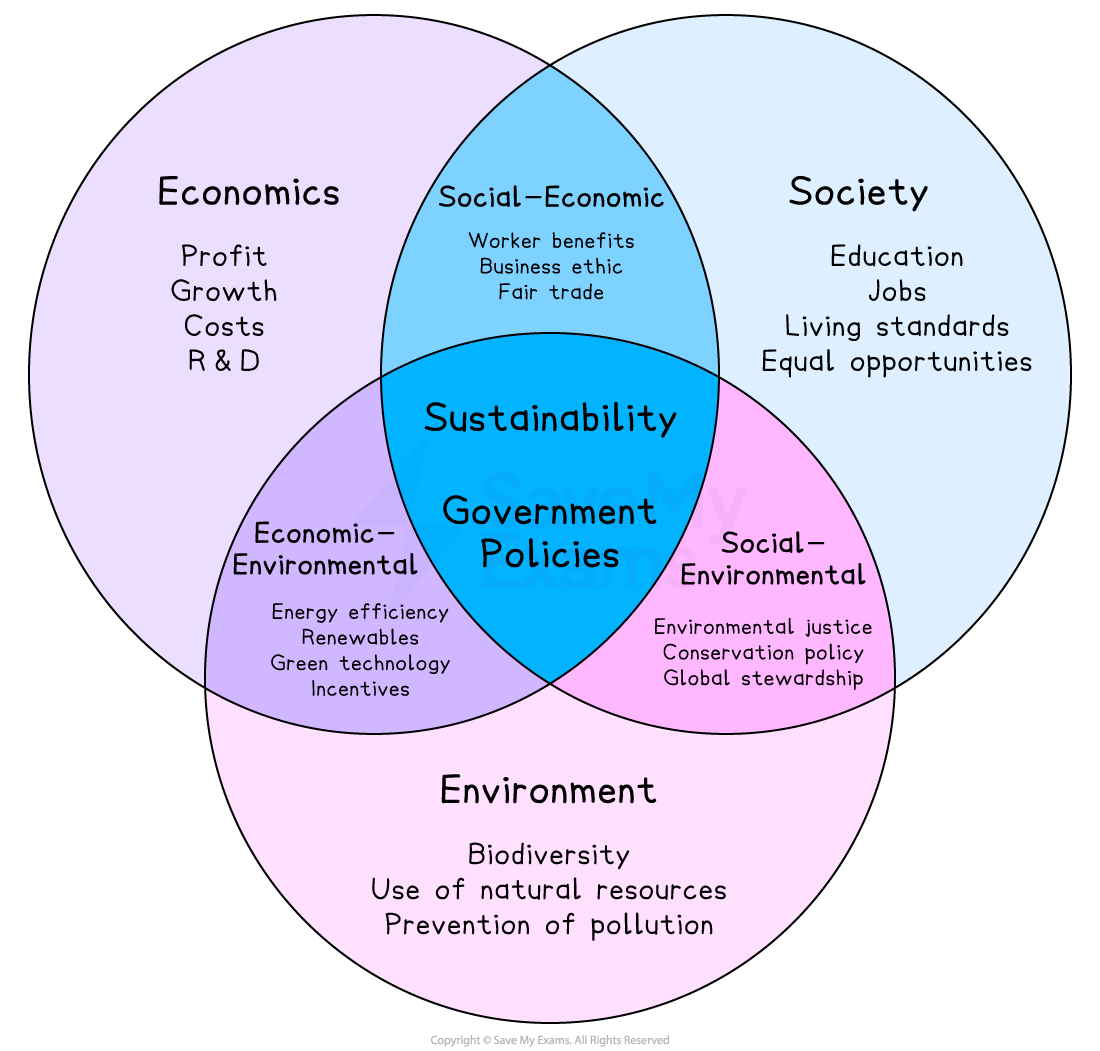
Sustainability depends on balancing three key areas in government policy
Economic
Profit, growth, costs, research and development (R&D)
Focuses on creating wealth and economic stability
Social
Education, jobs, living standards, equal opportunities
Focuses on quality of life and fairness
Environmental
Biodiversity, natural resource use, pollution prevention
Focuses on protecting the planet
These three areas are interconnected, so government policy often reflects this
Economic + Social (social-economic)
Worker benefits
Business ethics
Fair trade
Economic activity should be fair and responsible
Economic + Environmental (economic-environmental)
Energy efficiency
Renewable energy
Green technology
Incentives (such as subsidies)
Growth should not damage the environment
Social + Environmental (social-environmental)
Environmental justice
Conservation policy
Global stewardship
Environmental protection should be fair
Sustainability is achieved when government policy achieves a balance of the economic, social and environmental factors
Perspectives on priorities in measuring development
Traditionally and historically, economic development has been the most widely accepted way to determine the development of the state
Some actors believe that measuring economic development should be prioritised over others
The economic status of a state is the best way to see if it has the wealth to support social and environmental development
Healthcare, education and infrastructure is expensive
Economic development is easier to measure and may be considered more accurate than other development measures
Other actors argue that measuring other types of development give a more accurate picture of the sustainability of improvements
Environmental development should be prioritised and measured, as the future of humanity depends on it
Social development should be measured as a priority because people leading meaningful and productive lives is at the core of human existence
Political development must be measured as a priority because people need to have input into policies that change their lives and corruption makes all forms of development impossible
IGOs, including the United Nations and the European Union. see the value of measuring all types of development due to their interdependent nature
Case Study
Costa Rica – Beyond economic development
Costa Rica is often highlighted as a state that prioritises environmental and social development, rather than focusing only on economic growth
It shows that focusing only on economic development can be misleading
Strong environmental, social and political development can produce high living standards even without very high income
Economic development
Costa Rica is a middle-income state with steady but moderate growth
It does not have the same level of industrialisation as many richer states
This suggests that economic measures alone may underestimate its development
Environmental development priority
Around 98% of electricity comes from renewable energy
The government has invested heavily in conservation and reforestation
Nearly 30% of land is protected as national parks or reserves
This supports the view that environmental development is essential for long-term survival
Social development priority
High levels of education and literacy
Strong healthcare system with good life expectancy
No standing army since 1948, allowing more spending on public services
This shows that quality of life can be high without extreme wealth
Political development
Stable democratic system with regular elections
Low levels of corruption compared to many states in the region
Citizens have input into government decisions
This supports the argument that political development is key to effective policy
The role of IGOs
The United Nations ranks Costa Rica highly on measures like HDI and environmental performance
This reflects the importance of using multiple indicators of development
Pathways to development
Modernisation theory
This theory, developed by Rostow looks at the historical process and argues there are specific steps taken by all societies as they develop
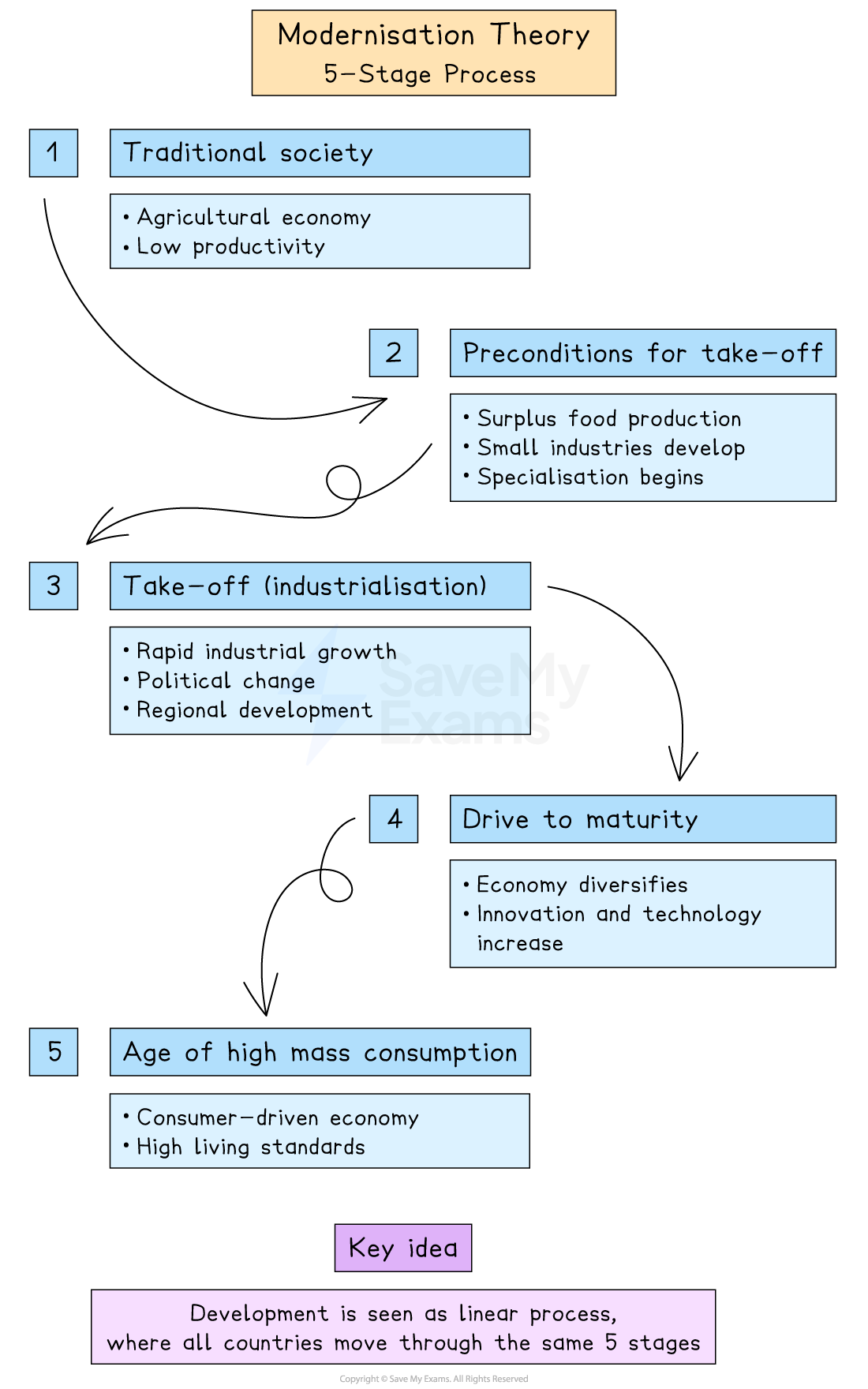
Criticisms of the Modernisation theory
It is based on a historical European model of development and may not apply to all states
Policies based on this model are therefore not always successful
Post-colonialists and neo-Marxists see this theory as a model of Western imperialism
This leads to the exploitation of marginalised people and workers
Environmentalists argue that mass production and overconsumption is destroying the planet
Dependency theory
Dependency theory is favoured by neo-Marxists and neo-colonialists
It attempts to explain why there are such different levels of development among states
After states were freed from colonialism, they were left with weak governance
They were forced to depend on maintaining exploitative economic relationships with former colonisers who remained powerful
Therefore, the best pathway to development requires changing the international structure of the global economy
Criticisms of Dependency theory
Changing the international structure of global economy is not realistic
The global economy continues to work for most nations and has enabled development
Neoliberalism
Neoliberals criticise Dependency theory, and argue that the interdependent nature of the global economy benefits all
The key to economic growth for all states is international trade
Some states are less developed due to internal factors such as poor government and a lack of political structures and infrastructure
Therefore, the best pathway to development is for states to make internal changes to government and economic structures which inhibit free trade
Criticisms of neo-liberalism theory
Neoliberalism has mostly benefited already powerful economically developed states and non-state actors and companies
The focus is entirely on economic development, which presents a limited view of development

Unlock more, it's free!
Join the 100,000+ Students that ❤️ Save My Exams
the (exam) results speak for themselves:

Was this revision note helpful?
