Coordinate Geometry (AQA GCSE Further Maths): Revision Note
Exam code: 8365

Distance between two points
How do I calculate the distance between two points?
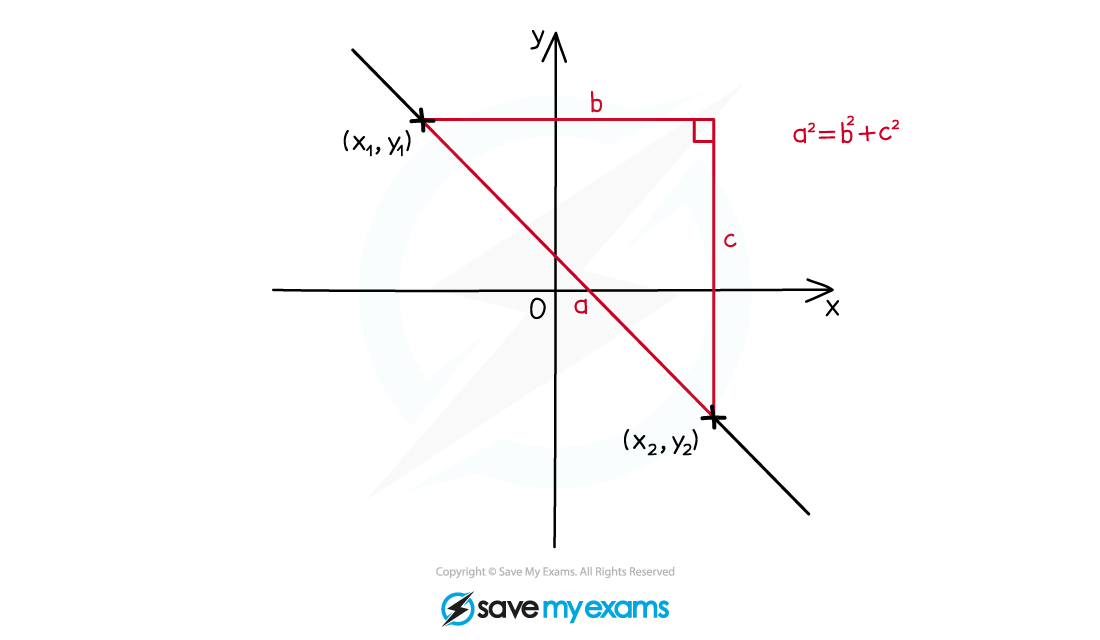
The distance between two points with coordinates and can be found using the formula
This formula is really just Pythagoras’ Theorem , applied to the difference in the -coordinates and the difference in the -coordinates;
You may be asked to find the length of a diagonal in 3D space. This can be answered using 3D Pythagoras
Examiner Tips and Tricks
As we are squaring the difference in and in the formula, it does not matter if they are positive or negative
32 is the same as (-3)2, this may help to speed up your working
Worked Example
Point A has coordinates (3, -4) and point B has coordinates (-5, 2).
Calculate the distance of the line segment AB.
Using the formula for the distance between two points,
Substituting in the two given coordinates:
Simplify:
Answer = 10 units
Midpoints
How do I find the midpoint of a line?
The midpoint of a line will be the same distance from both endpoints
You can think of a midpoint as being the average (mean) of two coordinates
The midpoint of and is
Examiner Tips and Tricks
Unlike when finding the distance between two points, when finding a midpoint we are finding a location, so the negative signs definitely do matter here
Be very careful to include any negative signs, and check your calculations
Worked Example
The coordinates of A are (−4, 3) and the coordinates of B are (8, −12).
Find M, the midpoint of AB.
The midpoint can be found using M =
Fill in the values of x and y from each coordinate
Simplify
M = (2, −4.5)
Using a ratio to find a point
How can I use a ratio to find a point on a line?
The midpoint of AB splits AB in the ratio 1 : 1.
If you are asked to find the point that divides AB in the ratio m : n, then you need to find the point that lies of the way from A to B.
E.g. dividing AB in the ratio 2 : 3 means finding the point that is of the way from A to B.
Normally an exam question will ask you to find the point that divides AB in the ratio 1 : n, so;
find the difference between the x coordinates,
divide this difference by [1 + n], and add the result to the x coordinate of A,
repeat for the y coordinates.
Worked Example
The coordinates of A are (−4, 3) and the coordinates of B are (8, −12).
A point N divides AB in the ratio 1 : 2.
Find the coordinates of N.
Calculate the difference between the x coordinate of A and the x coordinate of B
Divide this difference by 3 (as there are 1 + 2 = 3 parts in the ratio 1 : 2)
Add 4 to the x coordinate of A
Repeat for y
Alternatively, you may find it helpful to sketch the coordinates A and B and find N intuitively. Note that in the sketch, the coordinates do not need to be placed in the correct orientation to one another, simply along a straight line:
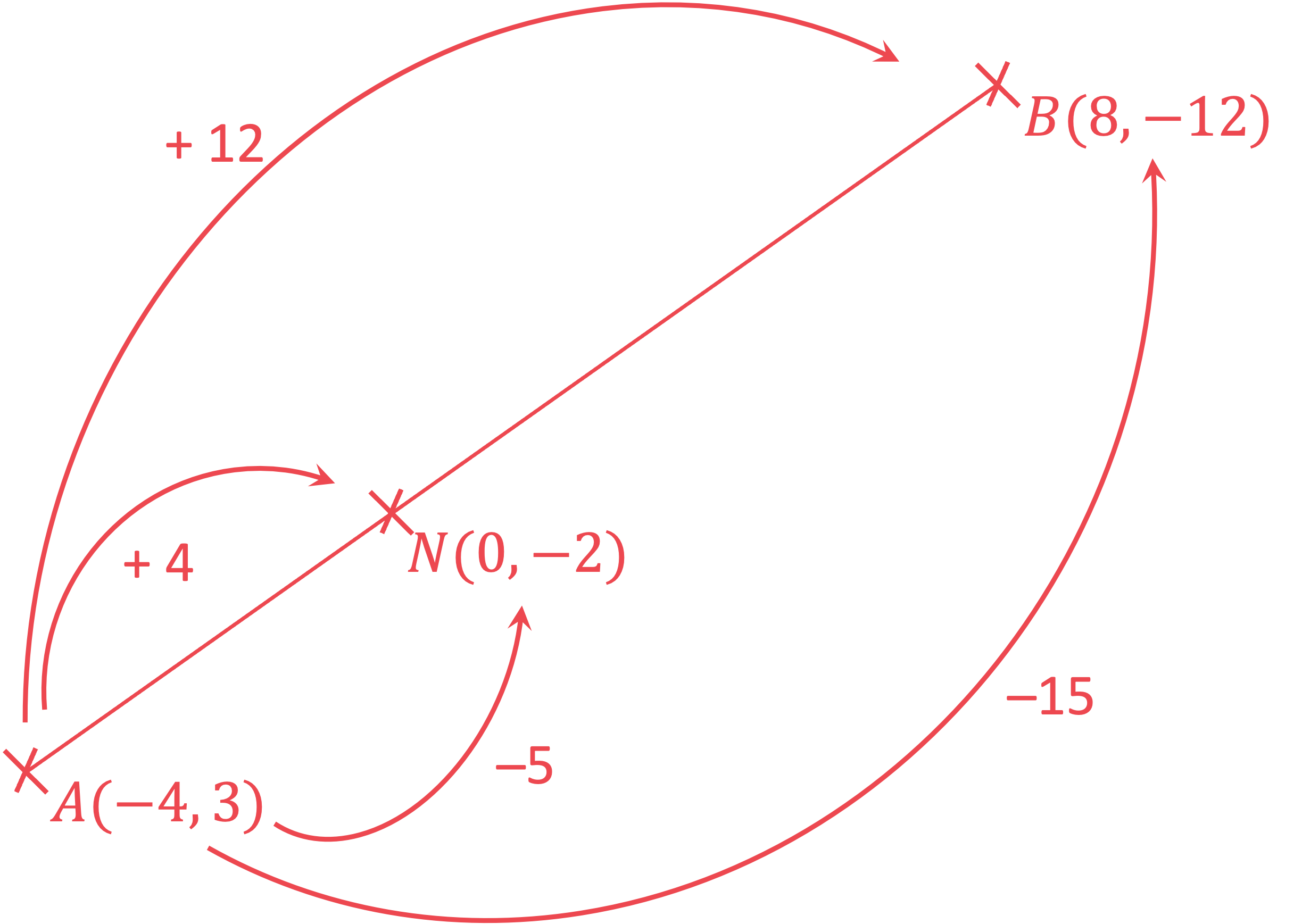
Write the final answer as a coordinate point
N = (0, −2)

Unlock more, it's free!
Join the 100,000+ Students that ❤️ Save My Exams
the (exam) results speak for themselves:

Was this revision note helpful?
Build on this topic
