Forming & Solving Equations (AQA GCSE Further Maths): Revision Note
Exam code: 8365

Algebraic ratio & percentages
How do I change ratios and percentages into algebra?
If equals then
the equals sign now allows you to use algebra
of can be written
this simplifies to
An increase of on can be written
this can also be written
Worked Example
Let and let .
Find the value of in each of the cases below.
(a)
As , it is also true that
Substituting in the expressions for and
Now we need to solve the equation for
Multiply both sides by 2, and then by
Simplify and solve
(b) of 50 equals of 250
As of 50 = of 250, we can write that
Substituting in the expressions for and
Now we need to solve the equation for
Multiply both sides by 100 to remove the fractions
Multiply out both sides, and then solve for
Forming & solving equations
How do I form an expression or equation?
An expression is an algebraic statement without an equals sign e.g. or
Sometimes we need to form expressions to help us express unknown values
If a value is unknown you can represent it by a letter such as
An equation is simply an expression with an equals sign that can then be solved
For example
If Adam is 10 years younger than Barry and the sum of their ages is 25, you can find out how old each one is
Represent Adam's age as then Barry's age is
We can solve the equation or
Sometimes you might have two unrelated unknown values (x and y) and have to use the given information to form two simultaneous equations
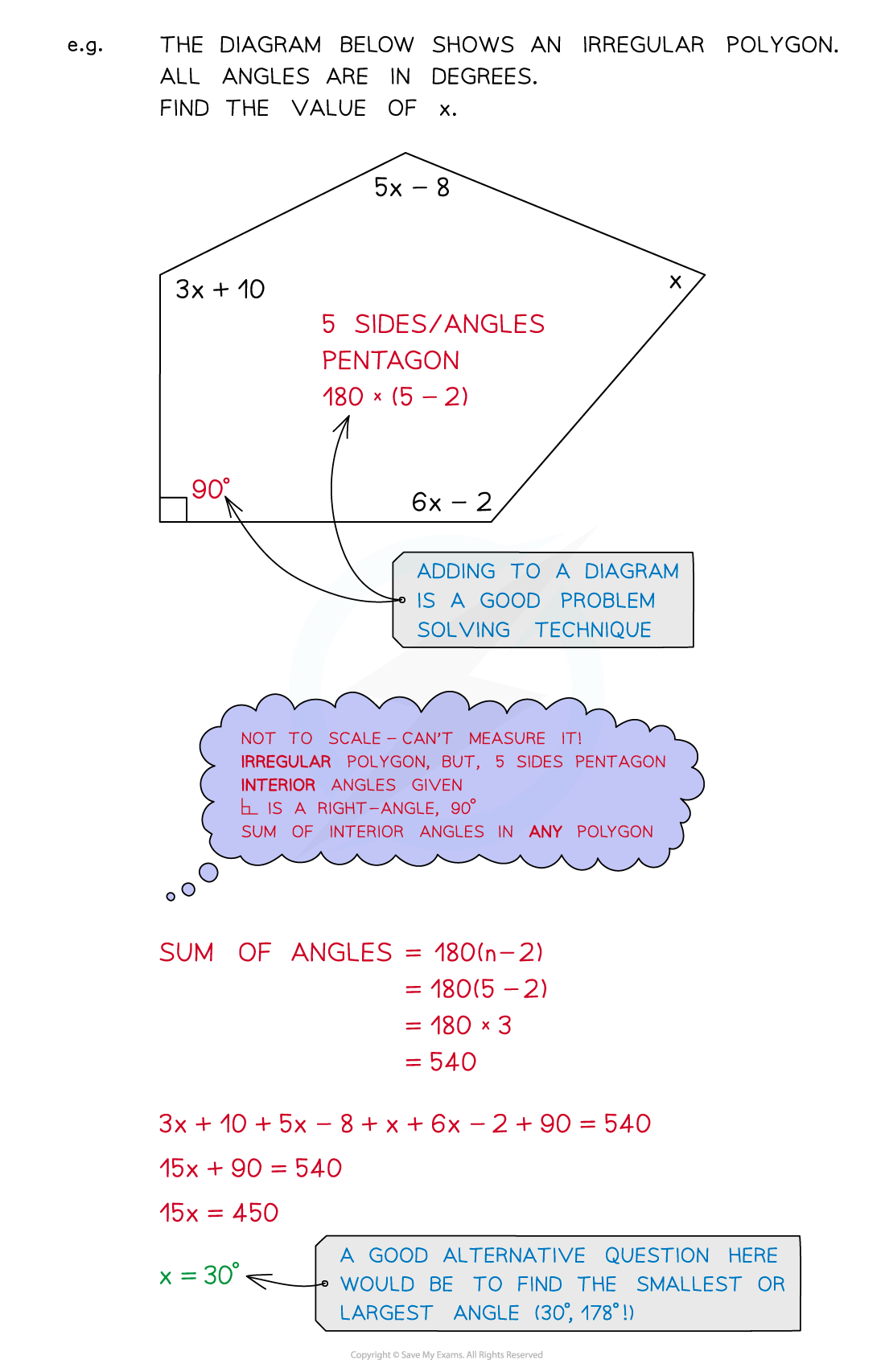
Many questions involve having to form and solve equations from information given about things relating to shapes, like lengths or angles.
How do I form an equation involving a 2D shape?
If no diagram is given it is almost always a good idea to quickly sketch one
Add any information given in the question to the diagram
This information will normally involve expressions in terms of one or two variables
If the question involves perimeter, figure out which sides are equal length
If a triangle is given, are any of the sides equal length?
If the question involves area, write down the necessary formula for the area of that shape
If it is an uncommon shape you may need to split it up into two or more common shapes that you can work out areas for
this is often called compound area in GCSE Mathematics courses
Remember that a regular polygon means all the sides are equal length
For example, a regular pentagon with side length 2x – 1 has 5 equal sides so its perimeter is 5(2x – 1)
If one of the shapes is a circle or part of a circle, use π throughout rather than multiplying by it and ending up with long decimals
Consider the properties of angles within the given shape to decide which sides will have equal lengths
If a triangle is given, how many of the angles are equal?
An isosceles triangle has two equal angles
An equilateral triangle has three equal angles
Consider angles in parallel lines (alternative, corresponding, co-interior)
In a parallelogram or rhombus, opposite angles are equal and all four sum to 360°
A kite has one equal pair of opposite angles
If the question involves angles, use the formula for the sum of the interior angles of a polygon
For a polygon of n sides, the sum of the angles will be 180°×(n - 2)
Remember that a regular polygon means all the angles are equal
You may also have to use circle theorems to spot which angles are equal to each other, or to spot right-angles
How do I form an equation involving the surface area or volume of a 3D shape?
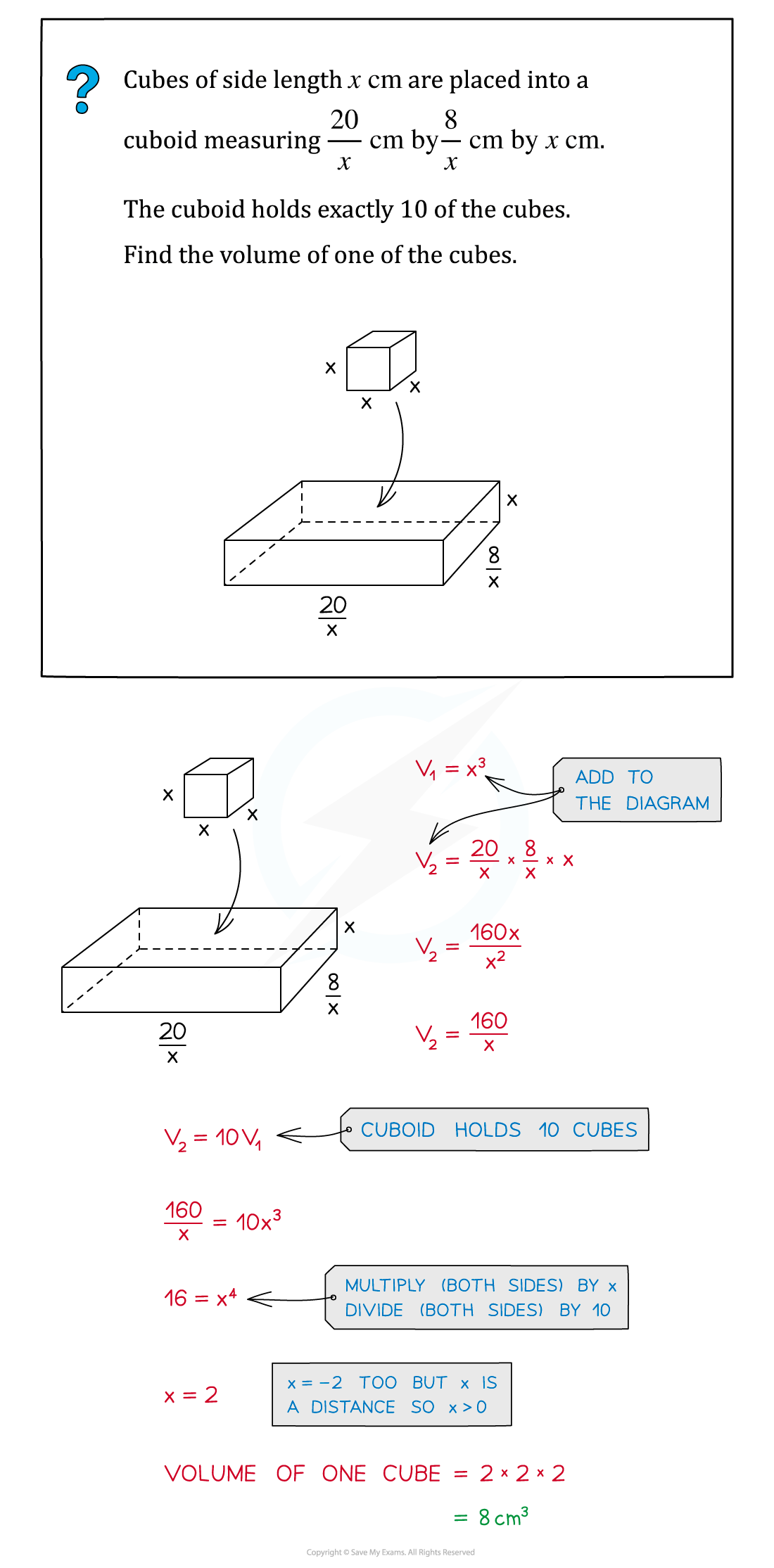
If no diagram is given it is almost always a good idea to quickly sketch one
Add any information given in the question to the diagram
This information will normally involve expressions in terms of one or two variables
Consider the properties of the given shape to decide which sides will have equal lengths
In a cube all sides are equal
All prisms have the same shape (cross section) at the front and back
If the question involves volume, write down the necessary formula for the volume of that shape
If it is an uncommon shape the exam question will give you the formula that you need
It the question involves surface area,
Remember to consider any faces that may be hidden in the diagram
STEP 1
Write down the number of faces the shape has and if any are the sameSTEP 2
Identify the 2D shape of each face and write down the formula for the area of each oneSTEP 3
Substitute the given expressions into the formula for each oneSTEP 4
Add the expressions together, double checking that you have one for each of the faces
Examiner Tips and Tricks
Do not start by focusing on what the question has asked you to find, but on what maths you can do
If your attempt turns out to be unhelpful, that’s fine, you may still pick up some marks
If your attempt is relevant it could nudge you towards the full solution – and full marks!
Add information to a diagram as you work through a problem
If there is no diagram, try sketching one
Worked Example
Worked Example
The base radius, , of a cone is the same as the radius of a hemisphere. The total surface area of the cone is equal to the total surface area of the hemisphere.
The surface area of a sphere is given by .
The curved surface area of a cone is given by .
(a) Find the slant height, , of the cone in terms of .
Find an expressions for the surface area of the hemisphere in terms of and .
Remember that a hemisphere has both a curved surface area and a flat circular face so the formula for the surface area is:
Surface area of hemisphere =
Find an expressions for the surface area of the cone in terms of and .
Remember that a cone has both a curved surface area and a flat circular face so the formula for the surface area is:
Surface area of cone =
The surface areas are equal, so set these two formulae equal to each other.
Rearrange to make the subject.
Begin by dividing both sides by .
(b) Given that cm, find the curved surface area of the cone.
Give your answer accurate to 1 decimal place.
Use your answer from part (a) to find the value of , by substituting into
Substitute and into the formula for the curved surface area of the cone.
Note that this is not for the whole surface area.
Round your answer to 1 decimal place.
The first decimal place is a 2, and this is followed by a 2 so you do not need to round it up.

Unlock more, it's free!
Join the 100,000+ Students that ❤️ Save My Exams
the (exam) results speak for themselves:

Was this revision note helpful?
Build on this topic
