Functions Toolkit (AQA GCSE Further Maths): Revision Note
Exam code: 8365

Introduction to functions
What is a function?
A function is a combination of one or more mathematical operations that takes a set of numbers and changes them into another set of numbers
It may be thought of as a mathematical “machine”
For example, if the function (rule) is “double the number and add 1”, the two mathematical operations are "multiply by 2 (×2)" and "add 1 (+1)"
Putting 3 in to the function would give 2 × 3 + 1 = 7
Putting -4 in would give 2 × (-4) + 1 = -7
Putting in would give
The number being put into the function is often called the input
The number coming out of the function is often called the output
What does a function look like?
A function f can be written as f(x) = …
Other letters can be used. g, h and j are common but any letter can technically be used
Normally, a new letter will be used to define a new function in a question
For example, the function with the rule “triple the number and subtract 4” would be written
In such cases, would be the input and would be the output
Sometimes functions don’t have names like f and are just written as y = …
eg.
How does a function work?
A function has an input and output
Whatever goes in the bracket (instead of )with f, replaces the on the other side
This is the input
If the input is known, the output can be calculated
For example, given the function
If the output is known, an equation can be formed and solved to find the input
For example, given the function
If , the equation can be formed
Solving this equation gives an input of 7
Worked Example
A function is defined as .
(a) Find .
The input is , so substitute 7 into the expression everywhere you see an .
Calculate.
(b) Find .
The input is so substitute into the expression everywhere you see an .
Expand the brackets and simplify.
A second function is defined .
(c) Find the value of for which .
Form an equation by setting the function equal to -16.
Solve the equation by first adding 4 to both sides, then dividing by 3.
Domain & range
How are functions related to graphs?
Functions can be represented as graphs on x and y axes
The x-axis values are the inputs
The y-axis values are the outputs
To see what graph to plot, replace f(x) = ... with y = ...

What is the domain of a function?
The domain of a function is the set of all inputs that the function is allowed to take
Domains can be described in words
they must refer to x
you can use inequality signs if needed
you can exclude parts by saying "except" if needed
For f(x) = 2x + 3
the domain "x > 0" means only positive values of x can be inputted
the domain "2 < x < 5 except 4" means only values of x between 2 and 5, except 4, can be inputted
this includes non-integers, like x = π
the domain "all real values" means any x can be inputted
For you cannot square root a negative number
the domain is x ≥ 2
this is from solving x - 2 ≥ 0
For you cannot divide by zero
the domain is all real values of x except 5
this is from solving x - 5 = 0
What is the range of a function?
The range of a function is the set of all outputs that the function gives out
Ranges can be described in words
they must refer to f(x)
not x or y
Ranges are based on domains
For f(x) = 3x + 2 with domain x > 0
the range is "f(x) > 2"
This is because if the inputs are all greater than 0, the outputs will all be greater than 2
This could be seen from a sketch of y = 3x + 2 in the region x > 0
How do I solve problems involving the domain and range?
You need to be able to deduce the range of a function from its expression and domain
To find the range of g(x) = 3x2 with the domain x ≥ 0...
...sketch the graph for x ≥ 0 only (use a table-of-values if required)...

...read-off the range by seeing which values of y are possible
Possible y values are y ≥ 0
rewrite "y" as "f(x)" when giving ranges
the range is f(x) ≥ 0
Examiner Tips and Tricks
A graph / sketch of the function helps to “see” the domain on the x-axis and range on the y-axis
Worked Example
Two functions are given by
(a) If the domain of function f is , find the range.
Sketch the graph of by substituting for and sketching the linear graph .
The domain of the function is so only draw the graph between these points.
Substitute and into the function to find the endpoints of the range.

The range is the values that the graph goes from and to.
Use the domain to decide whether the range has an non-strict inequality (≤ or ≥) or a strict inequality (< or >).
The domain is greater than 2 but less than or equal to 4 so the range is greater than 11, but less than or equal to 17.
When writing the range you must use the notation in the final answer.
(b) If the range of g is , find the domain.
Sketch the graph of by substituting for and sketching the linear graph .
The range of the function is so substitute and into the function and solve to find the endpoints of the domain.
For ,
For ,

The domain is the values that the graph goes from and to.
Use the given range to decide whether the range has a strict inequality (≤ or ≥) or a non-strict inequality (< or >).
The range is greater than 4 but less than or equal to 6 so the domain is greater than or equal to 3, but less than 5. (Make sure you look at the coordinates to check which part of the domain goes with which part of the range).
Note that this would be difficult to see without sketching the graph, as the function decreases.
Piecewise functions
What is a piecewise function?
A piecewise function is a single function with different parts across different domains
The function has three domains
the input 0.5 lies in , so
the input 3 lies in so
the input 8.5 lies in , so
How do I sketch a piecewise function?
Think of the shape of each part
f(x) = mx + c is a straight line, f(x) = k is horizontal at height k, f(x) = x2 is quadratic etc
Plot the coordinates of the end-points to help
for the domain a ≤ x ≤ b find the heights of the graph, f(a) and f(b)
Not all parts have to "join up"
there may be a jump (discontinuity)
For
it's y = x from x = 0 to 1, then horizontal at y = 1 from x = 1.5 to 2, then 0 everywhere else
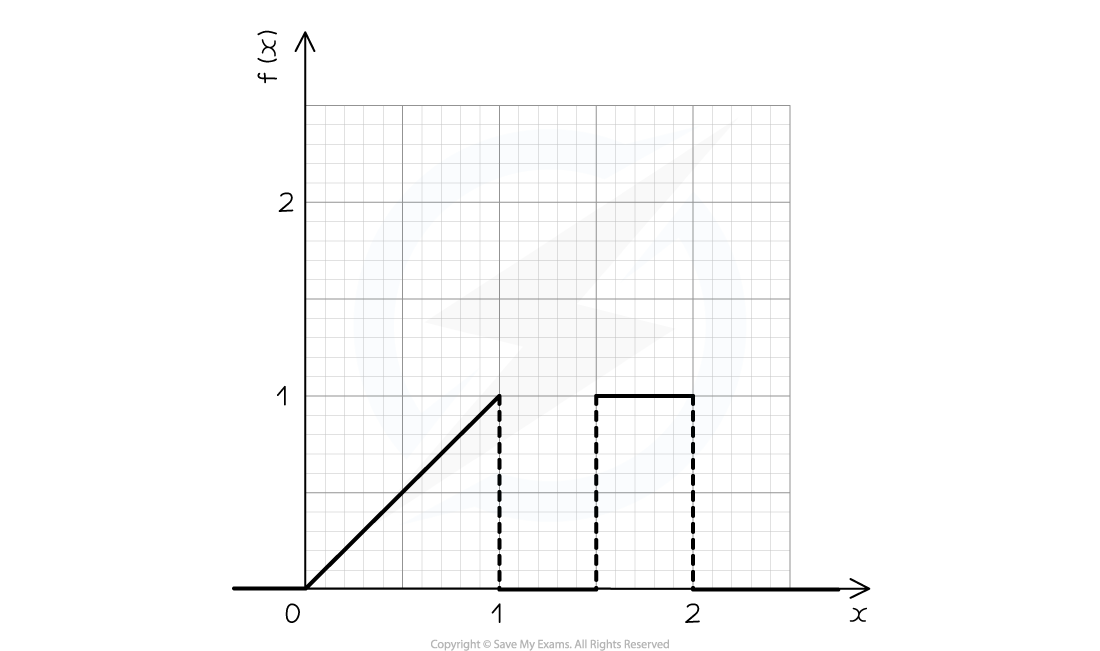
Sketching helps see the range (all possible outputs on the y-axis), for this example it's
A table of values can also be used
How do I find the equation of a piecewise function from a sketch?
Build an equation in the form
don't include a domain end-point twice (use ≤ with one part and < with another, in either order)
Horizontal sections have the form f(x) = k, where k is the height
Straight line sections can be thought of as a coordinate geometry problem
how do I find the equation of a straight line from (x1, y1) to (x2, y2)?
Quadratic sections have two different equation forms
f(x) = (x - a)2 + b is a positive quadratic (U-shape) with vertex (turning point) at (a, b)
the vertical line x = a is the line of symmetry
f(x) = (x - a)(x - b) is a positive quadratic (U-shape) with x-intercepts x = a and x = b
Worked Example
Sketch the function
Consider each part of the function separately.
From to the function is a linear graph, with a gradient of 1 and a -intercept of 3. Find the endpoints of this part of the function.
At ,
At ,
Plot the points (-3, 0) and (0, 3) and then draw a straight line between them. Check that its gradient is one.
From to the function is a positive quadratic graph (u shape).
Find the endpoints of the quadratic graph by substituting and into the function and finding the corresponding values.
At ,
At ,
Find the -intercepts of the quadratic graph by setting each bracket to 0 and solving.
Let ,
Let ,
Plot the points (0, 3), (1, 0) (3, 0) and (4, 3) and draw a smooth u-shaped curve through them.
The final part of the function is a horizontal line from the coordinates (4, 3) to (6, 3).


Unlock more, it's free!
Join the 100,000+ Students that ❤️ Save My Exams
the (exam) results speak for themselves:

Was this revision note helpful?
Build on this topic