Problem Solving with Binomial Expansion (AQA GCSE Further Maths): Revision Note
Exam code: 8365

Problem-solving with binomial expansion
How do I find a specific term in a binomial expansion?
If asked to find a specific term, use the fact that each term in the expansion of has the form
where
the Pascal coefficient comes from the row in Pascal's triangle starting with
the powers of and sum to the power of the binomial,
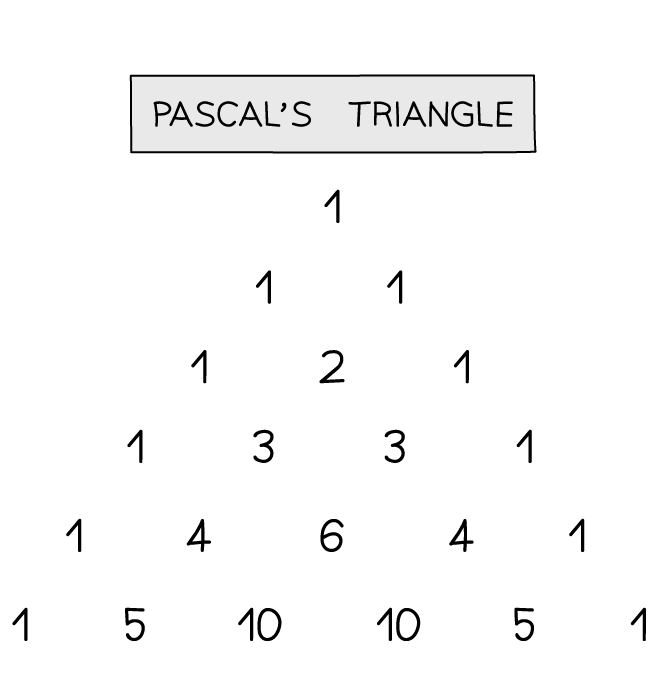
For example, to find the coefficient of the term in the expansion of
Find the row in Pascal's triangle that starts with 1, 4, ...
1, 4, 6, 4, 1
Imagine where the power would be in the expansion
Pascal coefficient | 1 | 4 | 6 | 4 | 1 |
Power of | |||||
Power of |
The term must be formed from the middle column,
meaning the coefficient of the term is
How do I expand binomials with fractions?
Some binomials have fractional terms
Remember the index law
For example,
This simplifies to
Powers of can then be cancelled
Note how the constant term is no longer at the end of the expansion
Examiner Tips and Tricks
Look out for extra information about unknowns
e.g. if it says "...where " and you have then use the positive value
If you forget how to find a specific term in the exam, just expand the whole binomial using Pascal's triangle then find it
Worked Example
(a) Find the coefficient of in the expansion of .
Imagine and in
The row from Pascal's triangle that starts 1, 5, ... is
The term required is , which is third along when considering
Therefore the term required is in the expansion of
So the coefficient of is
The coefficient of the term is 2560
(b) Given that and that the coefficient of in the expansion of is 59 535, find the value of .
Imagine and in
The row from Pascal's triangle that starts 1, 6, ... is
The term required is , which is third along when considering
Therefore the term required is in the expansion of
So the coefficient of is
The question gives the coefficient as 59 535 so set up and solve an equation for
so the positive square root is needed
The value of is 7
(c) Find the coefficient of in the expansion of .
Imagine and in
The row from Pascal's triangle that starts 1, 5, ... is
The term required is in , but this time both terms in the binomial depend on so consider how their powers are multiplied together in the expansion,
The third along gives, so select the third number from the row in Pascal's triangle
The term required is in the expansion of
So the coefficient of is
The coefficient of the term is 80

Unlock more, it's free!
Join the 100,000+ Students that ❤️ Save My Exams
the (exam) results speak for themselves:

Was this revision note helpful?
Build on this topic
