Differentiating Powers of x (AQA GCSE Further Maths): Revision Note
Exam code: 8365

Differentiating powers of x
What is differentiation?
Differentiation is the process of finding an expression of the derivative (gradient function) from the equation of a curve
The equation of the curve is written and the gradient function is written
How do I differentiate powers of x?
Powers of are differentiated according to the following formula:
If then
e.g. If then
you "bring down the power" then "subtract one from the power"
Don't forget these two special cases:
If then
e.g. If then
If then
e.g. If then
These allow you to differentiate linear terms in and constants
Functions involving fractions with denominators in terms of will need to be rewritten as negative powers of first
e.g. If then rewrite as and differentiate
How do I differentiate sums and differences of powers of x?
The formulae for differentiating powers of work for a sum or difference of powers of
e.g. If then
This is sometimes referred to differentiating 'term-by-term'
Products and quotients (divisions) cannot be differentiated in this way so they need expanding/simplifying first
e.g. If then expand to which is a sum/difference of powers of and can then be differentiated
What can I do with derivatives (gradient functions)?
The derivative can be used to find the gradient of a function at any point
The gradient of a function at a point is equal to the gradient of the tangent to the curve at that point
A question may refer to the gradient of the tangent
Examiner Tips and Tricks
Don't try to do too many steps in your head; write the expression in a format that you can differentiate before you actually differentiate it
e.g. can be rewritten as which is then far easier to differentiate
Worked Example
Find the derivative of
(a)
Rewrite the term
Apply the rule for differentiating powers () and apply the special cases for the terms and 8 ( and )
Unless a question specifies there is not usually a need to rewrite/simplify the answer
(b)
This is a product of two (equal) brackets so cannot be differentiated directly
Expand the brackets to get an expression in powers of
Take time to get the expansion correct, writing stages out in full if necessary
Differentiate 'term-by-term', looking out for those special cases
There is a factor of 4 but there is no demand to factoise the final answer in the question
(c)
This is a quotient so cannot be differentiated directly
Spot the single denominator which means we can split the fraction by the two terms on the numerator
Simplify using the laws of indices
Each term is now a power of , so differentiate 'term-by-term'
There is demand to simplify or write the answer in a particular form
Finding gradients of curves
Using the derivative to find the gradient of a curve
To find the gradient of a curve, at any point on the curve, substitute the x‑coordinate of the point into the derivative
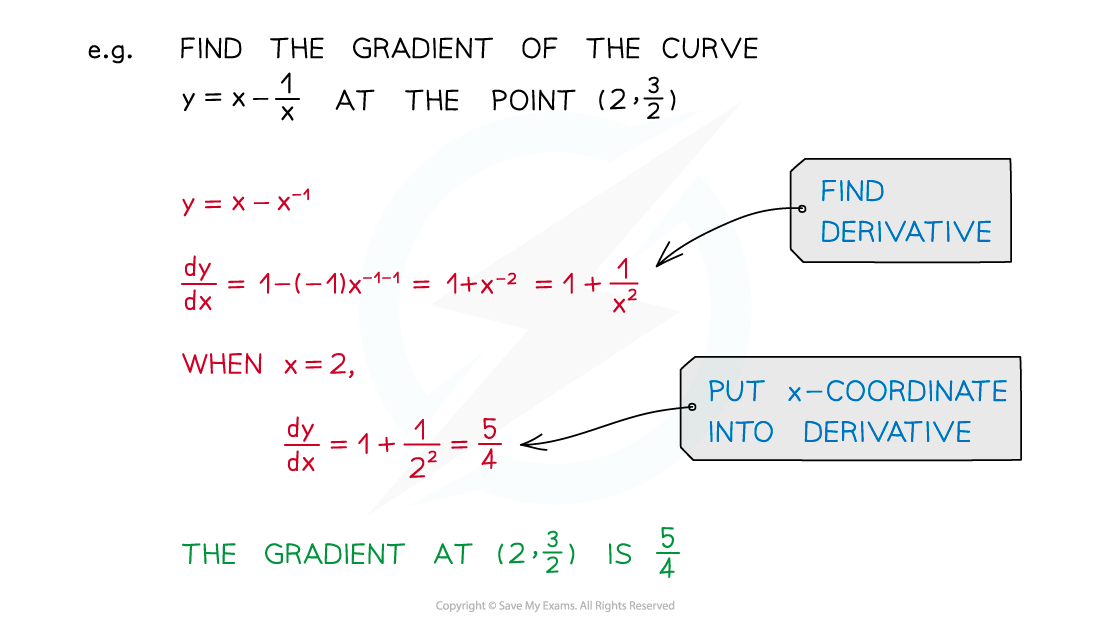
Examiner Tips and Tricks
Read the question carefully; sometimes you are given and so don't need to differentiate initially - don't just automatically differentiate the first thing you see!
The following mean the same thing:
"Find the gradient of the curve at "
"Find the gradient of the tangent at "
the tangent gradient = curve gradient at that point
"Find the rate of change of y with respect to x at "
Worked Example
A curve has the equation .
(a) Find the gradient of the curve when .
is already in a form that can be differentiated
Substitute into
The gradient of the curve at is 19
(b)
Work out the possible values of for which the rate of change of with respect to is 4.
"Rate of change" is another way of describing the derivate
Solve this equation to find
Note that it is quadratic equation so it could have up to two solutions
The question refers to 'values' implying there is (or could be) more than one value for
The possible values of , that give a rate of change of 4, are and

Unlock more, it's free!
Join the 100,000+ Students that ❤️ Save My Exams
the (exam) results speak for themselves:

Was this revision note helpful?
Build on this topic
