Linear Simultaneous Equations (AQA GCSE Further Maths): Revision Note
Exam code: 8365

Linear simultaneous equations
What are linear simultaneous equations?
When there are two unknowns (say x and y) in a problem, we need two equations to be able to find them both: these are called simultaneous equations
you solve two equations to find two unknowns, x and y
for example, 3x + 2y = 11 and 2x - y = 5
the solutions are x = 3 and y = 1
If they just have x and y in them (no x2 or y2 or xy etc) then they are linear simultaneous equations
How do I solve linear simultaneous equations by elimination?
"Elimination" completely removes one of the variables, x or y
To eliminate the x's from 3x + 2y = 11 and 2x - y = 5
Multiply every term in the first equation by 2
6x + 4y = 22
Multiply every term in the second equation by 3
6x - 3y = 15
Subtract the second result from the first to eliminate the 6x's, leaving 4y - (-3y) = 22 - 15, i.e. 7y = 7
Solve to find y (y = 1) then substitute y = 1 back into either original equation to find x (x = 3)
Alternatively, to eliminate the y's from 3x + 2y = 11 and 2x - y = 5
Multiply every term in the second equation by 2
4x - 2y = 10
Add this result to the first equation to eliminate the 2y's (as 2y + (-2y) = 0)
The process then continues as above
Check your final solutions satisfy both equations
How do I solve linear simultaneous equations by substitution?
"Substitution" means substituting one equation into the other
Solve 3x + 2y = 11 and 2x - y = 5 by substitution
Rearrange one of the equation into y = ... (or x = ...)
For example, the second equation becomes y = 2x - 5
Substitute this into the first equation (replace all y's with 2x - 5 in brackets)
3x + 2(2x - 5) = 11
Solve this equation to find x (x = 3), then substitute x = 3 into y = 2x - 5 to find y (y = 1)
Check your final solutions satisfy both equations
How do you use graphs to solve linear simultaneous equations?
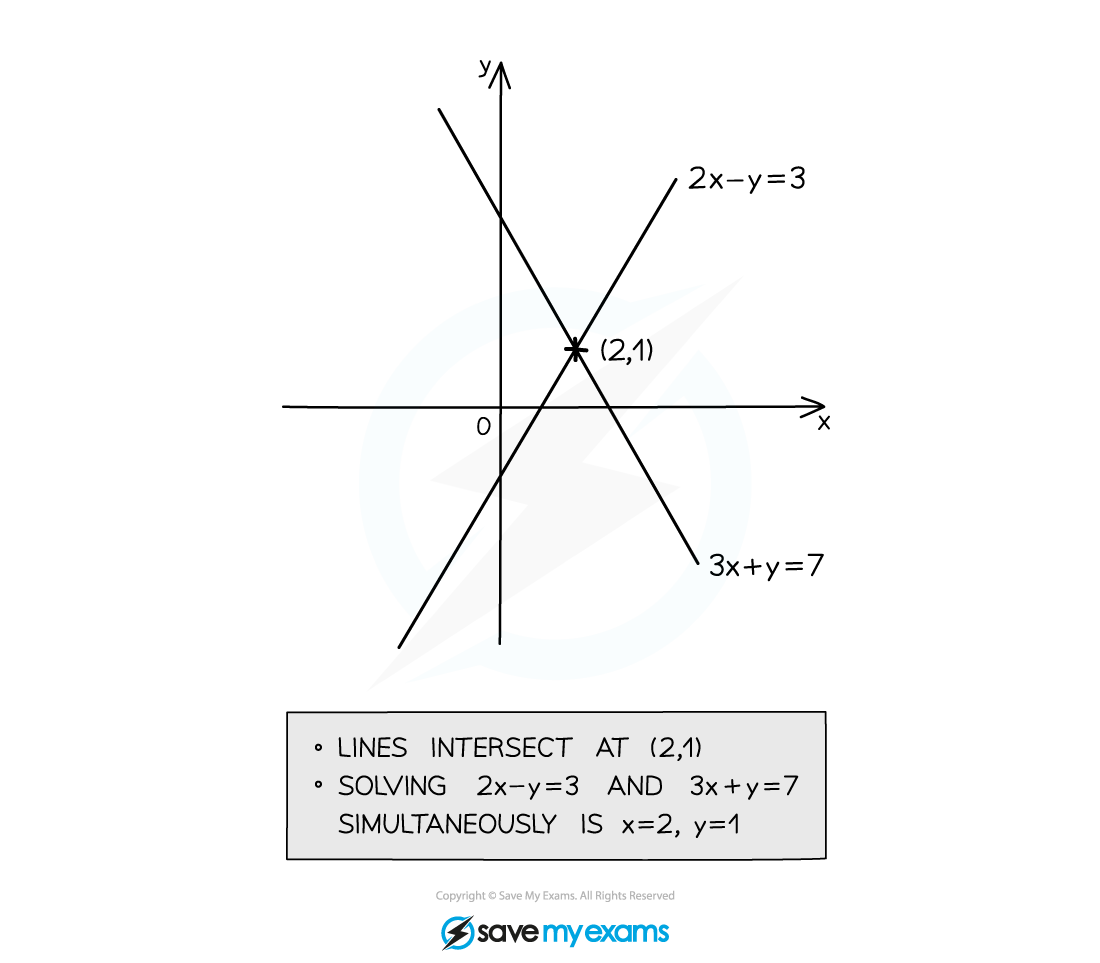
Plot both equations on the same set of axes
to do this, you can use a table of values or rearrange into y = mx + c if that helps
Find where the lines intersect (cross over)
The x and y solutions to the simultaneous equations are the x and y coordinates of the point of intersection
e.g. to solve 2x - y = 3 and 3x + y = 7 simultaneously, first plot them both (see graph)
find the point of intersection, (2, 1)
the solution is x = 2 and y = 1
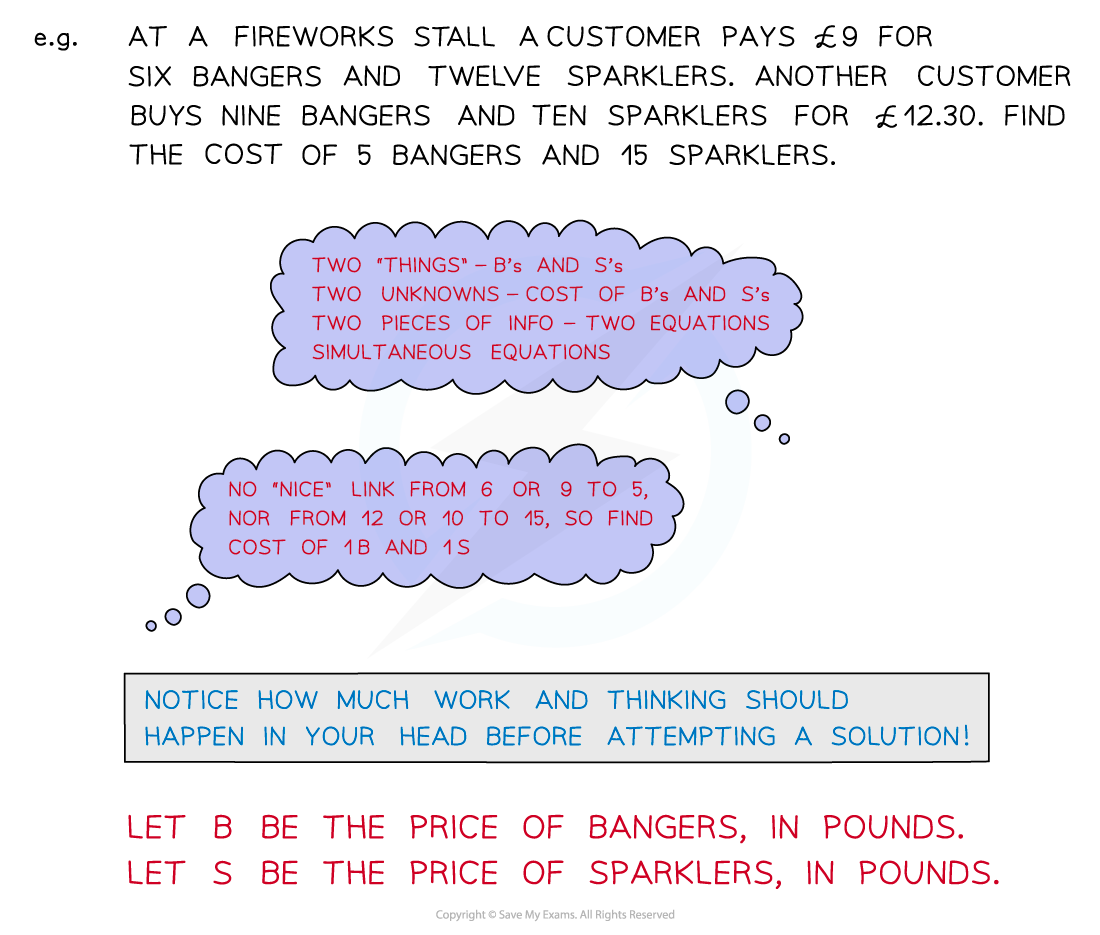
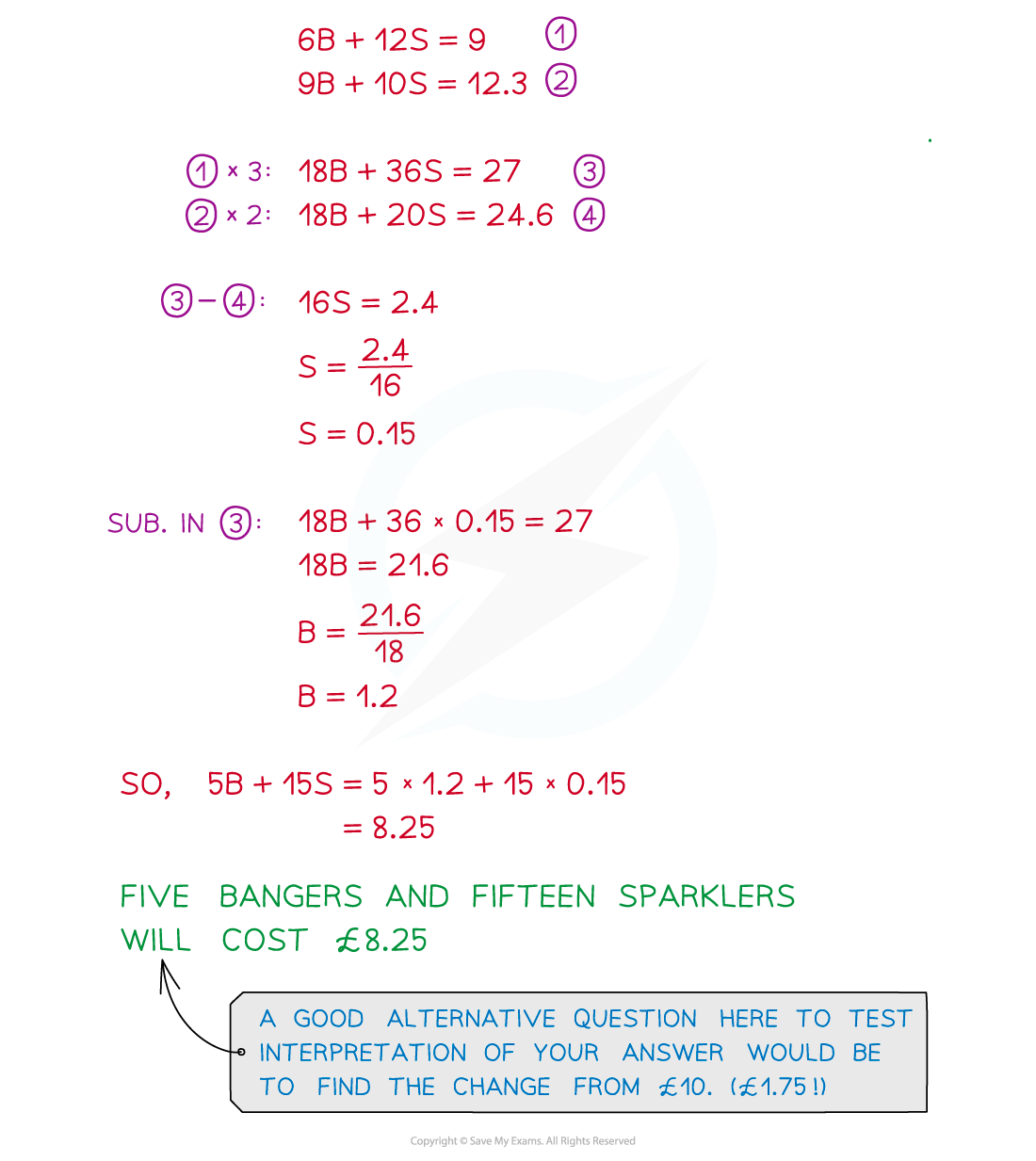
How do I solve linear simultaneous equations from worded contexts?
Examiner Tips and Tricks
Always check that your final solutions satisfy the original simultaneous equations
you will know immediately if you've got the right solutions or not
Worked Example
Solve the simultaneous equations
5x + 2y = 11
4x - 3y = 18
Number the equations.
Make the y terms equal by multiplying all parts of equation (1) by 3 and all parts of equation (2) by 2.
This will give two 6y terms with different signs. The question could also be done by making the x terms equal by multiplying all parts of equation (1) by 4 and all parts of equation (2) by 5, and subtracting the equations.
The 6y terms have different signs, so they can be eliminated by adding equation (4) to equation (3).
Solve the equation to find x by dividing both sides by 23.
Substitute into either of the two original equations.
Solve this equation to find y.
Substitute x = 3 and y = - 2 into the other equation to check that they are correct

Unlock more, it's free!
Join the 100,000+ Students that ❤️ Save My Exams
the (exam) results speak for themselves:

Was this revision note helpful?
Build on this topic
