11 mark
What type of particle is ammonia?
Atom
Ion
Molecule
Was this exam question helpful?
Exam code: 8465
What type of particle is ammonia?
Atom
Ion
Molecule
Was this exam question helpful?
This question is about structure and bonding.
Why can metals be shaped?
Different-sized atoms distort the structure.
Layers of atoms slide over each other.
Metallic bonds are weak.
Metals have low melting points.
Explain how metals conduct electricity.
You should answer in terms of electrons.
Figure 1 represents the structure of diamond and of sodium chloride.
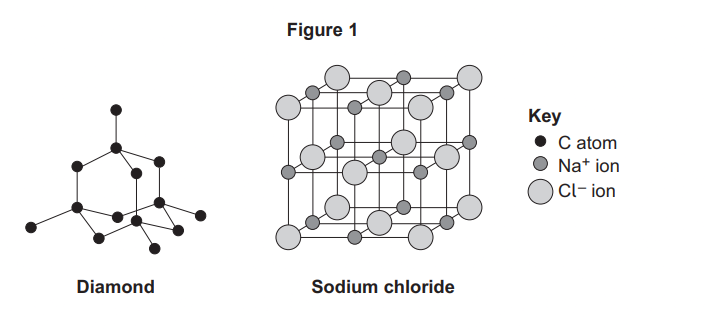
Compare the structure and bonding of diamond with the structure and bonding of sodium chloride.
Ethene molecules join together to form long-chain poly(ethene) molecules.
Explain why poly(ethene) has a higher melting point than ethene.
You should refer to the:
size of the molecules
intermolecular forces.
Was this exam question helpful?
Hydrogen reacts with oxygen to produce water.
Figure 6 represents the equation for the reaction.
Figure 6
2 H—H + O=O → 2 H—O—H
Table 1 shows bond energies.
Table 1
Bond | Bond energy in kJ/mol |
|---|---|
H—H | 436 |
O=O | 498 |
O—H | 464 |
Calculate the energy released during bond formation in the reaction.
Use Figure 6 and Table 1.
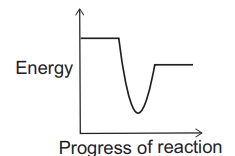
In the reaction to produce water, the energy needed to break bonds is less than the energy released when bonds are formed.
Which reaction profile represents this reaction?
Reaction profile A
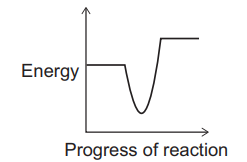
Reaction profile B
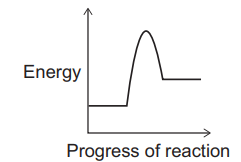
Reaction profile C
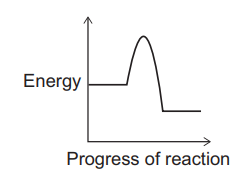
Reaction profile D
Complete the dot and cross diagram for a water molecule.
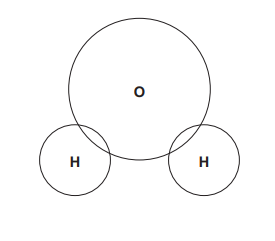
Explain why hydrogen gas (H2) consists of molecules rather than single atoms.
Was this exam question helpful?
Calcium is in Group 2 of the periodic table.
What is the symbol for a calcium ion?
Ca-
Ca2-
Ca+
Ca2+
Was this exam question helpful?
This question is about metals.
FIGURE 14 represents the electronic structure of an atom.
FIGURE 14
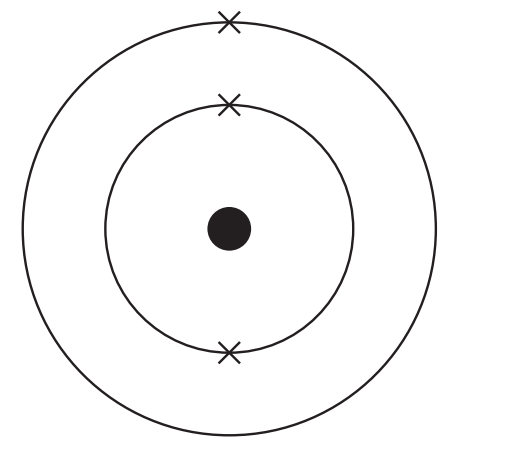
Identify the metal represented in FIGURE 14.
Use the periodic table.
How does the atom in FIGURE 14 form a positive ion?
Copper is too soft for some uses.
Copper can be mixed with other metals to make a mixture that is harder than copper.
Name the type of mixture formed when copper is mixed with other metals.
FIGURE 15 shows the percentage (%) by mass of three metals in a mixture.
FIGURE 15
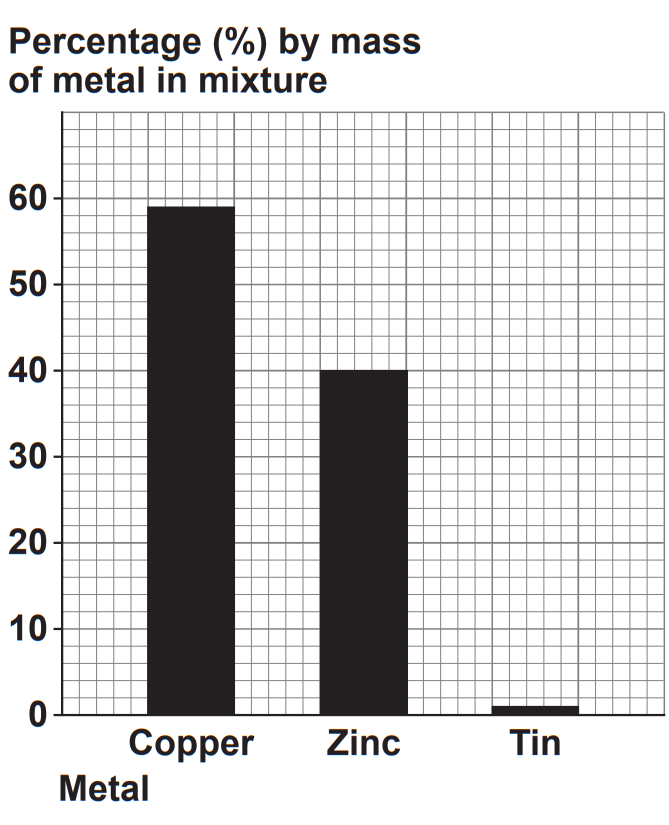
Determine the mass of copper in 20 g of the mixture.
Mass of copper = ____________________ g
FIGURE 16 represents pure copper and a mixture of copper and metal X.
FIGURE 16
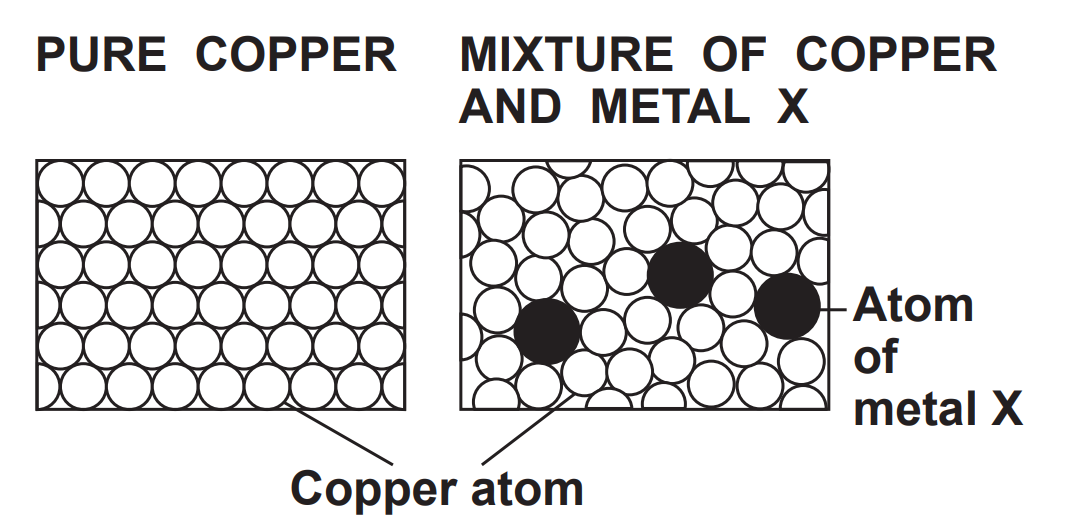
Explain why the mixture of copper and metal X is harder than pure copper.
Give TWO reasons why copper has a high melting point.
Why is copper a good conductor of electricity?
Was this exam question helpful?
What type of structure does chlorine have?
Tick (✓) one box.
Giant covalent
Ionic lattice
Small molecules
Was this exam question helpful?
Iron is extracted from iron oxide.
An oxide ion is an oxygen atom that has gained two electrons.
What is the formula of an oxide ion?
Tick (✓) one box.
O2
O2–
O2+
Was this exam question helpful?
Give TWO limitations of using a dot and cross diagram to represent a methane molecule.
Was this exam question helpful?
Aluminium sulfate is a salt made of Al3+ ions and SO42- ions.
What is the formula of aluminium sulfate?
Tick (✓) ONE box.
Al2SO4
Al2(SO4)3
Al3SO4
Al3(SO4)2
Was this exam question helpful?
What is the type of bonding in oxygen?
Tick (✓) one box.
Covalent
Ionic
Metallic
Was this exam question helpful?
This question is about reactions involving gases.
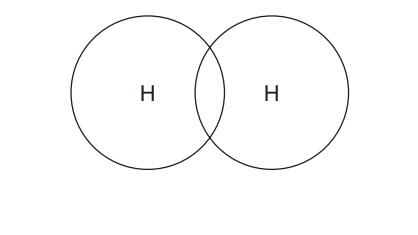
Hydrogen gas consists of hydrogen molecules.
A hydrogen atom has one electron.
Complete the dot and cross diagram for a hydrogen molecule (H2).
Hydrogen reacts with nitrogen to produce ammonia.
Figure 3 represents a molecule of ammonia.
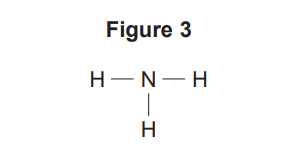
What is represented by — (a line) in Figure 3?
What is the formula of ammonia?
Use Figure 3.
Was this exam question helpful?
Magnesium reacts with oxygen to form magnesium oxide.
Describe what happens when a magnesium atom reacts with an oxygen atom to produce magnesium oxide.
A student reacted different masses of magnesium with oxygen.
The student determined the mass of magnesium oxide produced.
Table 3 shows the results.
Table 3
Mass of magnesium reacted in grams | Mass of magnesium oxide produced in grams |
|---|---|
0.08 | 0.12 |
0.17 | 0.25 |
0.24 | 0.38 |
0.33 | 0.54 |
0.42 | 0.67 |
0.49 | 0.81 |
Complete Figure 6.
You should:
use a suitable scale for the y-axis
plot the data from Table 3.
Figure 6: A graph with 'Mass of magnesium reacted in grams' on the x-axis (scaled from 0.00 to 0.50) and 'Mass of magnesium oxide produced in grams' on the y-axis (unscaled). The first point (0.08, 0.12) has been plotted.
The student's results cannot be used to show that the method gives precise measurements.
Give one reason why.
Was this exam question helpful?
Acids react with bases to produce salts and water (H2O).
The electronic structure of a hydrogen atom is 2,1.
The electronic structure of an oxygen atom is 2,6.
Draw a diagram to show the arrangement of the outer shell electrons in a molecule of water.
Was this exam question helpful?
Carbon nanotubes are cylindrical fullerenes.
Explain the properties of carbon nanotubes.
Answer in terms of structure and bonding.
Was this exam question helpful?
A student investigates a potassium salt, X.
She finds that salt X:
has a high melting point
does not conduct electricity when it is solid
dissolves in water and the solution does conduct electricity.
What is the type of bonding in salt X?
Tick (✓) one box.
Covalent
Giant molecular
Ionic
Metallic
Why does a solution of salt X in water conduct electricity?
Was this exam question helpful?
Lithium oxide is an ionic compound.
Draw a dot and cross diagram to show how lithium and oxygen combine to form lithium oxide.
Only show the electrons in the outer shell of each atom.
Give the charges on the ions formed.
Was this exam question helpful?