Forces & Energy Changes (AQA GCSE Combined Science: Synergy: Physical Sciences): Exam Questions

Exam code: 8465

2 hours15 questions
1a
1 mark

Figure 4 shows a student launching a toy aeroplane.

The student pulls on the aeroplane to stretch the spring and then lets go of the aeroplane.
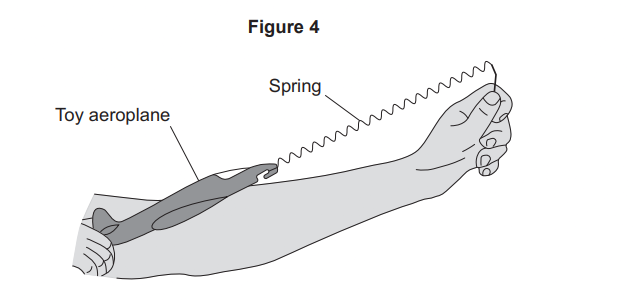
Diagram of a hand pulling a stretched spring attached to a toy aeroplane resting along a forearm, showing how the plane is launched.

Give one factor that would affect how high the aeroplane goes.

1b
Sme Calculator
2 marks

The extension of the spring is 0.20 m.

Calculate the elastic potential energy stored by the spring.

spring constant = 27 N/m

Use the equation:

\text{elastic potential energy} = 0.5 \times \text{spring constant} \times \left(\right) \text{extension} \left(\right)^{2}

1c
1 mark

A student investigated how the extension of the spring varied as the force on the spring was increased.

Figure 5 shows the results.
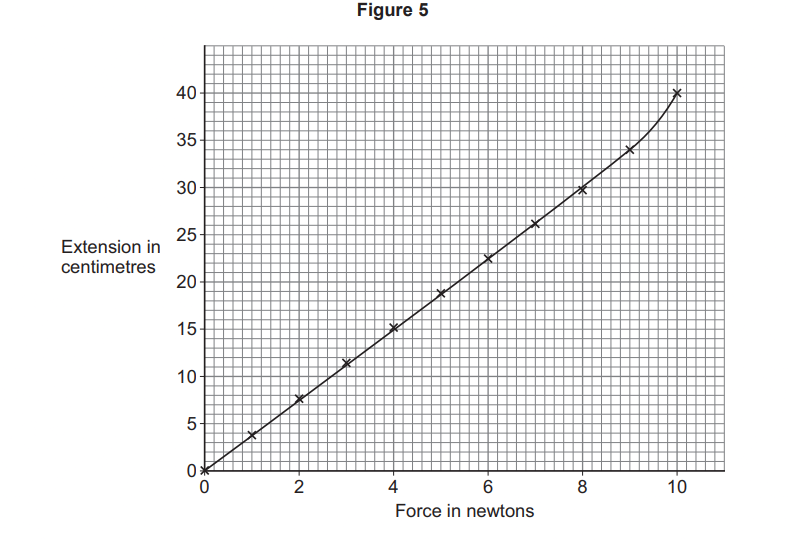
Graph of extension in centimetres against force in newtons, showing a straight-line increase up to about 8 N, then curving upwards to 10 N and 40 cm

What is a correct conclusion about the relationship between force and extension from 0 to 9 N?

  • Force and extension are inversely proportional.

  • Force and extension have a linear relationship.

  • Force and extension show a negative correlation.

1d
2 marks

The spring in Figure 5 was stretched inelastically.

What was the extension when the spring was at the limit of proportionality?

Tick one box.

9 cm

34 cm

40 cm

Give a reason for your answer.

1e
2 marks

Figure 6 shows what happened to the extension of the spring as the force was decreased.
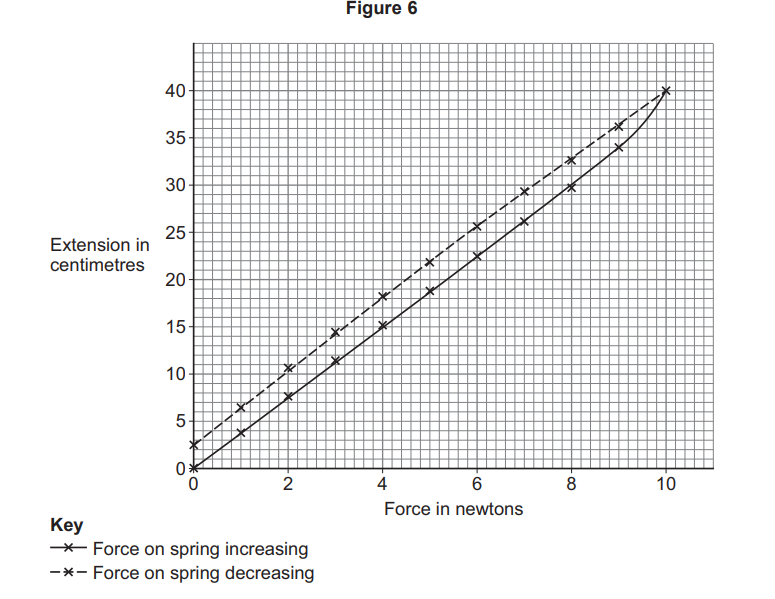
Graph of spring extension against force from 0–10 N, showing hysteresis loop with separate increasing and decreasing force lines up to 40 cm extension

Describe what happened to the spring as the force was decreased from 10 N to 0 N.

2
Sme Calculator
2 marks

The 0.025 kg mass dropped through a height of 0.60 m.

Calculate the change in gravitational potential energy of this mass.

gravitational field strength = 9.8 N/kg

Use the equation:

gravitational potential energy=mass×gravitational field strength×height

3a
1 mark

The braking distance of a vehicle depends on the mass of the vehicle.

Use the Physics Equations Sheet to answer questions 1.2 and 1.3.

Write down the equation which links gravitational field strength (g), mass (m) and weight (W).

3b
Sme Calculator
3 marks

Calculate the mass of a vehicle with a weight of 14 700 N.

gravitational field strength = 9.8 N/kg

4a
Sme Calculator
4 marks

A student investigated how the acceleration of a glider varied with the mass of the glider.

The force causing the acceleration was constant.

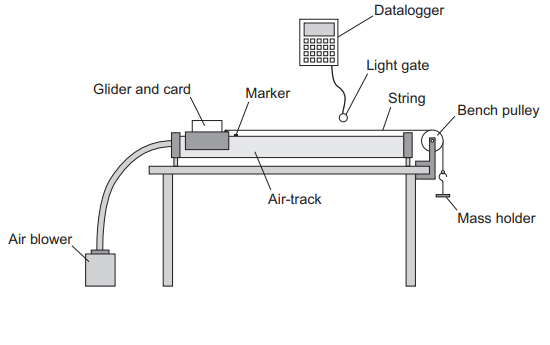
Figure 13 shows the equipment used.

The air blower allows the glider to move along the air-track with very little friction.

Figure 13

Diagram showing equipment: air-track with air blower, glider and card, light gate, bench pulley, string, mass holder, datalogger, and a marker

This is the method used.

  1. Line up the front of the glider with the marker.

  2. Release the glider.

  3. Record the velocity as the glider passes through the light gate.

  4. Calculate the acceleration of the glider.

  5. Repeat steps 1 to 4 using gliders of different mass.

The mass on the mass holder was 25 g.

The change in gravitational potential energy of the mass was 0.147 J.

gravitational field strength = 9.8 N/kg

Calculate the change in height of the mass.

Use the Physics Equations Sheet.

4b
3 marks

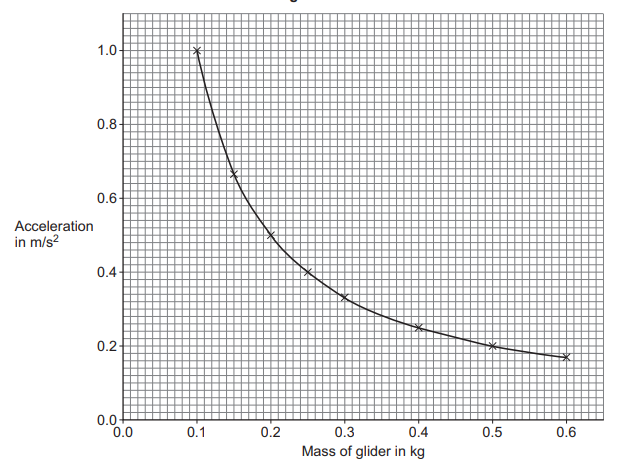
Figure 14 shows the results.

Graph showing acceleration in m/s^2^ (y-axis, 0–1.0) against mass of glider in kg (x-axis, 0–0.6). The graph shows a curve that decreases as mass increases, consistent with inverse proportionality

The student concluded:

'The acceleration of the glider is inversely proportional to the mass of the glider.'

Explain why the student was correct.

Use data from Figure 14 in your answer.

4c
1 mark

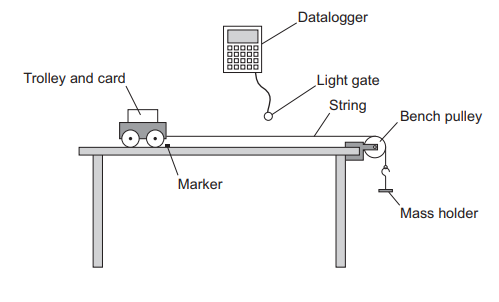
A different student did the investigation using a trolley instead of an air blower and glider.

Figure 15 shows the equipment.

Figure 15

Diagram showing equipment: bench with trolley and card, light gate, bench pulley, string, mass holder, datalogger, and a marker

Give one way that the student could make the trolley roll more easily along the bench.

5a
1 mark

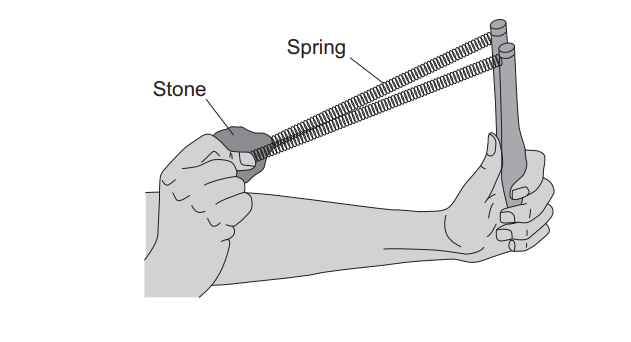
Figure 16 shows a student using a catapult to launch a small stone.

The catapult contains a spring.

Figure 16

Diagram of hands using a slingshot: right hand holds forked handle, left pulls back stretched spring with a stone ready to be launched.

What is the relationship between the extension of a spring and the force applied to the spring?

5b
Sme Calculator
3 marks

The extension of the spring is 20 cm.

The elastic potential energy stored by the spring is 1.16 J.

Calculate the spring constant of the spring.

Use the Physics Equations Sheet.

5c
3 marks

The student used the catapult to launch stone A and then stone B.

The spring had the same extension for each stone.

Stone B has a mass 4 times greater than stone A.

Explain the difference in the speed of stone A and the speed of stone B as they are launched from the catapult.

Your answer should include a calculation.

Use the Physics Equations Sheet.

5d
2 marks

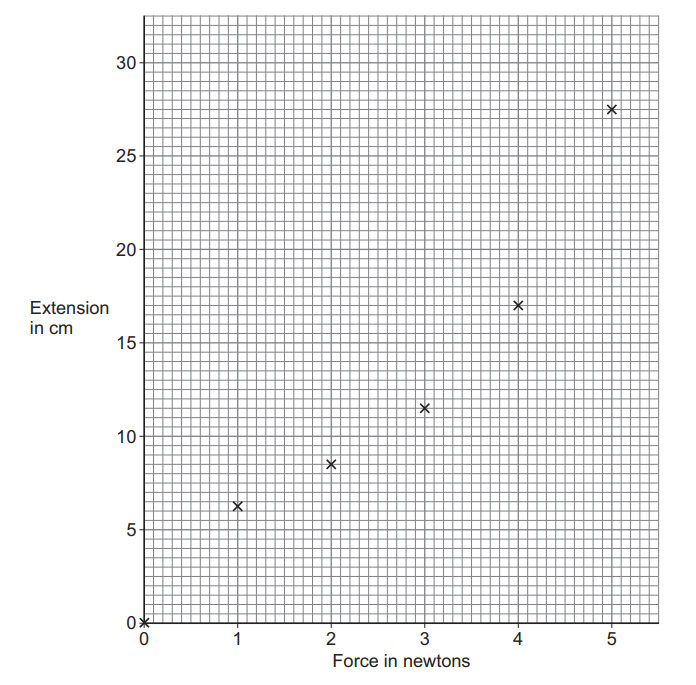
Some catapults use a rubber band instead of a spring.

A student investigated how the extension of a rubber band varied with the force on the rubber band.

Figure 17 shows the results.

Figure 17

Scatter graph of force versus extension, showing points from (0 N, 0 cm) up to (5 N, 27 cm) in a roughly straight, increasing linear pattern.

Explain why additional readings would allow the student to make a conclusion more easily.

Do not refer to repeat readings or calculating a mean.

6
Sme Calculator
3 marks

To make a fair comparison between the braking distance of the two cars, the mass of each car was the same.

Calculate the weight of a car.

mass = 850 kg

gravitational field strength = 9.8 N/kg

Use the equation:

weight=mass×gravitational field strength

Choose the unit from the box.

kilograms

metres

newtons

Weight = ______________ Unit _____________

7a
1 mark

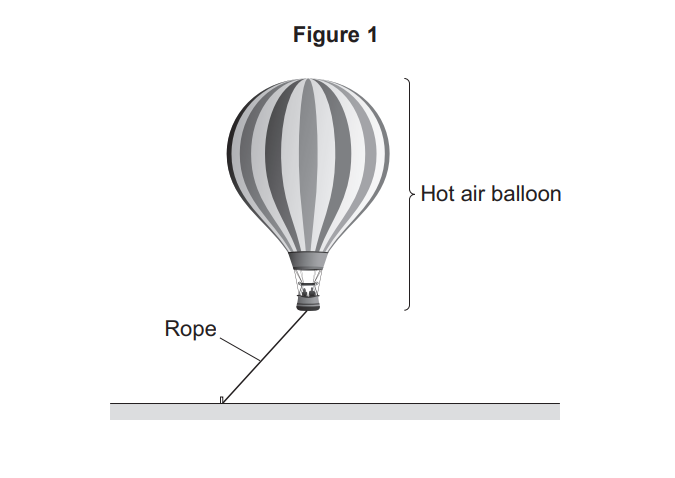
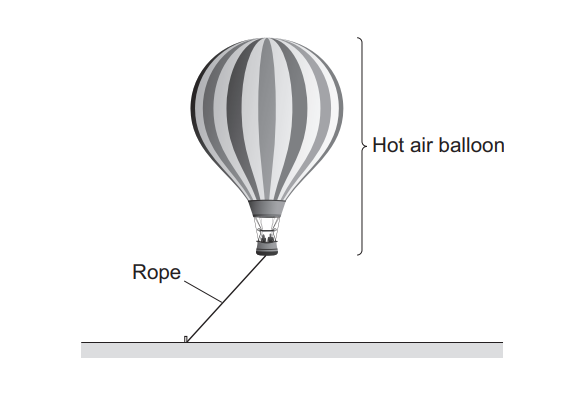
Figure 1 shows a floating hot air balloon attached to the ground by a rope. The hot air balloon is stationary.

Diagram labelled Figure 1 showing a striped hot air balloon above ground, tethered to the ground by a slanting rope.

The wind is exerting a force on the hot air balloon in Figure 1.

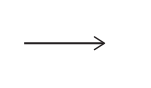
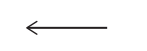
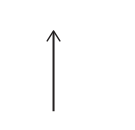
Which arrow shows the direction of the force of the wind in Figure 1?

Tick (✓) one box.

  • Simple black right-pointing arrow on a white background, indicating direction or movement to the right
  • Simple black left-pointing arrow icon on a white background, indicating backwards navigation or return to the previous page
  • Simple black vertical arrow on a white background, pointing upwards towards the top edge of the image
7b
1 mark

Which force causes the hot air balloon to float?

Tick (✓) one box.

  • Air resistance

  • Gravity

  • Upthrust

7c
1 mark

The hot air balloon in Figure 1 is stationary.

What is the resultant force on the balloon?

Tick (✓) one box.

  • The resultant force is the tension in the rope.

  • The resultant force is the weight.

  • The resultant force is zero.

7d
Sme Calculator
2 marks

The mass of the hot air balloon is 350 kg.

Calculate the weight of the hot air balloon.

gravitational field strength = 9.8 N/kg

Use the equation:

weight = mass × gravitational field strength

7e
Sme Calculator
3 marks

The hot air balloon exerts a force of 200 N on the rope.

The force causes the rope to stretch by 1.60 m.

The rope behaves like a spring.

Calculate the spring constant of the rope.

Use the equation:

spring constant=forceextension

Choose the unit from the box.

m

N

m/N

N/m

8a
1 mark

This question is about forces.

Force is a vector quantity.

Which is a correct statement about a vector quantity?

Tick (✓) one box.

  • Has direction only

  • Has direction and magnitude

  • Has magnitude only

  • Has neither magnitude nor direction

8b
1 mark

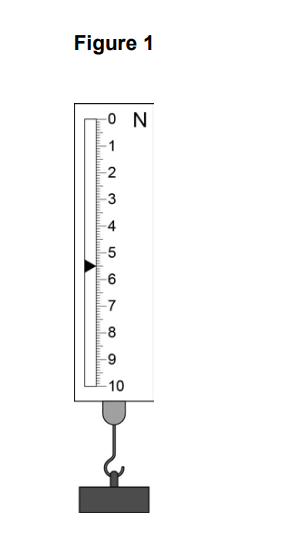
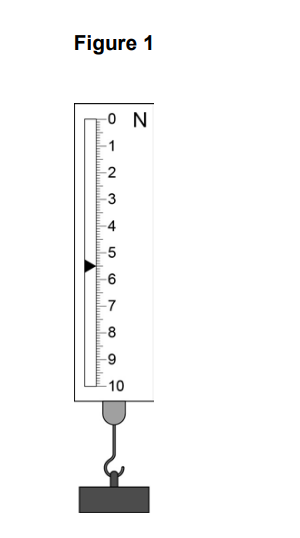
A newtonmeter measures the weight of an object.

Diagram of a newton metre with a block hanging from a hook; the pointer on the vertical scale reads 5 newtons.

What is the weight of the object in Figure 1?

Weight = N

8c
Sme Calculator
1 mark

An object has a weight of 6.4 N.

Calculate the mass of the object.

Use the equation:

mass=weightgravitational field strength (g)

gravitational field strength = 9.8 N/kg

Mass = ______________ kg

8d
1 mark

The mass of a bag of sugar is 1 kg.

  • On Earth the weight of this bag of sugar is 10 N.

  • On Mars the weight of this bag of sugar is 4 N.

Suggest why the weight of the bag of sugar is different on Earth and on Mars.

9a
Sme Calculator
5 marks

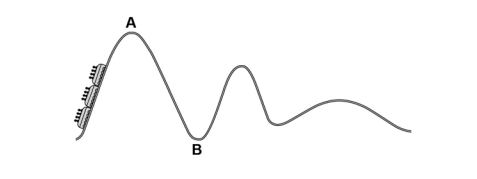
Figure 7 shows a rollercoaster.

Figure 7

shows a rollercoaster (a rollercoaster track with point A at the top of a hill 35 m above point B at the bottom; the rollercoaster car starts at the bottom of the track and is raised by a motor up to point A, then rolls down to point B)

The rollercoaster car is raised a vertical distance of 35 m to point A by a motor in 45 seconds.

The mass of the rollercoaster is 600 kg.

The motor has a power rating of 8 000 W.

Calculate the percentage efficiency of the motor.

Gravitational field strength = 9.8 N/kg.

Efficiency = ___________ %

9b
Sme Calculator
6 marks

The rollercoaster rolls from point A to point B, a drop of 35 m.

Calculate the speed of the rollercoaster at point B.

Assume that the decrease in potential energy store is equal to the increase in kinetic energy store.

Speed at point B = ____________m/s

10a
1 mark

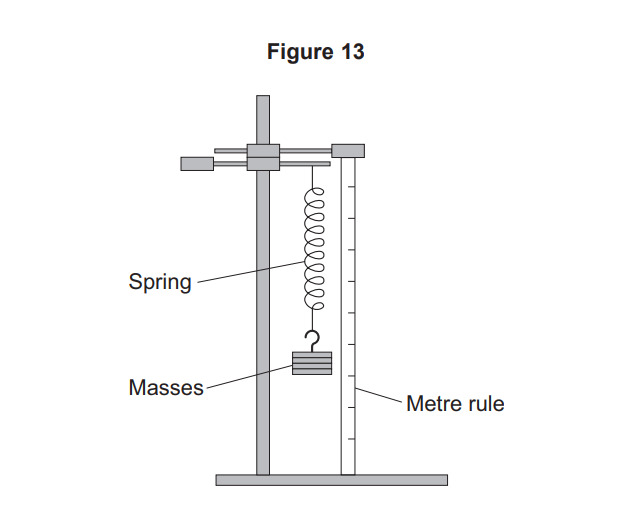
A student investigated how the extension of a spring varied with the force applied to the spring.

FIGURE 13 shows the equipment used.

Diagram of a vertical stand holding a hanging spring with masses attached, alongside a labelled metre rule used to measure the extension of the spring.

This is the method used.

  1. Measure the length of the unstretched spring.

  2. Hang the spring from the clamp stand.

  3. Hang a mass from the spring.

  4. Calculate the weight of the mass.

  5. Measure the new length of the spring.

  6. Calculate the extension of the spring.

  7. Repeat steps 3 to 6 for additional masses.

A spring can be elastically or inelastically deformed.

What does 'elastically deformed' mean?

10b
1 mark

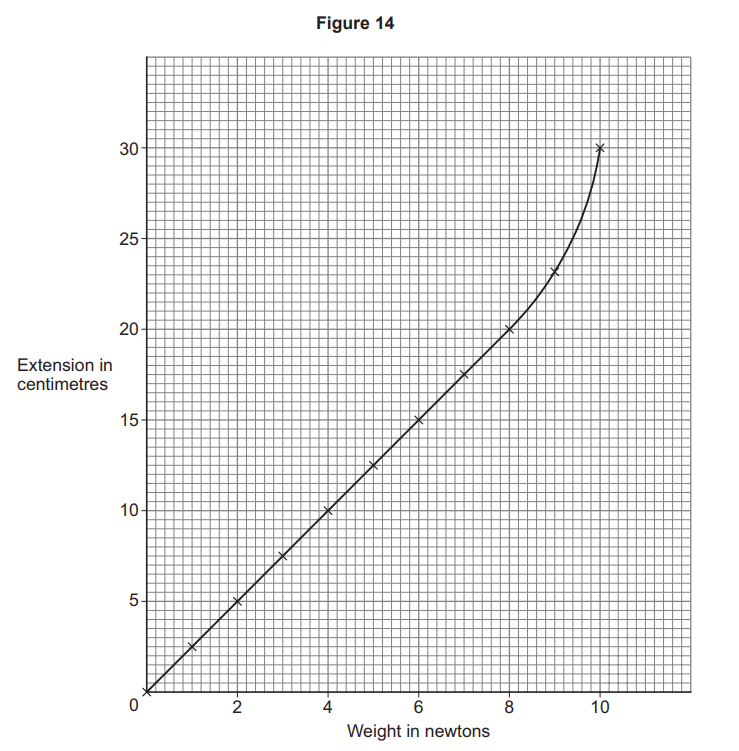
FIGURE 14 shows the results.

Graph of extension (cm) against weight (N) showing a straight-line increase up to about 8 N, then a curve upwards, indicating non-linear extension.

The student concluded:

'The extension of the spring is directly proportional to the weight up to a point called the limit of proportionality.'

What was the extension of the spring when the spring reached its limit of proportionality?

Extension =___________ cm

10c
Sme Calculator
4 marks

Determine the spring constant of the spring used by the student.

Use the Physics Equations Sheet.

10d
2 marks

The mass on the spring is stationary after the spring has extended.

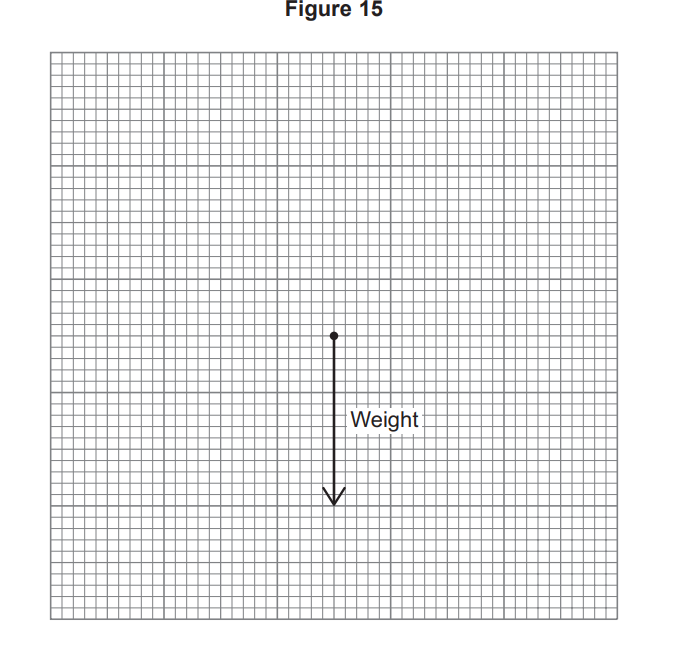
The force that the mass exerts on the spring is represented by the vector diagram in FIGURE 15.

Figure 15: grid with a single vertical arrow starting at a point and pointing downwards, labelled “Weight” to indicate the direction of gravitational force

Draw an arrow on FIGURE 15 to show the magnitude and direction of the tension in the spring.

11
2 marks

Suggest two factors that affect the maximum speed of the person as the sphere reaches the bottom of the hill.

12
1 mark

The forces acting on the skydiver during the fall were weight and air resistance.

What happened to the weight of the skydiver during the fall?

Tick (✓) one box.

  • Weight decreased

  • Weight stayed the same

  • Weight increased

13a
1 mark

Figure 11 shows a floating hot air balloon attached to the ground by a rope.

Figure 11

Diagram of a striped hot air balloon floating above the ground, tethered by a rope to a fixed point, with labels for the balloon and the rope.

The hot air balloon is stationary.

The wind is exerting a force on the hot air balloon in Figure 11.

Which direction is the force of the wind acting?

13b
1 mark

What is the name of the upwards force on the hot air balloon?

13c
Sme Calculator
4 marks

The weight of the hot air balloon is 3.43 kN.

gravitational field strength = 9.8 N/kg

Calculate the mass of the hot air balloon.

Use the Physics Equations Sheet.

13d
1 mark

The resultant force on the balloon is zero.

What is meant by 'resultant force'?

13e
3 marks

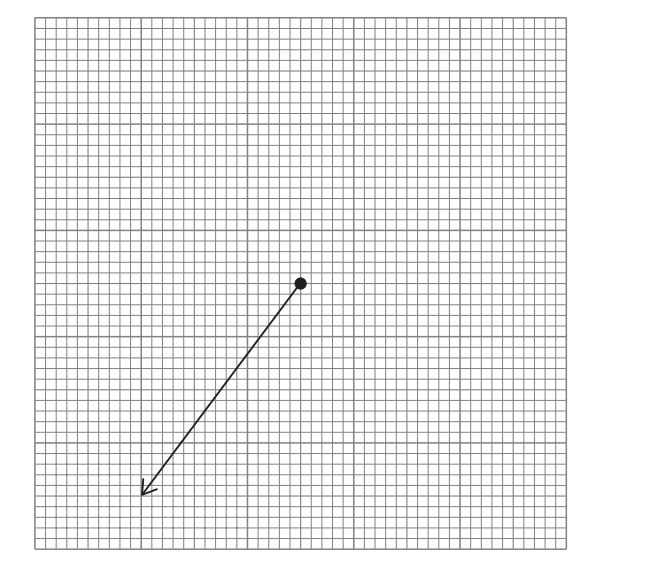
Figure 12 shows a vector diagram of the force of the rope on the hot air balloon.

Square grid with a single black point in the centre‑left, from which an arrowed line extends diagonally downwards to the left towards the bottom corner

Complete the vector diagram to determine the magnitude of the horizontal and vertical components of the force.

Horizontal component = _ N

Vertical component = _ N

14
Sme Calculator
3 marks

A small ball weighs 1.4 N.

gravitational field strength, g = 9.8 N/kg

Calculate the mass of the ball.

Mass = ____________ kg

15a
3 marks

Forces can be classed as contact or non-contact forces.

Look at Table 4.

Tick (✓) one box for each type of force to say whether it is a contact force or a non-contact force.

Table 4

Type of force

Contact force

Non-contact force

Electrostatic

Friction

Gravity

15b
2 marks

Force is a vector quantity.

What are two other vector quantities?

Tick (✓) two boxes.

  • Mass

  • Time

  • Velocity

  • Speed

  • Displacement

15c
1 mark

A student does a practical to investigate the relationship between force and extension for a spring.

Diagram of a newton metre with a hanging block, the pointer aligned between 4 and 5 newtons on the vertical scale.

What could the student do to improve the accuracy of his investigation?

Tick (✓) one box.

  • Use a longer ruler to measure the length

  • Use a pointer from the spring to measure the length

  • Use a new spring between each reading

  • Use a stronger spring in the investigation

15d
Sme Calculator
3 marks

The weight on the spring is the force applied to the spring.

The student puts a mass of 25 g on the spring.

Gravitational field strength = 9.8 N/kg

Calculate the weight on the spring.

Use the equation:

weight=mass×gravitational field strength

Weight on spring = N

15e
1 mark

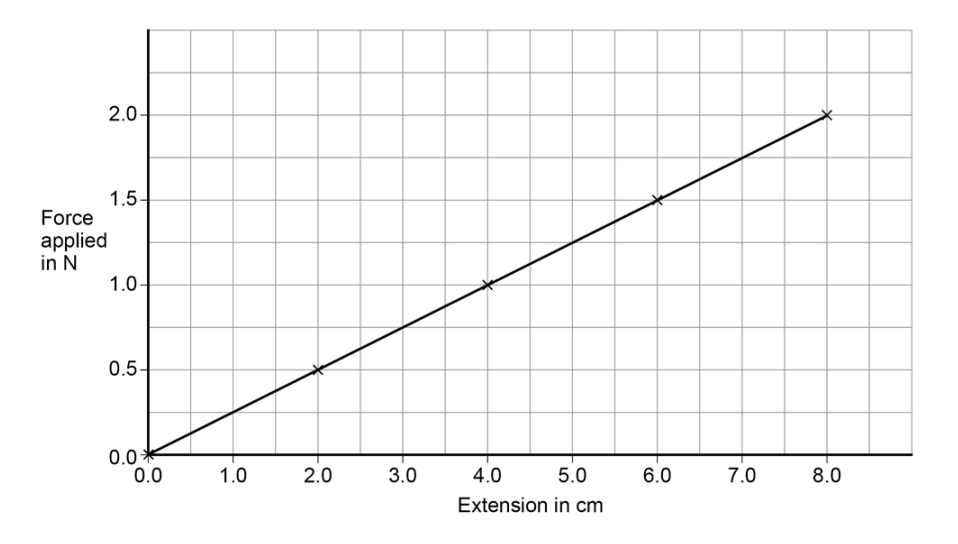
The student plotted a graph of force applied and extension of the spring.

Figure 6 shows his graph.

Figure 6

Line graph of force versus extension for a spring, showing a straight line from (0 cm, 0 N) to (8 cm, 2 N), indicating a directly proportional relationship

What is the relationship between force applied and extension?

Tick (✓) one box.

  • Extension is directly proportional to force

  • Extension increases by smaller values as force increases

  • Extension is inversely proportional to force

15f
1 mark

Use Figure 6 to determine the force needed to give an extension of 4.5 cm.

Force needed = N

15g
Sme Calculator
2 marks

A different spring has a spring constant of 13.5 N/m.

Calculate the elastic potential energy stored in the spring when its extension is 12 cm.

Use the correct equation from the Physics equation sheet.

Elastic potential energy = J