Forces As Vectors (AQA GCSE Combined Science: Synergy: Physical Sciences): Revision Note
Exam code: 8465

Written by: Katie M
Updated on
Forces as Vectors
A scalar quantity is described by magnitude only
For example, speed or mass
A vector quantity is described by both magnitude and direction
For example, force or velocity
Forces are therefore vector quantities
The magnitude of a force is measured in newtons
The direction of a force can be described as left, right, up or down

A free body diagram of an object with two forces acting on it
Vector quantities are represented by an arrow
The length of the arrow represents the magnitude of the force
The direction of the arrow represents the direction of the force
The direction of a force can be imagined using a number line
Numbers to the left of zero are negative as are forces pointing left
Numbers to the right of zero are positive as are forces pointing right

Vectors represented as positive or negative vectors depending on their direction
Not all forces are directed perfectly horizontally or vertically and thus need to have an angle described
It is useful to describe an angle with respect to the vertical or the horizontal
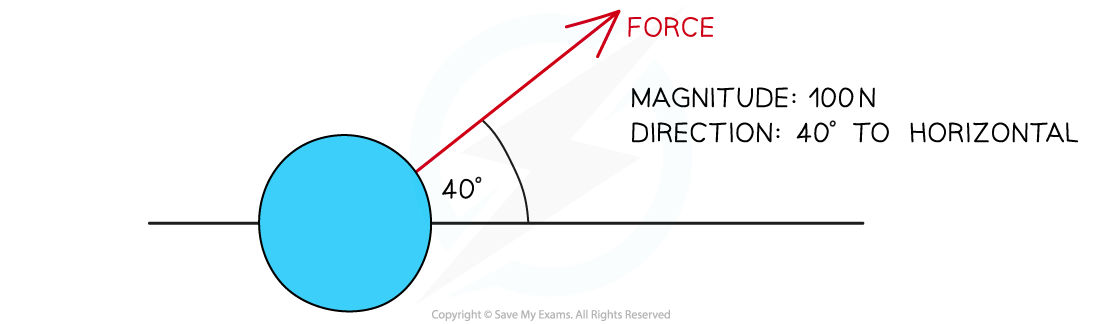
A force of magnitude 100 N directed 40° to the horizontal
Force Pairs
When there is an interaction between two objects, a force is exerted on each object by the other
This is known as a force pair
Examples of these force pairs include:
A laptop resting on a desk
The laptop exerts a downward force on the desk
The desk exerts an upward force on the laptop
A basketball player throwing a basketball
The basketball player exerts a push force on the ball
The ball exerts a push force on the basketball player
A person standing on the Earth
The Earth exerts a gravitational pull force on the person
The person exerts a gravitational pull force on the Earth
Force pairs can be represented by arrows in vector diagrams

The force pairs present with respect to a rock being pushed by a person
The person pushes on the rock, and the rock pushes on the person
The rock pushes on the ground, and the ground pushes on the rock
The person pushes on the ground, and the ground pushes on the person
Contact & Non-Contact Forces
A force is defined as:
A push or a pull that acts on an object due to the interaction with another object
Forces can have an effect on bodies in several different ways, such as by:
changing their speed
changing their direction
changing their shape
Some examples of these changes are:
An engine can increase the speed of a vehicle due to a force called thrust
A comet’s direction can be affected by gravitational attraction
A spring can have its shape changed by the force from a heavy load

Diagram showing the effects of forces on different objects
Important forces to be familiar with:
Weight – the name given to the force of gravity on a mass
Electrostatic force – the force between two charged objects
Thrust – the force causing an object to move (such as the force from a rocket engine)
Air resistance (or drag) – the friction of the air on a moving object
Upthrust – the force of a fluid (such as water) pushing an object upwards (making it float)
Compression – forces that act inward on an object, squeezing it
Tension – force transmitted through a cable or a string when pulled on by forces acting on its opposite ends
Reaction force – a force due to contact between two objects

Diagram showing several different types of forces acting on objects
All forces can be categorised into one of two types:
Contact forces
Non-contact forces
What is a contact force?
A contact force is defined as:
A force which acts between objects that are physically touching
Contact force examples
Examples of contact forces include:
Friction
Air resistance
Tension
Reaction force
Friction:
is a force that opposes motion
occurs when objects rub against each other
Air resistance:
is a type of friction
occurs when an object moves through air
Tension:
is a force that pulls two objects connected by a length, such as a string or rope
occurs when a force is applied to the length
Reaction force:
is a force that pushes touching objects apart
occurs when objects are supported by a surface


Examples of contact forces
What is a non-contact force?
A non-contact force is defined as:
A force which acts at a distance, without any contact between bodies, due to the action of a field
Non-contact force examples
Examples of non-contact forces include:
Gravitational force
Electrostatic force
Magnetic force
Gravitational attraction:
The attractive force experienced by two objects with mass
For example, the force between a planet and a comet
Electrostatic force:
A force experienced by charged objects which can be attractive or repulsive
For example, the attraction between a proton and an electron
Magnetic force:
A force experienced between magnetic poles that can be attractive or repulsive
For example, the attraction between the North and South poles of magnets

Examples of non-contact forces
Worked Example
Ben drags a sledge behind him as he climbs up a hill.
Describe the contact and non-contact forces involved in this scenario.
Answer:
Step 1: Identify the contact forces
Ben pulls on a rope attached to the sledge producing tension in the rope
The ground supports Ben and the sledge with a reaction force
There is friction between the sledge and the ground which opposes the motion
There is also friction between Ben’s shoes and the ground allowing Ben to climb the hill without slipping down
A very small force due to air resistance slows Ben’s motion up the hill
Step 2: Identify the non-contact forces
The gravitational attraction between the Earth and Ben pulls Ben and the sledge downwards
Examiner Tips and Tricks
When describing and labelling forces, ask yourself these questions:
Which object is exerting the force?
Is the force a push or a pull?
Which object is experiencing the force?
The description of the forces acting on a book resting on a table would be:
the table exerts a push force on the book
the Earth exerts a pull force on the book
Once you have this level of understanding, then you can begin using the names of the forces.
The contact force of the table exerts a push force on the book
The gravitational pull of the Earth (weight) exerts a pull force on the book
Force is such an important concept in physics that it is crucial to achieve a high level of confidence in identifying and describing forces.
Getting the terminology correct in this topic is key! When talking about the force of gravity, make sure you refer to it as weight or gravitational attraction. Avoid calling it simply “gravity”, as this term can mean several different things and will likely lose you a mark!
Avoid using the terms wind resistance (there’s no such thing) or air pressure (something entirely different) when you are talking about air resistance (or drag).

Unlock more, it's free!
Join the 100,000+ Students that ❤️ Save My Exams
the (exam) results speak for themselves:

Was this revision note helpful?
Build on this topic