Momentum (HT only) (AQA GCSE Combined Science: Synergy: Physical Sciences): Revision Note
Exam code: 8465

Written by: Ashika
Updated on
Conservation of Momentum
The principle of conservation of momentum states that:
In a closed system, the total momentum before an event is equal to the total momentum after the event
A closed system means the energy within the system is constant and the absence of external forces (e.g. friction)
In other words:
The total momentum before a collision = The total momentum after a collision
A system is a certain number of objects under consideration
This can be just one object or multiple objects
Since momentum is a vector quantity, a system of objects moving in opposite directions (e.g. towards each other) at the same speed will have an overall momentum of 0 since they will cancel out
Momentum is always conserved over time
The diagram below shows two masses m with velocity u and M at rest (ie. zero velocity)
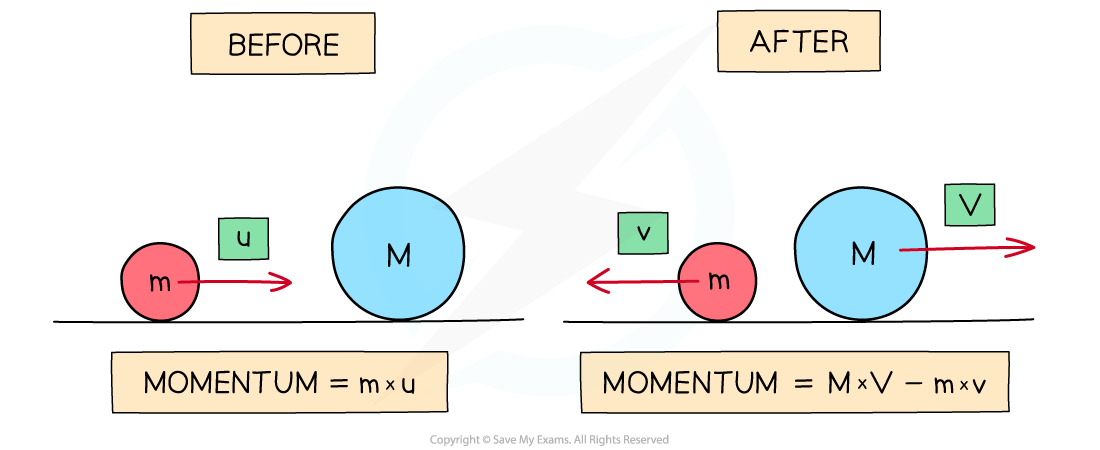
Before the collision:
The momentum is only of mass m which is moving
If the right is taken as the positive direction, the total momentum of the system is m × u
After the collision:
Mass M also now has momentum
The velocity of m is now -v (since it is now travelling to the left) and the velocity of M is V
The total momentum is now the momentum of M + momentum of m
This is (M × V) + (m × -v) or (M × V) – (m × v)
Worked Example
The diagram shows a car and a van, just before and just after the car collided with the van, which is initially at rest.
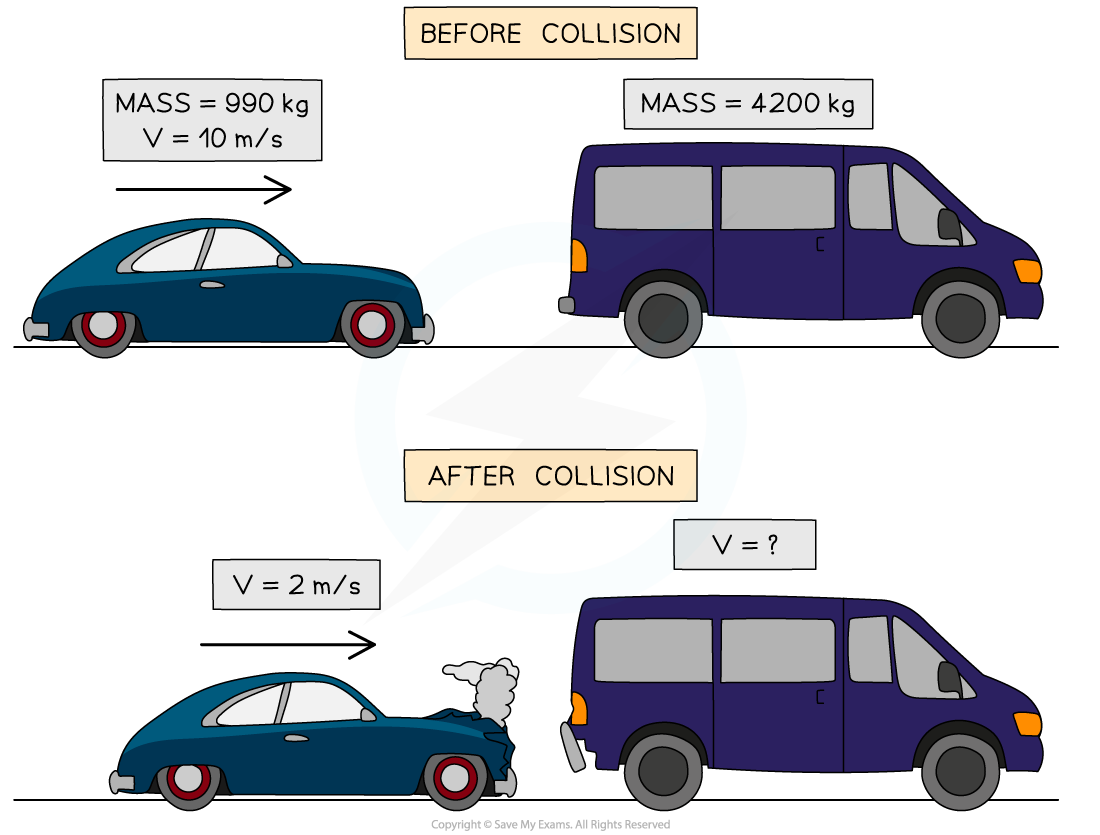
Use the idea of conservation of momentum to calculate the velocity of the van when it is pushed forward by the collision.
Answer:
Step 1: State the principle of conservation of momentum
In a closed system, the total momentum before an event is equal to the total momentum after the event
Step 2: Calculate total momentum before the collision
p = mv
Momentum of the car:
p = 990 × 10 = 9900 kg m/s
Momentum of the van:
The van is at rest, therefore v = 0 m/s and p = 0 kg m/s
Total momentum before:
pbefore = 9900 + 0 = 9900 kg m/s
Step 3: Calculate the momentum after the collision
Momentum of the car:
p = 990 × 2 = 1980 kg m/s
Momentum of the van:
p = 4200 x v
Total momentum after:
pafter = 1980 + 4200v kg m/s
Step 4: Rearrange the conservation of momentum equation for the velocity of the van
pbefore = pafter
9900 = 1980 + 4200v
9900 - 1980 = 4200v
V = = 1.9 m/s
Examiner Tips and Tricks
If it is not given in the question already, drawing a diagram of before and after helps keep track of all the masses and velocities (and directions) in the conservation of momentum questions.
Calculating Momentum
A moving object has momentum which is defined by the equation:
p = mv
Where:
p = momentum in kilogram metre per second (kg m/s)
m = mass in kilograms (kg)
v = velocity in metres per second (m/s)
This means that an object at rest (i.e v = 0) has no momentum
Momentum keeps an object moving in the same direction, making it difficult to change the direction of an object with a large momentum
Since velocity is a vector this means that the momentum of an object also depends on its direction of travel
This means that momentum can be either positive or negative
If an object travelling to the right has positive momentum, an object travelling in the opposite direction (to the left) will have negative momentum
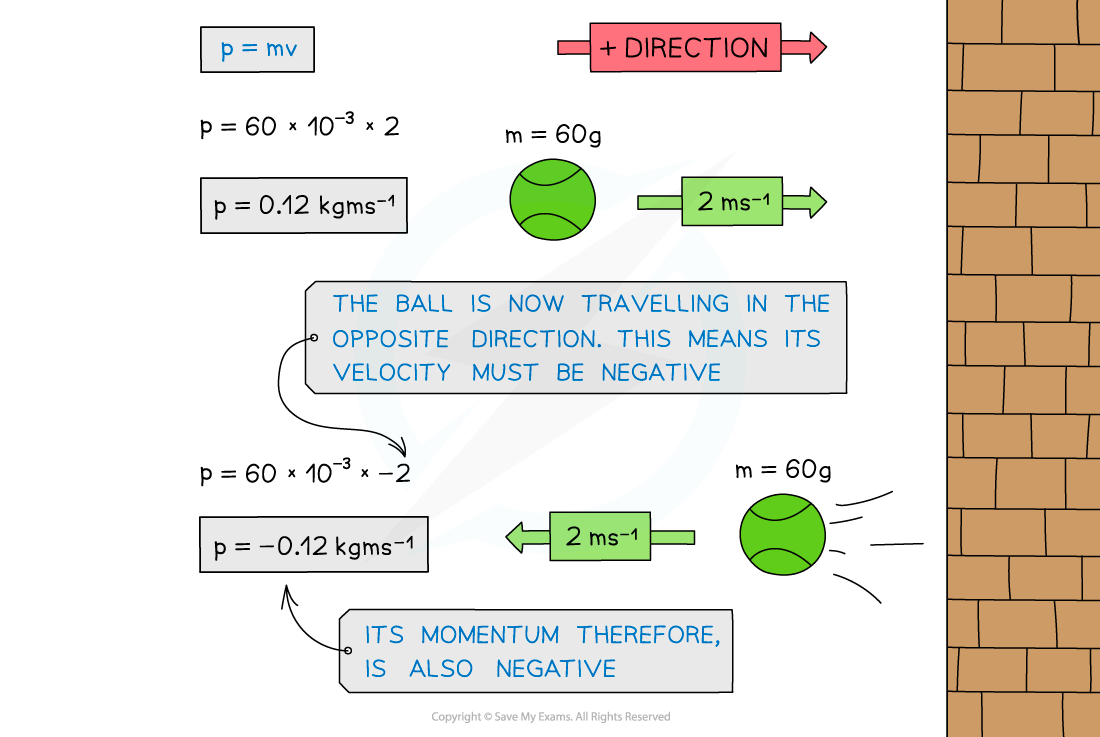
Therefore, the momentum of an object will change if:
The object accelerates (speeds up) or decelerates (slows down)
Changes direction
Its mass changes
Worked Example
Which object has the most momentum?
Answer:
Both the tennis ball and the brick have the same momentum
Even though the brick is much heavier than the ball, the ball is travelling much faster than the brick
This means that on impact, they would both exert a similar force (depending on the time it takes for each to come to rest)
Examiner Tips and Tricks
Remember the units of momentum as kg m/s which is the product of the units of mass (kg) and velocity (m/s).Which direction is taken as positive is completely up to you in the exam. In general, the right and upwards are taken as positive, and down or to the left as negative.

Unlock more, it's free!
Join the 100,000+ Students that ❤️ Save My Exams
the (exam) results speak for themselves:

Was this revision note helpful?
Build on this topic