Resistors In Series & Parallel (AQA GCSE Combined Science: Synergy: Physical Sciences): Revision Note
Exam code: 8465

Resistors in Series
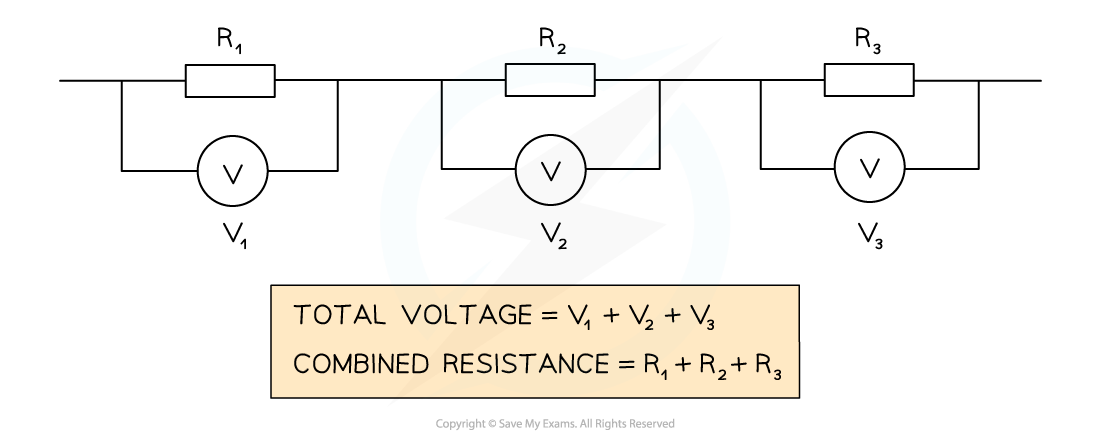
When two or more resistors are connected in series, the total resistance is equal to the sum of their individual resistances
For resistors of resistance R1, R2 and R3, the total resistance can be calculated using:
combined resistance in series, R = R1 + R2 + R3...
Where R is the total resistance, in ohms (Ω)
Increasing the number of resistors increases the overall resistance, as the charge now has more resistors to pass through
Worked Example
The combined resistance R in the following series circuit is 60 Ω. What is the resistance value of R2?

A. 100 Ω
B. 30 Ω
C. 20 Ω
D. 40 Ω
Answer: C
Step 1: Write down the equation for the combined resistance in series
R = R1 + R2 + R3
Step 2: Substitute the values for total resistance R and the other resistors
60 Ω = 30 Ω + R2 + 10 Ω
Step 3: Rearrange for R2
R2 = 60 Ω – 30 Ω – 10 Ω = 20 Ω
Resistors in Parallel
When two or more resistors are connected in parallel, the total resistance decreases
The total resistance of the resistors R1 and R2 is less than the resistance of the smallest individual resistor

This happens because each resistor creates an extra path along which the charge can flow
This allows a greater total current to flow for the same potential difference
This means the total resistance is smaller
The advantages of this kind of circuit are:
The components can be individually controlled, using their own switches
If one component stops working, the others will continue to function
Examiner Tips and Tricks
Students often struggle to understand how adding resistors to a circuit can actually reduce resistance.
Take a simple series circuit with just a cell, some wires, and a 5 Ω resistor. You now want to add a 10 Ω resistor to that circuit. You have two options; you can add the 10 Ω resistor in series to the 5 Ω resistor or in parallel to it.
If you add the 10 Ω resistor in series, then all of the electrons in the circuit have to flow through both resistors. That's why the resistances add together. The total resistance of the new circuit is 5 + 10 = 15 Ω.
If you add the 10 Ω resistor in parallel, then you are creating a new loop, which is a new path for the electrons to flow through. They either flow through the 5 Ω resistor or they flow through the 10 Ω resistor. Now, because of the extra loop, that extra path for the electrons, there is actually more charge flowing around the circuit than there was before that 10 Ω resistor was added. That means a higher current, which means an overall smaller resistance than the original 5 Ω circuit.
Make sure you don't say that the resistance is 'shared'. Instead, explain that there are multiple paths for the charge to flow, so the total current is greater for the same potential difference. That is the idea examiners want to see.
Remember that when you add a resistor in parallel, the potential difference across each branch stays the same as the potential difference of the supply. The extra path lets more current flow, so the total resistance is lower.

Unlock more, it's free!
Join the 100,000+ Students that ❤️ Save My Exams
the (exam) results speak for themselves:

Was this revision note helpful?
Build on this topic
