Newton’s Second Law (AQA GCSE Combined Science: Synergy: Physical Sciences): Revision Note
Exam code: 8465

Written by: Ashika
Updated on
Newton's Second Law
Newton's second law of motion states:
The acceleration of an object is proportional to the resultant force acting on it and inversely proportional to the object's mass
Newton's second law explains the following important principles:
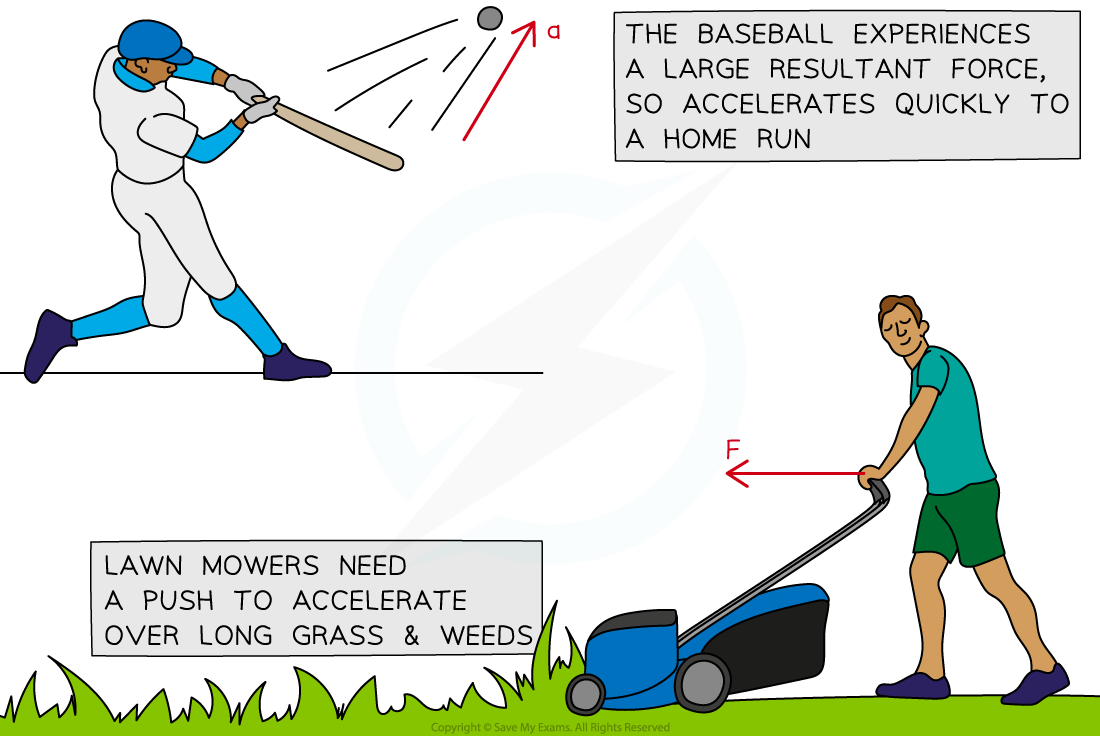
An object will accelerate (change its velocity) in response to a resultant force
The bigger this resultant force, the larger the acceleration
For a given force, the greater the object's mass, the smaller the acceleration experienced
The image below shows some examples of Newton's second law in action:
Calculating Force & Acceleration
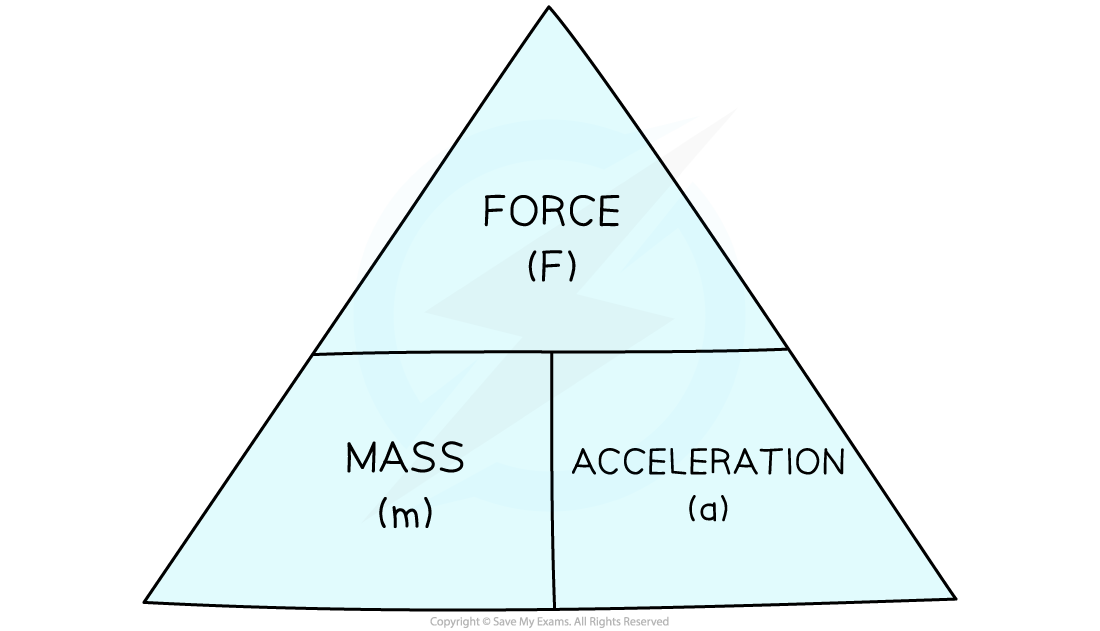
Newton's second law can be expressed as an equation:
F = ma
Where:
F = resultant force on the object in Newtons (N)
m = mass of the object in kilograms (kg)
a = acceleration of the object in metres per second squared (m/s2)
This equation can be rearranged with the help of a formula triangle:
Worked Example
A car salesman says that his best car has a mass of 900 kg and can accelerate from 0 to 27 m/s in 3 seconds.
Calculate:
a) The acceleration of the car in the first 3 seconds.
b) The force required to produce this acceleration.
Answer:
Part (a)
Step 1: List the known quantities
Initial velocity = 0 m/s
Final velocity = 27 m/s
Time, t = 3 s
Step 2: Calculate the change in velocity
change in velocity = Δv = final velocity − initial velocity
Δv = 27 − 0 = 27 m/s
Step 3: State the equation for acceleration
a =
Step 4: Calculate the acceleration
a = 27 ÷ 3 = 9 m/s2
Part (b)
Step 1: List the known quantities
Mass of the car, m = 900 kg
Acceleration, a = 9 m/s2
Step 2: Identify which law of motion to apply
The question involves quantities of force, mass and acceleration, so Newton's second law is required:
F = ma
Step 3: Calculate the force required to accelerate the car
F = 900 × 9 = 8100 N
Worked Example
Three shopping trolleys, A, B and C, are being pushed using the same force. This force causes each trolley to accelerate.
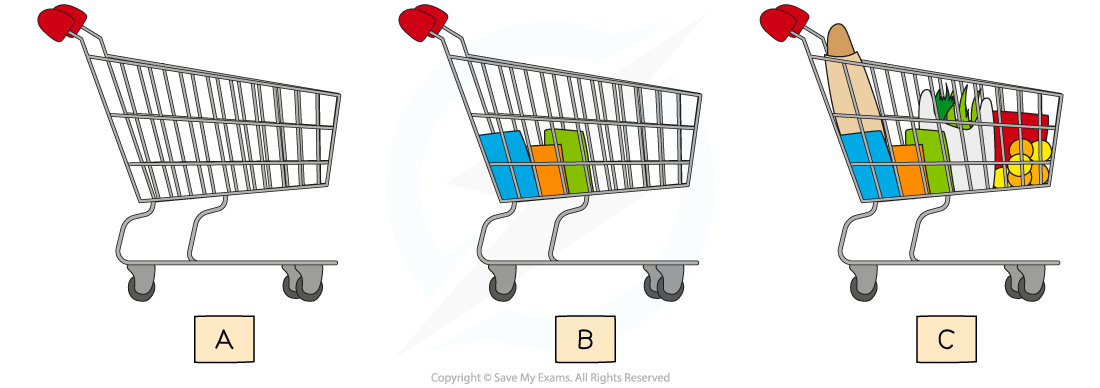
Which trolley will have the smallest acceleration? Explain your answer.
Answer:
Step 1: Identify which law of motion to apply
The question involves quantities of force and acceleration, and the image shows trolleys of different masses, so Newton's second law is required:
F = ma
Step 2: Re-arrange the equation to make acceleration the subject
a =
Step 3: Explain the inverse proportionality between acceleration and mass
Acceleration is inversely proportional to mass
This means for the same amount of force, a large mass will experience a small acceleration
Therefore, trolley C will have the smallest acceleration because it has the largest mass
Estimating Speed, Acceleration & Force
Newton's second law can be used to estimate the sizes of forces and accelerations in realistic scenarios
When estimating quantities, an approximate answer can be shown using the symbol ~
For example, an adult person has a mass of ~70 kg
Worked Example
A passenger travels in a car at a moderate speed. The vehicle is involved in a collision, which brings the car (and the passenger) to a halt in 0.1 seconds.
Estimate:
a) The acceleration of the car (and the passenger).
b) The force on the passenger.
Answer:
Part (a)
Step 1: Estimate the required quantities and list the known quantities
A moderate speed for a car is about 50 mph or 20 m/s
Initial velocity ~ 20 m/s
Final velocity = 0 m/s
Time, t = 0.1 s
Step 2: Calculate the change in velocity of the car (and the passenger)
change in velocity = Δv = final velocity − initial velocity
Δv = 0 − 20
Δv = −20 m/s
Step 3: Calculate the acceleration of the car (and the passenger) using the equation:
a =
Step 4: Calculate the deceleration
a = −20 ÷ 0.1
a = ~ −200 m/s2
Part (b)
Step 1: Estimate the required quantities and list the known quantities
An adult person has a mass of about 70 kg
Mass of the passenger, m ~ 70 kg
Acceleration, a = −200 m/s2
Step 2: State Newton's second law
This question involves quantities of force, mass and acceleration, so the equation for Newton's second law is:
F = ma
Step 3: Calculate an estimate for the decelerating force
F = 70 × −200
F ~ −14 000 N
Examiner Tips and Tricks
Remember that resultant force is a vector quantity.
Examiners may ask you to comment on why its value is negative - this happens when the resultant force acts in the opposite direction to the object's motion.
In the worked example above, the resultant force opposes the passenger's motion, slowing them down (decelerating them) to a halt, this is why it has a minus symbol.
Inertia
Higher Tier Only
The concept of inertia is closely related to motion, it is defined as:
The tendency of an object to continue in its state of rest, or in uniform motion unless acted upon by an external force
In other words, inertia is an object's resistance to a change in motion
If an object is at rest, it will tend to remain at rest
If an object is moving at a constant velocity (constant speed in a straight line), it will continue to do so
The image below illustrates the concept of inertia using a coin and a cup of water:

Inertial Mass
Inertial mass is the property of an object which describes how difficult it is to change its velocity
It is defined as the ratio between the force applied to it and the acceleration it experiences, and can be calculated by:
Where:
m = inertial mass in kilograms (kg)
F = force in newtons (N)
a = acceleration in metres per second squared (m/s2)
This equation shows that for a given force, inertial mass is inversely proportional to acceleration
This means that:
Larger inertial masses are harder to accelerate, so they speed up more slowly
Smaller inertial masses are easier to accelerate, so they speed up more quickly


This collection of objects have a variety of inertial masses. For the same applied force, their accelerations are inversely proportional to their mass
Worked Example
Three objects are used by a physics technician to demonstrate the concept of inertial mass. She applies the same force to each of the three objects and notes that:
Object A accelerates at 1.5 m/s2
Object B accelerates at 0.7 m/s2
Object C accelerates at 2.0 m/s2
Which object has the largest inertial mass?
Answer:
Step 1: State the definition of inertial mass
Inertial mass is defined as the ratio of force to acceleration:
inertial mass =
Step 2: Apply the definition to each of the objects in the question
Since the same force is applied to all three objects, the inertial mass of each object depends on how much it accelerates
An object that accelerates less must have a greater inertial mass.
This means the object with the smallest acceleration will have the largest inertial mass.
Object B has the smallest acceleration (0.7 m/s²), so it has the largest inertial mass.
Examiner Tips and Tricks
The definition of inertial mass as a ratio between force and acceleration should look similar to Newton's second law. That's because when you calculate the mass of an object using Newton's second law, you are in fact calculating its inertial mass.

Unlock more, it's free!
Join the 100,000+ Students that ❤️ Save My Exams
the (exam) results speak for themselves:

Was this revision note helpful?
Build on this topic