Speed & Velocity (AQA GCSE Combined Science: Synergy: Physical Sciences): Revision Note
Exam code: 8465

Written by: Katie M
Updated on
Scalars & Vector Quantities
All quantities can be one of two types:
A scalar
A vector
Scalars
Scalars are quantities that have only a magnitude
For example, mass is a scalar quantity since it is a quantity that has no direction to it
Vectors
Vectors have both a magnitude and a direction
Velocity is a vector quantity
It is the speed of an object in a given direction
When describing the velocity of a car it is necessary to mention both its speed and the direction in which it is travelling
For example, 60 km per hour in a Westerly direction
Distance is a scalar quantity
It is a value describing only how long an object is or how far it is between two points
Displacement on the other hand also describes the direction in which the distance is measured
This means it is a vector quantity
For example, 100 km in a Northern direction
Comparing Scalars & Vectors
The table below lists some common examples of scalar and vector quantities:
Scalar | Vector |
|---|---|
Distance | Displacement |
Speed | Velocity |
Mass | Weight |
Energy | |
Volume | |
Density | |
Temperature | |
Power | |
Force | |
Acceleration | |
Momentum |
Some vectors and scalars are similar to each other
For example, the scalar quantity distance corresponds to the vector quantity displacement
Corresponding vectors and their scalar counterparts are aligned in the table where applicable
Examiner Tips and Tricks
Make sure you are comfortable with the differences between similar scalars and vectors, the most commonly confused pairings tend to be:
Distance and displacement
Speed and velocity
Weight and mass
Students often find the difference between distance and displacement confusing. Distance measures the length of the path you take to get from point A to point B. This includes all the twists and turns you take. Displacement measures the length of a line between Point and A and Point B if you used a ruler to join points A and B on a map. You would also draw the arrowhead on that line to show that you travelled from point A to point B.
The reason this is important is because displacement is often less than the distance travelled, so this has consequences in calculations.
Representing Vectors
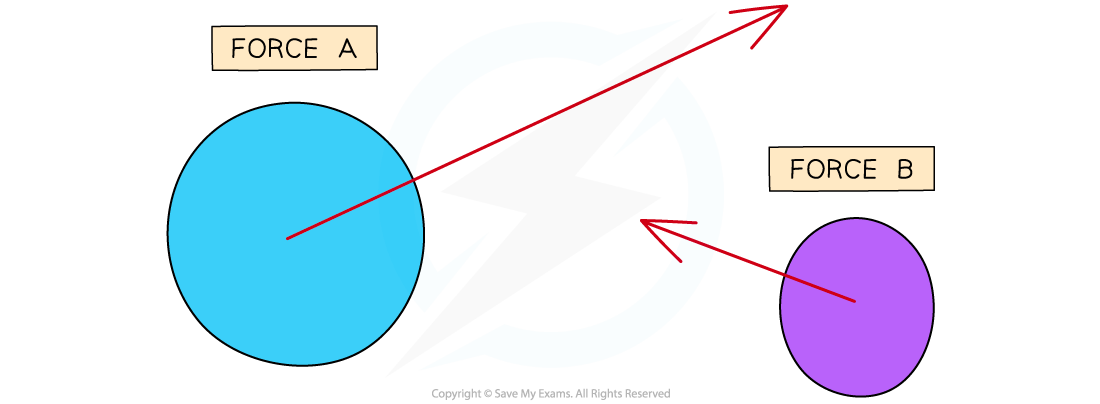
A vector can be represented by using an arrow
The length of the arrow represents the magnitude of the vector
The direction of the arrow indicates the direction of the vector
Worked Example
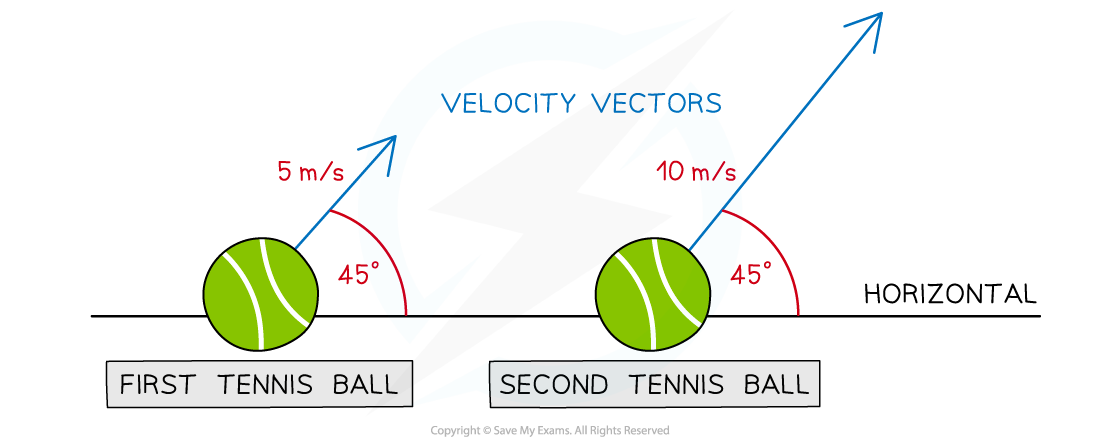
A tennis ball is thrown at an angle of 45° to horizontal at a speed of 5 m/s. A second tennis ball is thrown in the same direction at a speed of 10 m/s. Draw the velocity vectors of the balls.
Answer:
Step 1: Draw the first tennis ball and its velocity vector
Measure the 45° angle with a protractor

Step 2: Draw the second tennis ball and its velocity vector
The second ball has a speed of 10 m/s, so the arrow will be twice as long
Typical Speeds
The speed of an object is the distance it travels every second
Speed is a scalar quantity
This is because it only contains a magnitude (without a direction)
The average speed of an object is given by the equation:
average speed =
Distance is measured in metres, m
Time is measured in seconds, s
Speed is therefore measured in metres per second, m/s
Typical speeds
The speed of a moving object is rarely constant
For example, when people walk, run or travel in a car their speed is constantly changing
The speed that a person can walk, run or cycle depends on many factors including:
Age
Terrain
Fitness
Distance travelled
Typical mean speeds are:
Walking, 1.5 m/s
Running, 3 m/s
Cycling, 6 m/s
The speed of sound and the speed of wind also vary
A typical value for the speed of sound is 330 m/s
Examiner Tips and Tricks
Remember that average speed is the mean speed of the moving object.Its speed at a specific moment could be higher or lower - so because the speed changes you need to consider the total distance and time taken.
Non-Uniform Motion
The speed of an object is rarely constant
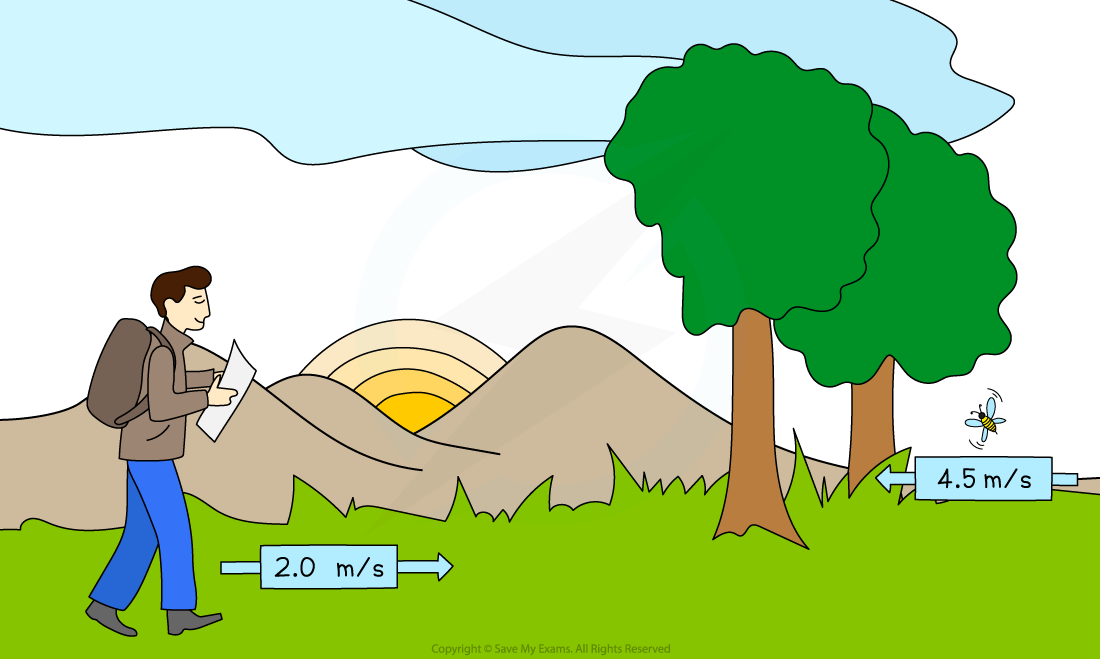
Hikers change their pace continuously as they walk
Bumblebees buzz around in all directions with varying speed
Cars are constantly speeding up and slowing down throughout a journey
Non-uniform motion refers to motion that is changing
Changing motion can mean the object is changing its speed, direction or both

Examiner Tips and Tricks
The term 'non-uniform motion' sounds much scarier than it actually is. Uniform means constant, or the same. So non-uniform just means not constant or changing. Non-uniform motion really just means changing motion. The speed of the object changes throughout its journey.

Unlock more, it's free!
Join the 100,000+ Students that ❤️ Save My Exams
the (exam) results speak for themselves:

Was this revision note helpful?
Build on this topic