Energy Conservation & Dissipation (AQA GCSE Combined Science: Synergy: Physical Sciences): Revision Note
Exam code: 8465

Written by: Leander Oates
Updated on
The principle of conservation of energy
The law of conservation of energy states that:
Energy cannot be created or destroyed, it can only be transferred from one store to another
This means the total amount of energy in a closed system remains constant
Energy can be:
Transferred from store to store usefully (to do work)
Stored in a different energy store (e.g. gravitational potential, elastic potential)
Dissipated to the thermal store of the surroundings
Examples of Energy Conservation
Conservation of energy applies to all energy transfers
Example 1: A bat hitting a ball
The moving bat has energy in its kinetic store
Some of that energy is transferred usefully to the kinetic store of the ball
Some of that energy is dissipated by heating to the thermal store of the bat, the ball, and the surroundings
The impact of the bat and the ball causes the particles of the bat and ball to vibrate
The sound wave causes the air particles to vibrate


Conservation of energy: a bat hitting a ball
Example 2: An electric heater
Energy is transferred electrically from the mains supply to the thermal store of the heating element
Some of that energy is usefully transferred to the thermal store of the surroundings by heating the air particles in the room
Some of that energy is dissipated to the thermal store of the surroundings by radiation (light)

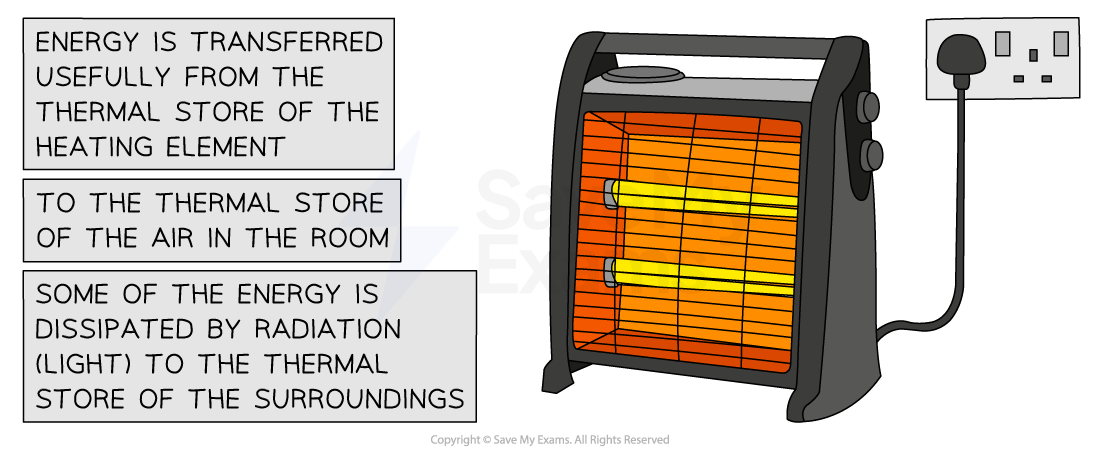
Conservation of energy: electric heater
Example 3: Rollercoasters
When the rollercoaster is on an elevated piece of track, it has energy in its gravitational potential store
When the rollercoaster descends to a lower piece of track, energy is transferred usefully to the kinetic store as the rollercoaster gains speed
When the rollercoaster ascends again, energy is transferred from the kinetic store to the gravitational store as the rollercoaster loses speed
Energy is dissipated to the thermal store of the surroundings by heating due to
friction heating the wheels and track
sound waves vibrating the air particles

As the rollercoaster in the diagram travels from A to D, the useful energy transfers that take place are:
gravitational potential store → kinetic store → gravitational potential store → kinetic store
This is sometimes also described as
GPE → KE → GPE → KE
Example 4: Trampoline
Whilst jumping, the person has energy in their kinetic store
When the person lands on the trampoline, most of that energy is transferred to the elastic potential store of the trampoline
That energy is transferred usefully back to the person's kinetic store as they bounce upwards
Energy is transferred from the person's kinetic store to their gravitational potential store as they gain height
Some of the energy is dissipated by heating to the thermal store of the surroundings (the person, the trampoline and the air)
The useful energy transfers taking place are:
elastic potential store → kinetic store → gravitational potential store

Useful energy transfers: person on a trampoline
Worked Example
Describe the energy transfers in the following scenarios:
a) A falling object
b) A battery powering a torch
c) A mass on a spring
Answer:
Part (a)
For a falling object:
Energy is transferred mechanically from the gravitational potential store of the object to the kinetic store of the object
Part (b)
For a battery powering a torch:
Energy is transferred electrically from the chemical store of the cell to the thermal store of the bulb
Part (c)
For a mass on a spring:
Energy is transferred mechanically from the elastic potential store of the spring to the kinetic store of the mass
Wasted Energy
In practice, most systems tend to be open systems
When energy transfers occur that are not useful, these are described as energy being dissipated to the surroundings
Dissipated just means spread out
Dissipated energy is stored in less useful ways, typically in the thermal store of the surroundings
This is considered to be wasted energy
These less useful energy transfers often involve heating, light and sound
When energy is transferred to the thermal stores of the objects, the temperature of the objects increases
The particles that make up the objects vibrate more, hence the transfer pathway is by heating (of the particles)
Visible light is electromagnetic radiation
Therefore, when light is produced, energy is transferred by radiation
When sound is produced, the sound waves make the air particles vibrate as the wave carries energy away
This increases the energy in the thermal store of the air, hence the transfer pathway is by heating (of the particles)
Useful energy can be defined as:
The energy that is transferred from store to store and used for an intended purpose
Wasted energy can be defined as:
The energy that is not useful for the intended purpose and is dissipated to the surroundings
Worked Example
A student uses an electric motor to lift a load.

The motor turns a mechanism that lifts the load. Some of the energy transfers are useful and the rest of the energy is wasted.
a) State the useful energy transfer occurring in this system.
b) State the wasted energy transfer occurring in this system.
Answer:
Part (a)
The motor turns the mechanism that lifts the load
Therefore, the useful transfer is:
Energy in the kinetic store of the motor is transferred to the gravitational potential store of the load
Part (b)
As the motor operates, friction causes a rise in the temperature of the components and the surroundings
In this case, the energy transfer from the kinetic store of the motor to the thermal store of the motor and the surroundings is not useful, hence it is a wasted energy transfer
Energy is dissipated, by heating, to the surroundings
Examiner Tips and Tricks
Make sure you are able to identify "useful" and "wasted" energy as this is commonly tested in exams! When describing wasted energy, make sure to say the energy is dissipated to the surroundings, if you say the energy is simply "lost", this will not gain you the mark as it implies energy is not conserved.

Unlock more, it's free!
Join the 100,000+ Students that ❤️ Save My Exams
the (exam) results speak for themselves:

Was this revision note helpful?
Build on this topic