Conservation & Dissipation of Energy (AQA GCSE Physics): Revision Note
Exam code: 8463

Conservation of Energy
The law of conservation of energy states that:
Energy cannot be created or destroyed, it can only be transferred from one store to another
This means the total amount of energy in a closed system remains constant
Energy can be transferred from store to store usefully (for the purpose the device is designed for)
Or energy can be dissipated to the thermal store of the surroundings
Examples of Energy Conservation
Conservation of energy applies to all energy transfers
A bat hitting a ball
The moving bat has energy in its kinetic store
Some of that energy is transferred usefully to the kinetic store of the ball
Some of that energy is dissipated by heating to the thermal store of the bat, the ball and the surroundings
The impact of the bat and the ball causes the particles of the bat and ball to vibrate
The sound wave causes the air particles to vibrate


Conservation of energy: a bat hitting a ball
An electric heater
Energy is transferred electrically from the mains supply to the thermal store of the heating element
Most of that energy is transferred usefully to the thermal store of the air in the room by heating (and by infrared radiation)
A small amount is dissipated to the surroundings, for example as light and sound, or through the walls and windows by heating

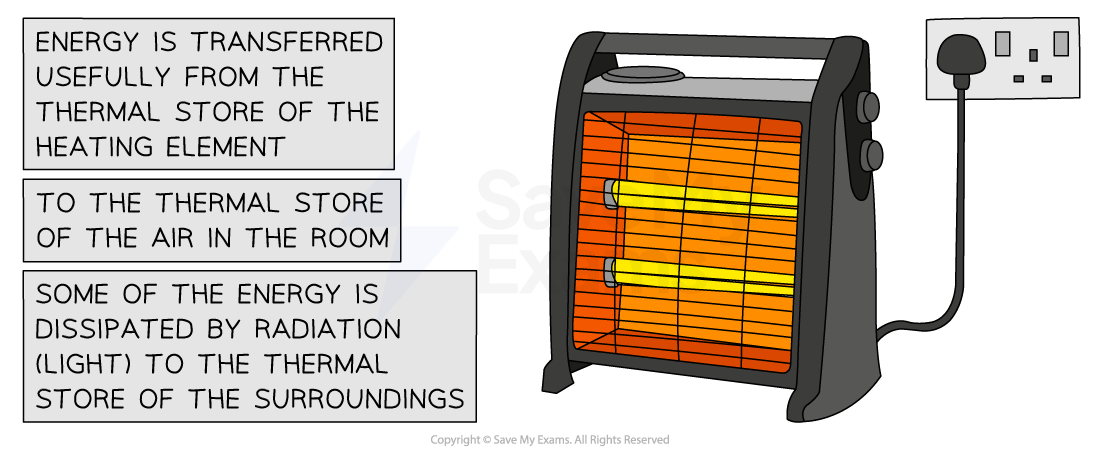
Conservation of energy: electric heater
Rollercoasters
When the rollercoaster is on an elevated piece of track, it has energy in its gravitational potential store
When the rollercoaster descends to a lower piece of track, energy is transferred usefully to the kinetic store as the rollercoaster gains speed
When the rollercoaster ascends again, energy is transferred from the kinetic store to the gravitational potential store as the rollercoaster loses speed
Energy is dissipated to the thermal store of the surroundings by heating due to
friction heating the wheels and track
sound waves vibrating the air particles
Work is done against air resistance and friction, which transfers energy by heating to the thermal store of the surroundings
This is why an object does not return to its starting height: not all the energy is transferred back to the gravitational potential store

As the rollercoaster in the diagram travels from A to D, the useful energy transfers that take place are:
gravitational potential store → kinetic store → gravitational potential store → kinetic store
This is sometimes also described as
GPE → KE → GPE → KE
Jumping on a trampoline
Whilst jumping, the person has energy in their kinetic store
When the person lands on the trampoline, most of that energy is transferred to the elastic potential store of the trampoline
That energy is transferred usefully back to the person's kinetic store as they bounce upwards
Energy is transferred from the person's kinetic store to their gravitational potential store as they gain height
Some of the energy is dissipated by heating to the thermal store of the surroundings (the person, the trampoline and the air)
Work is done against air resistance as the person moves, so each bounce is lower than the last
The useful energy transfers taking place are:
elastic potential store → kinetic store → gravitational potential store

Useful energy transfers: person on a trampoline
Worked Example
Describe the energy transfers in the following scenarios:
a) A falling object
b) A battery powering a torch
c) A mass on a spring
Answer:
Part (a)
Step 1: Identify the store that energy is transferred away from
A falling object starts at a height, so it has energy in its gravitational potential store
As it falls, its height decreases, so the energy in this store decreases
Step 2: Identify the store that energy is transferred to
As the object falls, it speeds up, so the energy in its kinetic store increases
Step 3: Identify the transfer pathway
The weight of the object (a force) acts on it over the distance it falls, so energy is transferred mechanically
Step 4: Write the full description
Energy is transferred mechanically from the gravitational potential store of the object to the kinetic store of the object
Part (b)
Step 1: Identify the store that energy is transferred away from
The cell in the battery contains chemicals that react, so energy starts in its chemical store
Step 2: Identify the store that energy is transferred to
The bulb gets hot and lights up, so energy is transferred to its thermal store
Step 3: Identify the transfer pathway
A current (a flow of charge) carries the energy around the circuit, so energy is transferred electrically
Step 4: Write the full description
Energy is transferred electrically from the chemical store of the cell to the thermal store of the bulb
Part (c)
Step 1: Identify the store that energy is transferred away from
When the spring is stretched or compressed, it has energy in its elastic potential store
Step 2: Identify the store that energy is transferred to
As the spring returns to its original shape, the mass speeds up, so energy is transferred to the kinetic store of the mass
Step 3: Identify the transfer pathway
The spring exerts a force on the mass as it moves, so energy is transferred mechanically
Step 4: Write the full description
Energy is transferred mechanically from the elastic potential store of the spring to the kinetic store of the mass

Unlock more, it's free!
Join the 100,000+ Students that ❤️ Save My Exams
the (exam) results speak for themselves:

Was this revision note helpful?
Build on this topic