Collisions (AQA GCSE Physics): Revision Note
Exam code: 8463

Collisions
Higher Tier Only
Examples of momentum in an event are collisions
Objects will either:
Collide and move in opposite directions
Collide, stick together, and move in the same direction together
When the objects move in opposite directions:
Each object will have a different velocity depending on its mass and the initial momentum of the system
When the objects stick together and move in the same direction together:
They will have a combined mass and velocity
Momentum is always conserved in a collision
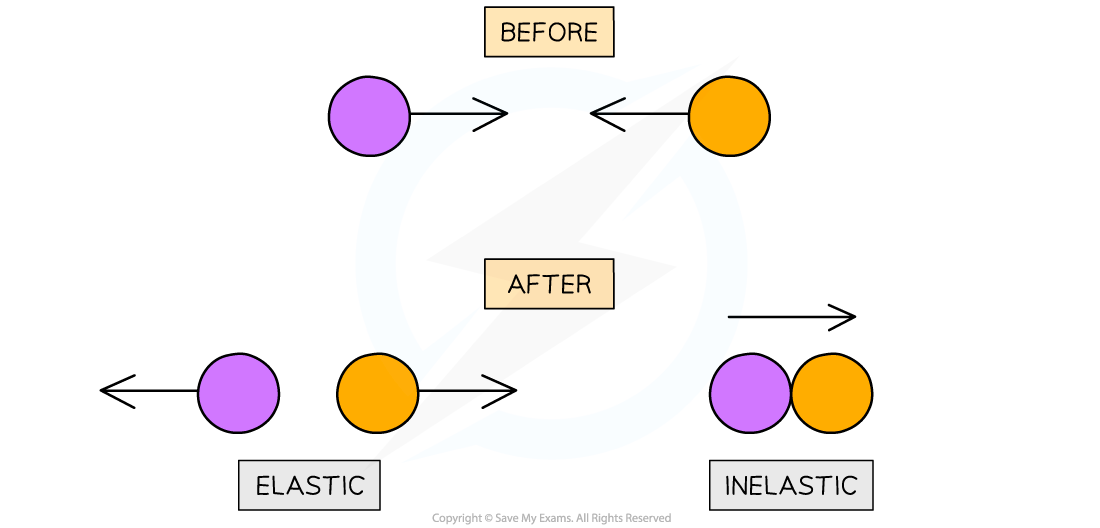
Types of collisions
Examiner Tips and Tricks
If you are asked to analyse a collision, make sure to consider:
The motion of each object before and after the collision
The speed and direction of each object
Calculations Involving Collisions
Higher Tier Only
Calculations involving collisions use the conservation of momentum to determine the velocity of an object (or objects) before or after the collision
This means the momentum before the collision must equal the momentum after the collision for momentum to be conserved
Worked Example
An object of mass 1 kg is travelling at 3 m/s when it collides with a heavier object of mass 2 kg. The two objects stick together and travel off as one. Calculate the combined velocity of the objects after the collision.
Answer:
Step 1: Draw a diagram

Step 2: State the principle of conservation of momentum
The total momentum before a collision = The total momentum after a collision
Step 3: Calculate the momentum before the collision
Before the collision, only the 1 kg object has any momentum
pbefore = mv = 1 × 3 = 3 kg m/s
Step 3: Determine the momentum after the collision
The combined mass is now 1 + 2 = 3 kg
pafter = mv = 3 × v
Step 4: Substitute values into conservation equation
pbefore = pafter
3 = 3 × v
Step 5: Rearrange for the combined velocity v
v = 3 ÷ 3 = 1 m/s
Examiner Tips and Tricks
Always double-check the signs (positive or negative) for the velocity in your answers, as this is the most common type of calculation error!

Unlock more, it's free!
Join the 100,000+ Students that ❤️ Save My Exams
the (exam) results speak for themselves:

Was this revision note helpful?
Build on this topic