Factors Affecting Thinking Distance & Reaction Time (AQA GCSE Physics): Revision Note
Exam code: 8463

Factors Affecting Reaction Time
The thinking distance is defined as:
The distance travelled by a car from when a driver realises they need to brake to when they apply the brakes
The thinking distance depends on two things:
the speed of the car
the driver's reaction time
For the same reaction time, a faster car travels further before the brakes are applied, so the thinking distance is greater
The driver's reaction time may be increased by:
Tiredness
Distractions (e.g. using a mobile phone)
Intoxication (i.e. consumption of alcohol or drugs)
Since these factors can affect the driver's reaction time, they directly affect the thinking distance
Worked Example
The graph below shows how the thinking distance of a driver depends on the speed of the car.
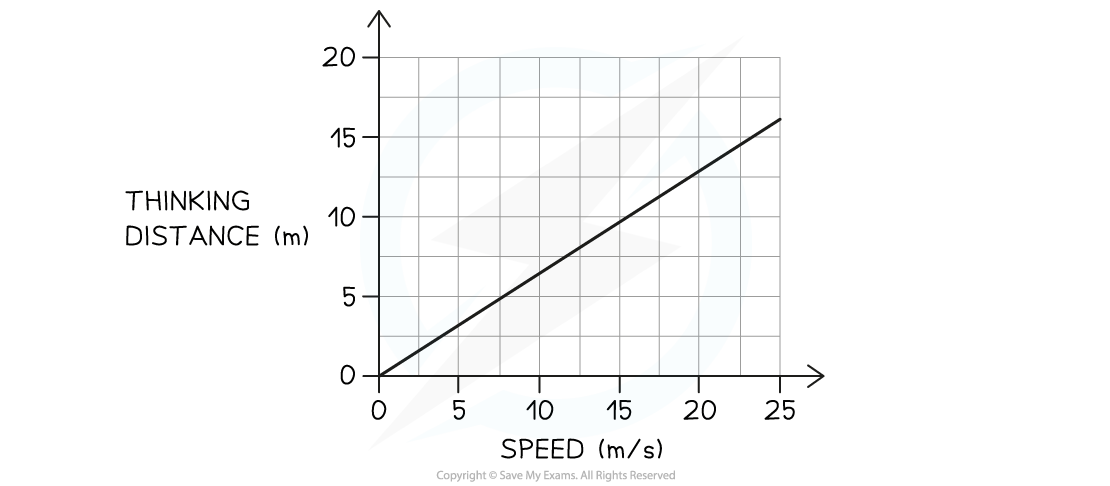
(a) Describe the connection between thinking distance and speed.
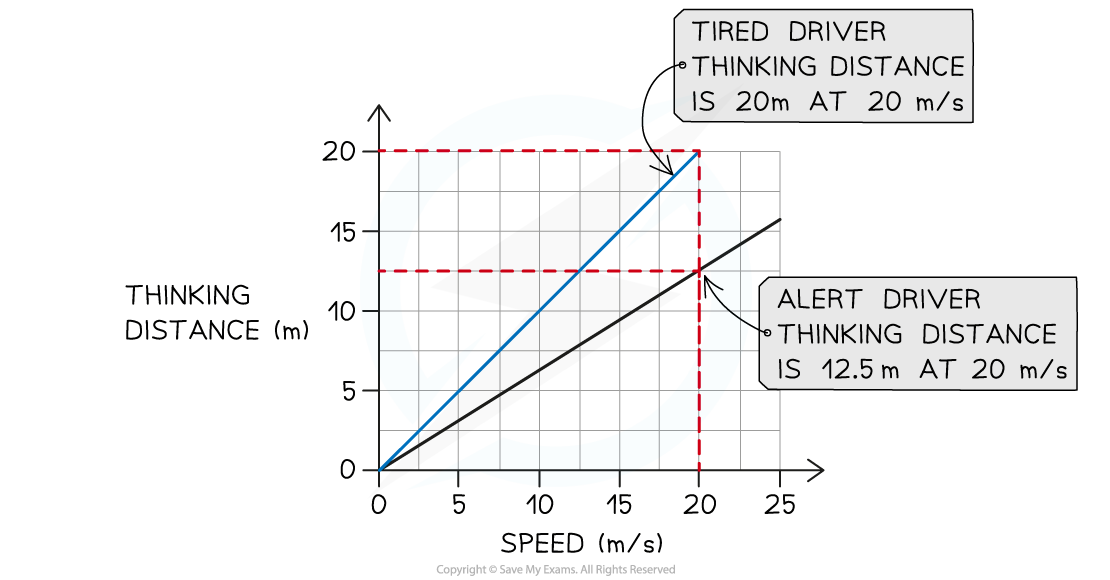
(b) Some people drive when they are tired, despite warnings against doing so. Draw a new line on the graph to show how thinking distance varies with speed for a tired driver.
Answer:
Part (a)
Step 1: Check if the line is straight and if it goes through the origin
The graph shows a straight line through the origin
Therefore, the thinking distance is directly proportional to the speed of the car
Part (b)
Step 1: Recall the factors which affect the thinking distance
Three additional factors affect the thinking distance, because they affect human reaction time:
Tiredness
Distractions
Intoxication
Hence, a tired driver's reaction time is greater (i.e. it takes longer for them to react)
Step 2: Draw a line that shows greater thinking distance for the same speed
At the same speed, a tired driver's thinking distance will be greater than a driver who is alert
This means a line should be drawn with a steeper gradient, as shown below:

Unlock more, it's free!
Join the 100,000+ Students that ❤️ Save My Exams
the (exam) results speak for themselves:

Was this revision note helpful?
Build on this topic
