Fields & Static (AQA GCSE Physics): Revision Note
Exam code: 8463

Fields & Static
Objects with static charge create an electric field in the space around them
If other charges enter the field then they will experience an electric force, attracting or repelling them from the object
Therefore, an electric field can be defined as:
A region in which a charged object will experience an electric force
Electric fields are represented by electric field lines that are always in the direction of positive to negative
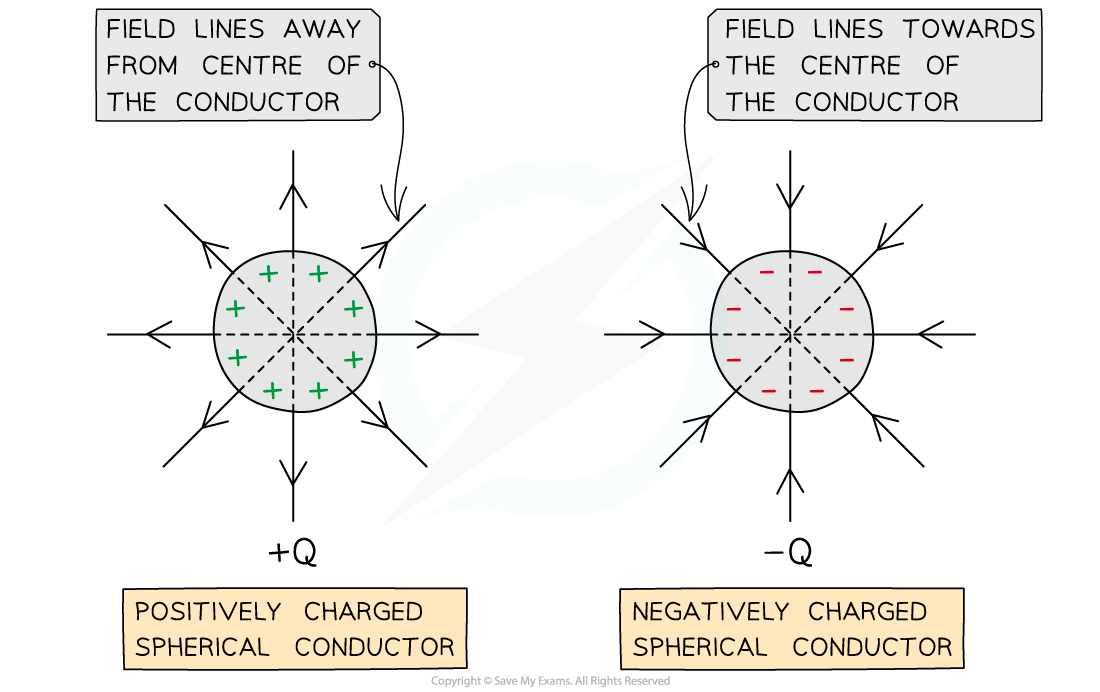
The electric field lines for a charged, isolated sphere, such as a spherical conductor:
Point away from the centre of a positive sphere
Point towards the centre of a negative sphere
A uniform electric field, such as that between two parallel plates, is represented by straight parallel lines from positive to negative:

Electric field lines between two parallel plates
The electric field pattern between two oppositely charged spheres (or point charges) is slightly different and looks like:

Electric field pattern for two opposite charges
The electric field helps to explain the non-contact force between charged objects since the electric field cannot be seen, but can be detected by another charged object that moves within that field due to the electric force
This is a non-contact force because the charged objects do not touch for the force to be exerted
If the electric field becomes strong enough (a very high field strength), it ionises the air, so the air breaks down and conducts charge. The charge then flows through the air as a spark
This is what happens for example, when a charged person touches a conductor
A spark jumps when there is a large potential difference between two objects
The strong electric field makes electrons move through the air from the negatively charged object to the other object
A spark can also jump when an object comes very close to, but does not touch, a high-voltage power cable. The very strong field ionises the air, which then conducts charge to the person or the ground

Positive and negative charges will travel towards the opposite charge, creating a spark
Examiner Tips and Tricks
Remember when drawing field lines to always include their direction with arrows pointing in the correct direction. If the field lines are straight, always use a ruler or a straight edge to draw them
All non-contact forces occur because of the presence of a field. Magnetism is a great example because you can feel the force of attraction and repulsion when you bring two magnets close to one another, and because (with the help of some iron filings) you are able to see the field pattern. Electric fields work in the same way as magnetic fields. When you have a charged object, there is an electric field around it. If you place another charged object in that field, it experiences a force. Like charges will repel and opposite charges will attract.
The more links you make between topics as you study and revise this course, the deeper your understanding will grow across all topics. Mind maps are a great visual way to organise concepts that can be linked together.
When you explain a spark, make sure you link your ideas together. The large potential difference makes the electrons move through the air, and that movement means there is a current in the air. Just stating each idea separately won't get you the full marks.
If a question asks about the danger of flying a kite near power cables, remember that static electricity is not the cause. The strong electric field ionises the air, and the kite does not need to touch the cable for charge to flow.

Unlock more, it's free!
Join the 100,000+ Students that ❤️ Save My Exams
the (exam) results speak for themselves:

Was this revision note helpful?
Build on this topic
