The Life Cycle of Larger Stars (AQA GCSE Physics): Revision Note
Exam code: 8463

Larger Stars
After the main sequence, a larger star finishes its life cycle in the following evolutionary stages:
red supergiant → supernova → neutron star or black hole
Red supergiant
After several million years, the hydrogen that fuels the fusion reactions in the star will begin to run out
Once this happens, the fusion reactions in the core will start to die down
The star will begin to fuse helium to form carbon
This is followed by further fusion reactions in which nitrogen and oxygen are formed
Heavier elements up to iron are also formed
This causes the outer part of the star to expand
As the star expands, its surface cools, and it becomes a red supergiant
Supernova
Once the fusion reactions inside the red supergiant cannot continue, the core of the star will collapse suddenly
The outer layers are blown away in a gigantic explosion
This is called a supernova
At the centre of this explosion, a dense body called a neutron star will form
The outer remnants of the star are ejected into space during the supernova explosion, forming new clouds of dust and gas (nebula)
The nebula from a supernova may form new stars with orbiting planets
The heaviest elements (elements heavier than iron) are formed during a supernova and are ejected into space
These nebulae may form new planetary systems
Neutron star (or black hole)
In the case of the most massive stars, the neutron star that forms at the centre will continue to collapse under the force of gravity until it forms a black hole
A black hole is an extremely dense object which has a gravitational pull so strong that not even light can escape from it
Life cycle of a larger star
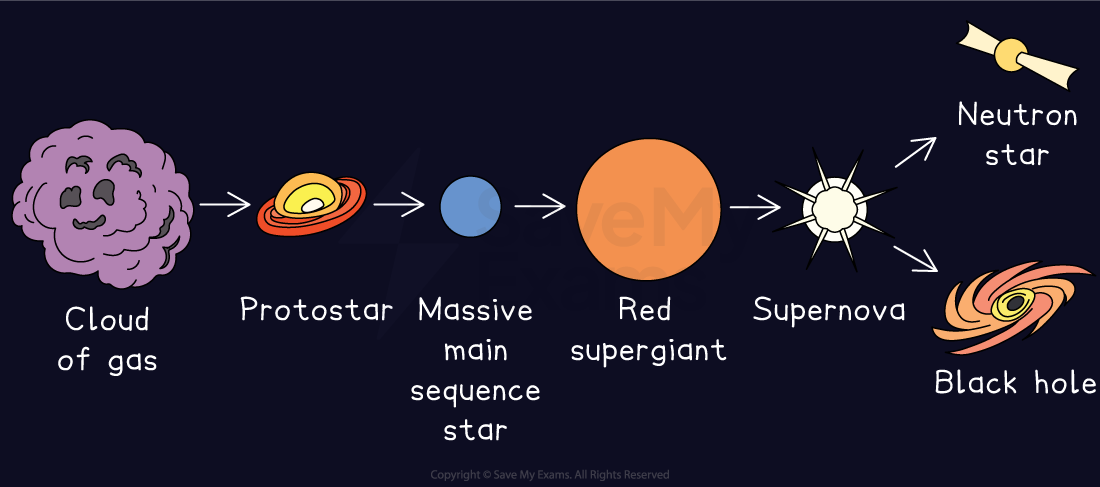
The life cycle of a star much larger than the Sun

Unlock more, it's free!
Join the 100,000+ Students that ❤️ Save My Exams
the (exam) results speak for themselves:

Was this revision note helpful?
Build on this topic