Wasted Energy (AQA GCSE Physics): Revision Note
Exam code: 8463

Wasted Energy
In practice, most systems are not closed
When energy transfers occur that are not useful, these are described as energy being dissipated to the surroundings
Dissipated means the energy is spread out into the surroundings and stored in a less useful way
Energy is never destroyed, so it is wrong to say it is 'used up' or 'destroyed'
This is considered to be wasted energy
These less useful energy transfers often involve heating, light and sound
When energy is transferred to the thermal stores of the objects, the temperature of the objects increases
The particles that make up the objects vibrate more; hence, the transfer pathway is by heating (of the particles)
Visible light is electromagnetic radiation
Therefore, when light is produced, energy is transferred by radiation
When sound is produced, energy is carried away by waves (mechanically) as air particles vibrate
The vibrating air particles then pass energy to the thermal store of the surroundings, so the energy is dissipated
Useful energy can be defined as:
The energy that is transferred from store to store and used for an intended purpose
Wasted energy can be defined as:
The energy that is not useful for the intended purpose and is dissipated to the surroundings
Worked Example
A student uses an electric motor to lift a load.

The motor turns a mechanism that lifts the load. Some of the energy transfers are useful and the rest of the energy is wasted.
a) State the useful energy transfer occurring in this system.
b) State the wasted energy transfer occurring in this system.
Answer:
Part (a)
Step 1: Identify what the system is designed to do
The motor turns the mechanism that lifts the load, so the purpose of the system is to raise the load
Step 2: Identify the stores involved in that purpose
The motor is turning, so it has energy in its kinetic store
As the load rises, its height increases, so the energy in its gravitational potential store increases
Step 3: Write the useful energy transfer
Energy in the kinetic store of the motor is transferred to the gravitational potential store of the load
Part (b)
Step 1: Identify any transfers that are not part of the purpose
As the motor operates, friction between its moving parts causes a rise in the temperature of the components and the surroundings
Raising the temperature does not help to lift the load, so this transfer is not useful
Step 2: Write the wasted energy transfer
Energy in the kinetic store of the motor is transferred to the thermal store of the motor and the surroundings
This energy is dissipated by heating to the surroundings, so it is a wasted energy transfer
Examiner Tips and Tricks
Make sure you are able to identify "useful" and "wasted" energy transfers in different scenarios, as this is commonly tested in exams. When describing wasted energy, make sure to say the energy is transferred or dissipated to the surroundings. If you say the energy is "wasted" or "lost", this will not gain you the mark, as it implies energy is not conserved.
Reducing Energy Loss
Mechanical processes can become wasteful when they cause a rise in temperature
These processes often involve friction
When friction acts, it has the effect of transferring energy from the kinetic store by heating to the objects and the surroundings
This energy cannot be used in a useful way, therefore it is called wasted energy
Energy that is transferred to the surroundings is said to be dissipated (spread out) to the surroundings
Lubrication
Friction is a major cause of wasted energy in machines
For example, the gears on a bike can become hot if the rider has been cycling for a long time
Energy is wasted as it is transferred from the kinetic energy store of the bike to the thermal energy store of the gears and the chain
This friction makes them become hot and transfers energy by heating to the thermal energy store of the surrounding air
This wasted energy can be reduced if the amount of friction can be reduced
This can be achieved by lubricating the parts that rub together
Less work is done against friction, so less energy is transferred to the thermal store of the parts and the surroundings
A greater proportion of the input energy is transferred usefully, so the efficiency increases
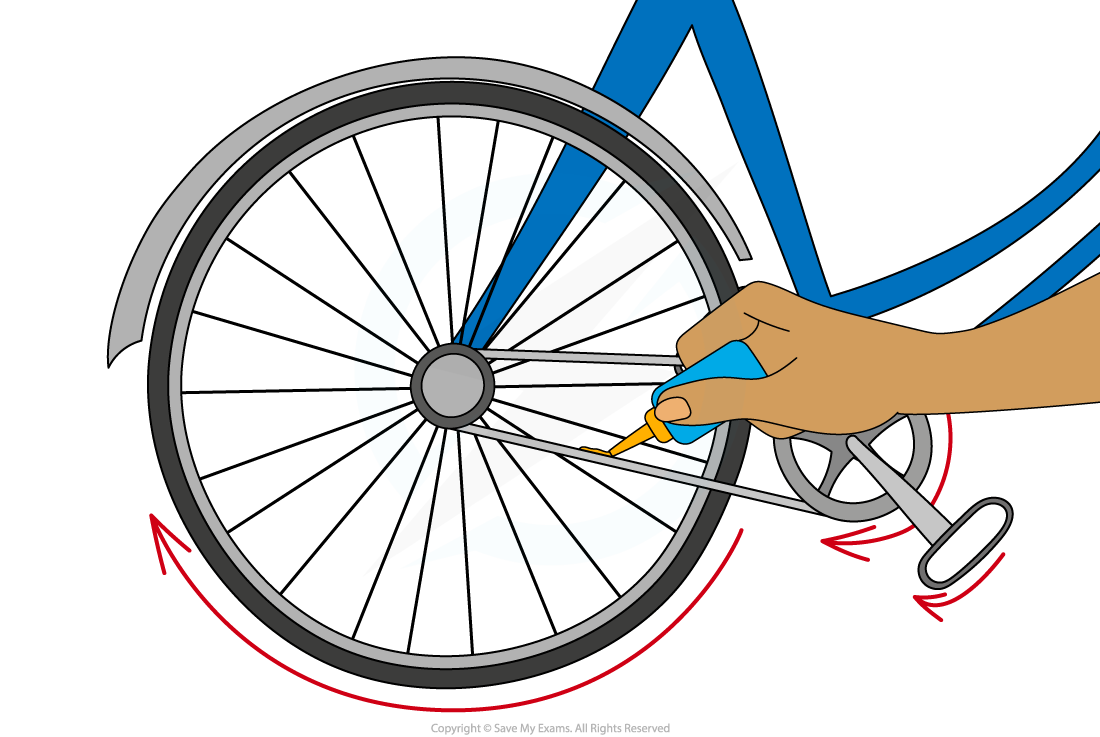
Lubrication helps reduce friction in the parts of a cycle
Insulation
In many situations, the energy transferred by heating is wanted. For example:
When heating a home
When boiling a kettle
If this energy can be prevented from dissipating, then less energy will be needed to replace the wasted energy
This can be achieved by surrounding the appliance with insulation
The effectiveness of insulation depends upon:
How well the insulation conducts heat
How thick the insulation is

Unlock more, it's free!
Join the 100,000+ Students that ❤️ Save My Exams
the (exam) results speak for themselves:

Was this revision note helpful?
Build on this topic
