Current In Series & Parallel (AQA GCSE Combined Science: Synergy: Physical Sciences): Revision Note
Exam code: 8465

Written by: Katie M
Updated on
Comparing Series & Parallel Circuits
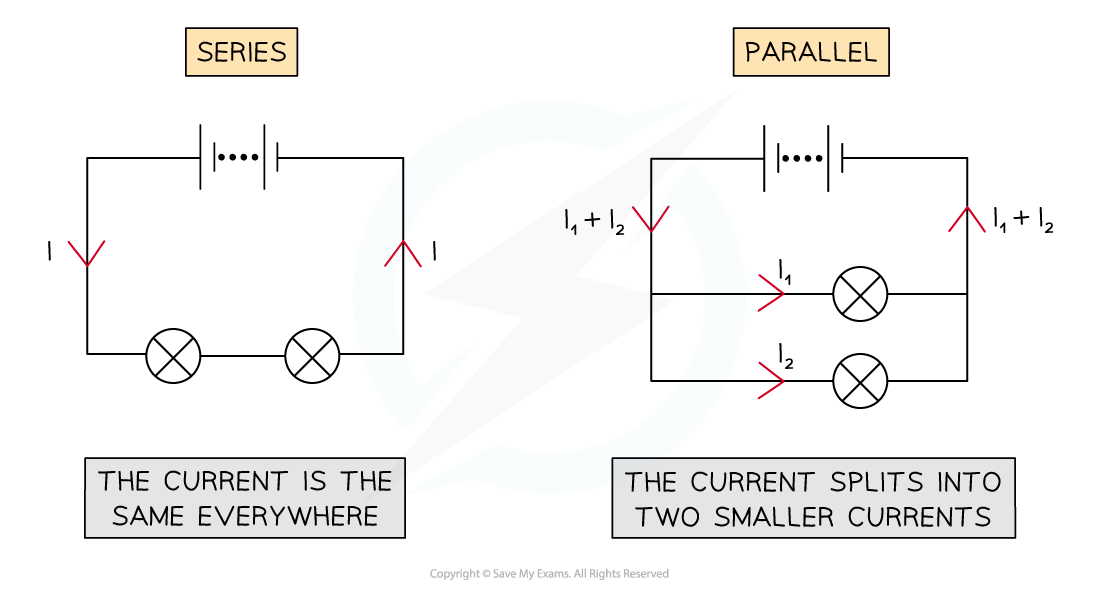
Current in Series & Parallel
In a series circuit, the current is the same at all points
In a parallel circuit, the current splits at junctions – some of it going one way and the rest going the other
Potential Difference in Series & Parallel
In a series circuit, the voltage of the power supply is shared between the components
In a parallel circuit, the voltage across each component is the same

Resistors in Series & Parallel
In a series circuit, the total resistance is the sum of the resistance in each component
Two resistors in series will have a larger overall resistance than just one
This is because the charge has to push through multiple components when flowing around the circuit
The more components the charge has to travel through, the higher the number of collisions that occur
In a parallel circuit, the total resistance decreases and is less than the resistance of any of the individual components
Two resistors in parallel will have a smaller overall resistance than just one
This is because the charge has more than one pathway to take, so only some charge will flow along each path
The more pathways there are, the smaller the amount of charge in each path
Series and Parallel Circuit Summary Table

Worked Example
A circuit was set up as shown in the diagram.

Calculate the resistance of the bulb.
Answer:
Step 1: Determine the voltage across the bulb
The components share the potential difference of the power supply, so:
12 V – 8 V = 4 V
Step 2: Write down the equation for voltage, current and resistance
V = IR
Step 3: Calculate the current through the resistor
I = V / R = 8 / 6 = 1.33 A
Step 4: Calculate the resistance of the bulb
In a series circuit, the current is the same everywhere, so:
R = V / I = 4 / 1.33 = 3.0 Ω

Unlock more, it's free!
Join the 100,000+ Students that ❤️ Save My Exams
the (exam) results speak for themselves:

Was this revision note helpful?
Build on this topic