Urbanisation (Cambridge (CIE) IGCSE Geography): Exam Questions

Exam code: 0460 & 0976

Syllabus Edition

First teaching 2018

Last exams 2026

2 hours21 questions
1
6 marks

Study Fig 1, which shows the world's megacities

J5ijl48J_q1-1-7-paper-1-cie-igcse-geography-tqs

Fig 1

(i)

Define a megacity

[1]

(ii)

Describe the location of the megacities shown on the map 

[3]

(iii)

Suggest two reasons for the location of the megacities shown 

[2]

2
2 marks
q2-1-7-paper-1-easy-cie-igcse-geography-tqs

Fig 1 - Percentage of China’s population living in urban and rural areas

Study Fig 1, which shows China’s urban and rural population

(i)

What percentage of the population lived in urban areas in 1985?

[1]

(ii)

By how much is China’s urban population predicted to grow between 2020 and 2030? 

[1]

3
2 marks

Urban areas have many problems.  Using the photograph Fig 1, explain how this improves an urban area

q3-1-7-paper-1-easy-cie-igcse-geography-tqs

Fig 1 - An electric bus

4
1 mark

Country

% living in urban areas in 2019

% living in urban areas in 2050 (projected)

UK

84

90

China

60

80

India

35

53

Nigeria

51

70

Which country will have the greatest increase in the % living in urban areas?

5
2 marks

Increased urbanisation can cause social and environmental challenges.  Suggest one cause for each:

  • Social challenge

  • Environmental challenge

6
10 marks

Study Fig. 2.1, which shows information about urbanisation.

un-world-urbanisation-prospects

Fig. 2.1

(i)

Define the term urbanisation.

[1]

(ii)

Using Fig. 2.1 only, name:

-        the continent which has most cities with a population of 10 million or more

-        the continent where there are no cities with a population of over 5 million.

[2]

(iii)

Using Fig. 2.1 only, describe the distribution of areas with over 80% of their population living in urban areas.

[3]

(iv)

Explain why the percentage of the total population living in cities in LEDCs is likely to continue growing rapidly.

[4]

7a
1 mark

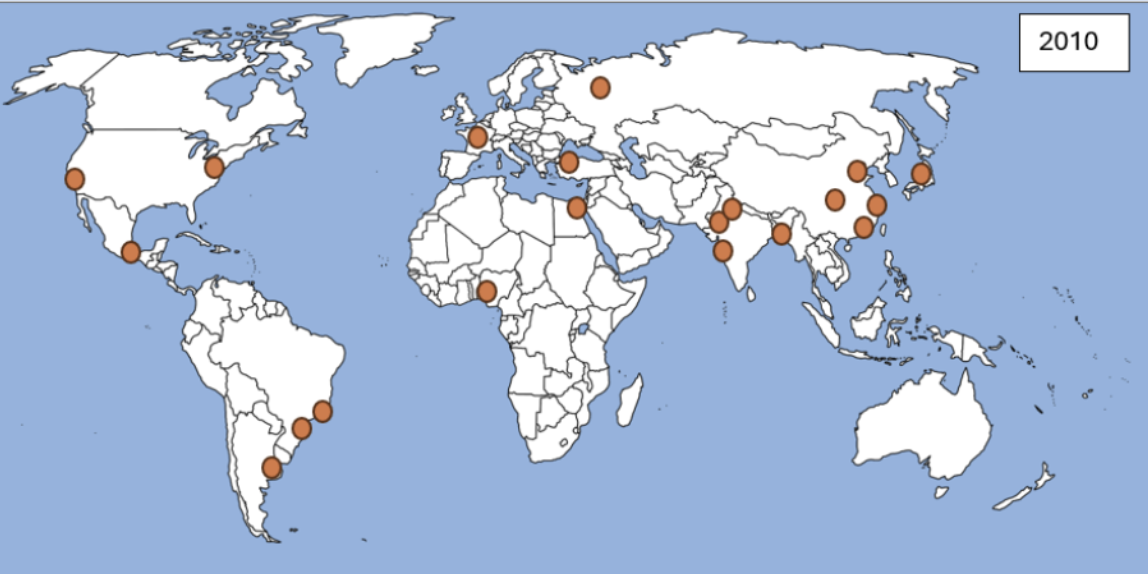
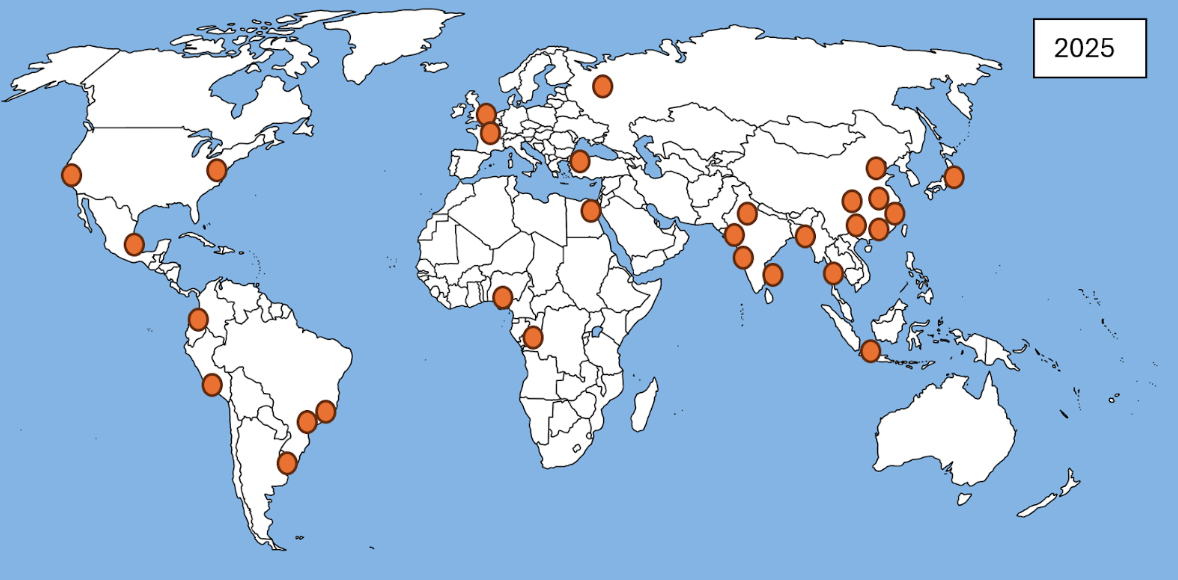
Fig 2.1 shows the location of megacities around the world in 2010 and 2025.

World map from 2010 with orange dots marking major cities across North and South America, Europe, and Asia.
World map with orange dots marking locations across North America, South America, Europe, Africa, and Asia. Blue oceans. Labelled 2025.
Figure 2.1 showing megacities around the world 2010 and 2025

Complete the following;

A megacity has at least …..........… inhabitants

7b
2 marks

State one push factor that leads to the growth of megacities and one pull factor that leads to the growth of megacities.

7c
3 marks

Describe the changes in the locations of megacities shown in the maps in Figure 2.1.

Include data in your answer

1
4 marks

Describe the problems caused when urban areas expand into rural areas 

2
8 marks

Study Fig. 2.2 (below), which is a photograph of part of an urban area in an LEDC which is being redeveloped.

fig-2-2-q2-0460-s20-in-12

(i)

Describe three features of the buildings in the redevelopment shown in Fig. 2.2.

[3]

(ii)

The land being redeveloped in Fig. 2.2 was previously used for a squatter settlement.

Suggest how this change in land use is likely to have both benefits and problems.

[5]

3
8 marks

Study Figs. 2.2 and 2.3, which are photographs taken in part of the urban area of Mumbai, India (an LEDC).

fig-2-2-paper12-cie-igcse-geography

Fig. 2.2

fig-2-3-paper12-cie-igcse-geography

Fig. 2.3

(i)

Describe three features of the buildings in the area shown in Fig. 2.2.

1 ...............................................
2 ...............................................
3 ...............................................

[3]

(ii)

Explain why the quality of life of some people who have moved to areas like those shown in both Figs. 2.2 and 2.3 may be worse than in the rural areas they moved from.

[5]

4
5 marks

Explain the environmental impacts of urban sprawl on the rural–urban fringe.

5
4 marks

Suggest reasons for the location of the megacities in 2025

1
7 marks

For a named urban area you have studied, describe what has been done to improve quality of life in a squatter settlement

2
Sme Calculator
7 marks

For an urban area you have studied, describe the impact of urbanisation on people who live there.

3
7 marks

For a named urban area, describe the causes of a problem faced by the residents and explain how the authorities in that urban area are attempting to solve it.

Name of urban area .....................

4
7 marks

For a named urban area you have studied, describe what has been done to reduce the problems caused by urban growth.

Name of urban area ................................

5
7 marks

For a named settlement in a LEDC country, describe the social challenges brought about by urban growth.