Problem Solving with Equations (Edexcel IGCSE Maths B): Revision Note
Exam code: 4MB1

Equations & problem-solving
What is problem solving?
Problem solving means you are given a specific situation (real life or constructed) and you need to form and solve equations to find answers to the questions asked
The equations can be any type that are in the course, including
Linear, e.g.
Quadratic, e.g.
Answers must always be given in context
This means related to the situation using words, phrases and units from the question
For example, "The population density is 225 people per square km" (not just )
What type of algebra can come up in a problem solving question?
Many questions will require you to solve quadratic equations
You need to be able to spot these
This may require bringing all the terms to one side to get "= 0"
You are often free to choose which quadratic method to use to solve them
If you get two solutions, you may need to justify which solution is correct
You may be asked to use algebra in other settings such as geometry or numbers
% is as a decimal
If the ratio is equivalent to 5 : 8, then
You may have unfamiliar equations to solve
such as multiplying both sides by in to form a quadratic
Examiner Tips and Tricks
If part (a) asks you to prove an equation and part (b) uses that equation, you can still do part (b) without having done part (a)!
This means you won't lose all the marks if you can't do part (a).
Worked Example
The net of a cube is shown below.
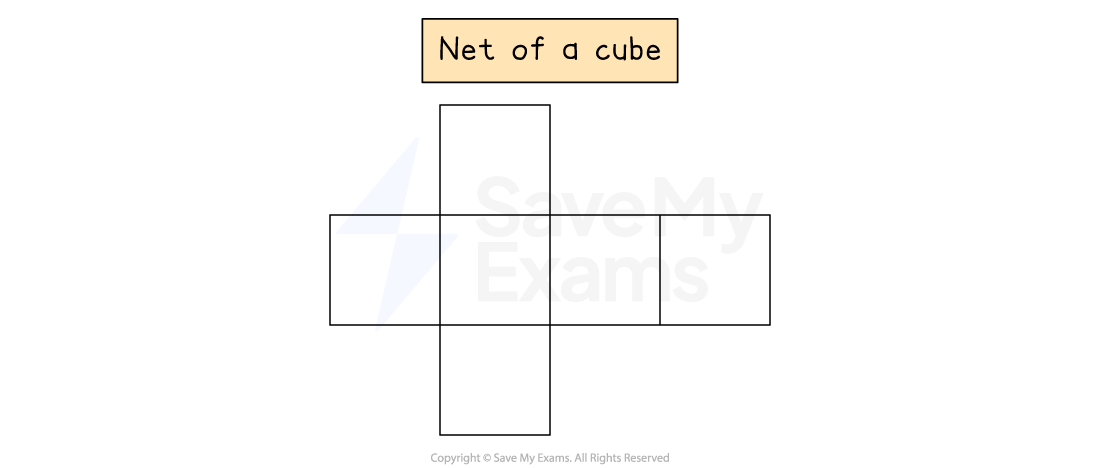
Let cm be the side length of the cube.
Find an expression in terms of for
(a) the perimeter of the net shown.
Answer:
Count the number of edges around the outside of the net
14 edges
Multiply this number by the side length,
The perimeter of the net shown is cm
(b) the area of the net shown.
Answer:
Count the number of faces (squares) in the net
6 faces
Multiply this number by the area of one face,
The area of the net shown is cm2
When the net is folded into a cube, the difference between the volume of the cube and the surface area of the net is eight times the perimeter of the net.
(c) Show that .
Answer:
First find an expression for the volume of the cube
This will have dimensions
The volume is
Then find an expression for the difference between the volume and the surface area in part (b)
Subtract the surface area from the volume
Set this difference equal to 8 times the perimeter of the net
Use the answer in part (a)
Simplify and bring all the terms to one side
You are nearly at the correct equation given in the question
Cancel both sides by (as cannot be zero)
To show this, you can factorise out an first
(d) Hence, find the exact volume of the cube when the net is folded.
Answer:
Hence means use the previous results
The volume of the cube is which involves an unknown,
To find , solve the equation in part (c), for example using the quadratic formula
Find the two possible answers
14 or -8
The side length cannot be a negative number
Substitute this into to find the volume
The question asks for the answer to be exact, so do not round
The volume is 2744 cm3

Unlock more, it's free!
Join the 100,000+ Students that ❤️ Save My Exams
the (exam) results speak for themselves:

Was this revision note helpful?
Build on this topic