Combined Conditional Probabilities (Edexcel IGCSE Maths B): Revision Note
Exam code: 4MB1

Combined conditional probabilities
What is a combined conditional probability?
This is when you have two (or more) successive events, one after the other, and the second event depends on (is conditional on) the first
How do I calculate combined conditional probabilities?
You need to adjust the number of outcomes as you go along
For example, selecting two cards from a pack of 52 playing cards without replacing the first card:
P(red 1st card) is 26 reds out of 52 cards
If the 1st card is not replaced, there are only 25 reds left out the remaining 51 cards
P(red 2nd card) is 25 reds out of 51 cards
P(red then red) =
Examiner Tips and Tricks
If a question says "two cards are drawn" then you may assume that they draw 1 card followed by another card without replacement (the maths is the same).
Can I draw a tree diagram for combined conditional probabilities?
Yes, a tree diagram is a useful way to show combined conditional probabilities
For example, two counters are drawn at random from a bag of 3 blue and 8 red counters without replacement
The probabilities are shown below
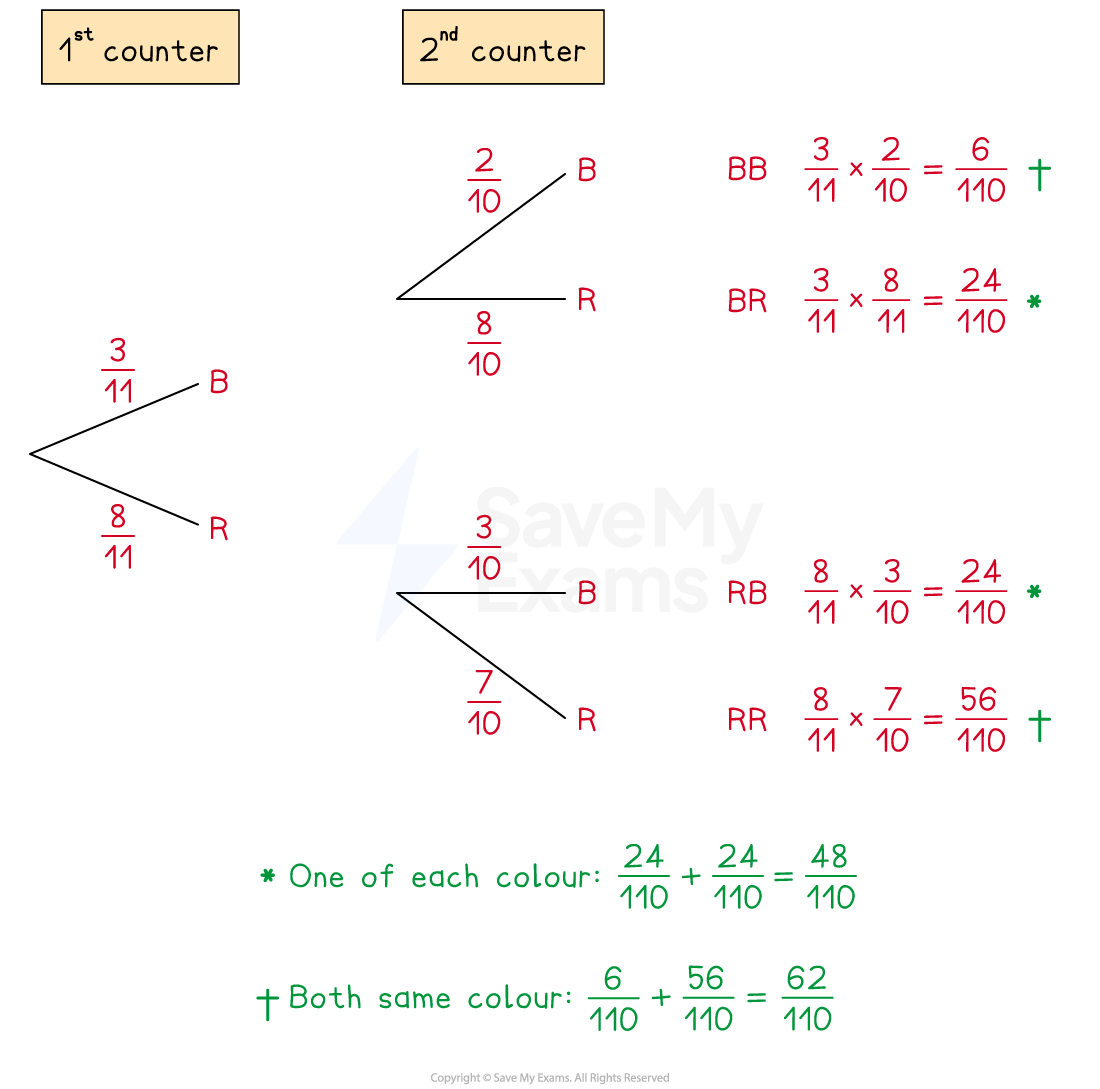
What if there are multiple possibilities within one question?
You may need a listing strategy (e.g. AAB, ABA, BAA)
You will need the or rule for multiple possibilities
P(AB or BA or AA or...) = P(AB) + P(BA) + P(AA) +...
Add the cases together
Remember that AB and BA are not the same
AB means A happened first, then B
BA means B happened first, then A
Examiner Tips and Tricks
Try not to simplify your probabilities too early as it is easier to add probabilities together when they all have the same denominator!
Worked Example
A bag contains 10 yellow beads, 6 blue beads and 4 green beads.
A bead is taken at random from the bag and not replaced.
A second bead is then taken at random from the bag.
(a) Find the probability that both beads are different colours.
Answer:
Let Y, B and G represent choosing a yellow, blue and green bead
Method 1
The probability of the beads being different colours is equal to 1 minus the probability that the beads are the same colour
Find the probability of both beads being the same colour
P(same colours) = P(YY) + P(BB) + P(GG)
Calculate each conditional probability separately, remembering the number of beads changes after one is drawn and not replaced
For example, P(YY) =
Multiply the pairs of fractions together and add their results
Subtract this from 1
Simplify the answer
Method 2
List all the possibilities of different colours
Remember that YB (yellow first, then blue) is different to BY (blue first, then yellow)
YB, BY, YG, GY, BG, GB
Use the "or" rule to add the cases together
P(different colours) = P(YB) + P(BY) + P(YG) + P(GY) + P(BG) + P(GB)
Calculate each conditional probability separately, remembering the number of beads changes after one is drawn and not replaced
For example, P(YB) =
Multiply the pairs of fractions together and add their results
Simplify the answer
(b) The second bead is not replaced and a third bead is taken at random from the bag.
Find the probability that all three beads are the same colour.
Answer:
List the possibilities
YYY, BBB, GGG
Use the "or" rule to add between cases
P(all the same colour) = P(YYY) + P(BBB) + P(GGG)
Use conditional probabilities in each separate case, remembering the number of beads changes after each one is drawn and not replaced
Multiply the triplets of fractions together then add their results
Simplify the answer
Worked Example
A bag contains only red and blue marbles. There are 3 more red marbles than blue marbles.
Kai takes 2 marbles from the bag at random.
The probability that Kai takes 2 blue marbles is .
Work out the number of blue marbles there were in the bag initially.
Show clear algebraic working.
Answer:
Write expressions for the number of each colour
Let be the number of blue marbles
Then there are red marbles
And there are marbles in total
Find the probability that the first marble is blue
Given that the first marble is blue, find the probability that the second marble is blue
After one blue marble is taken, there are blue marbles left out of marbles in total
Find the probability that both marbles are blue by multiplying the probabilities together
Set this equal to
Multiply through by to get rid of the fractions
Expand and simplify both sides
Rearrange to make one side equal to zero
Factorise the quadratic
Find two numbers that multiply to give 3×-6=-18 and add to give -17
1 and -18
Solve the quadratic equation
needs to be a positive whole number
blue marbles initially

Unlock more, it's free!
Join the 100,000+ Students that ❤️ Save My Exams
the (exam) results speak for themselves:

Was this revision note helpful?
Build on this topic