Cubic Graphs (Edexcel IGCSE Maths B): Revision Note
Exam code: 4MB1

Cubic Graphs
What is a cubic?
A cubic is a function of the form
and are constants
It is a polynomial of degree (order) 3
So and/or could be zero
but cannot be zero
To sketch the graph of a cubic, the polynomial needs to be in factorised form
E.g. is the factorised form of
Some cubics are simple to factorise
E.g.
For more complicated cubics you may be able to factorise them using the factor theorem and algebraic division
You should also be able to expand three brackets to find the expanded form of a cubic
What does the graph of a cubic look like?
In general the graph of a cubic will take one of four forms
All are smooth curves
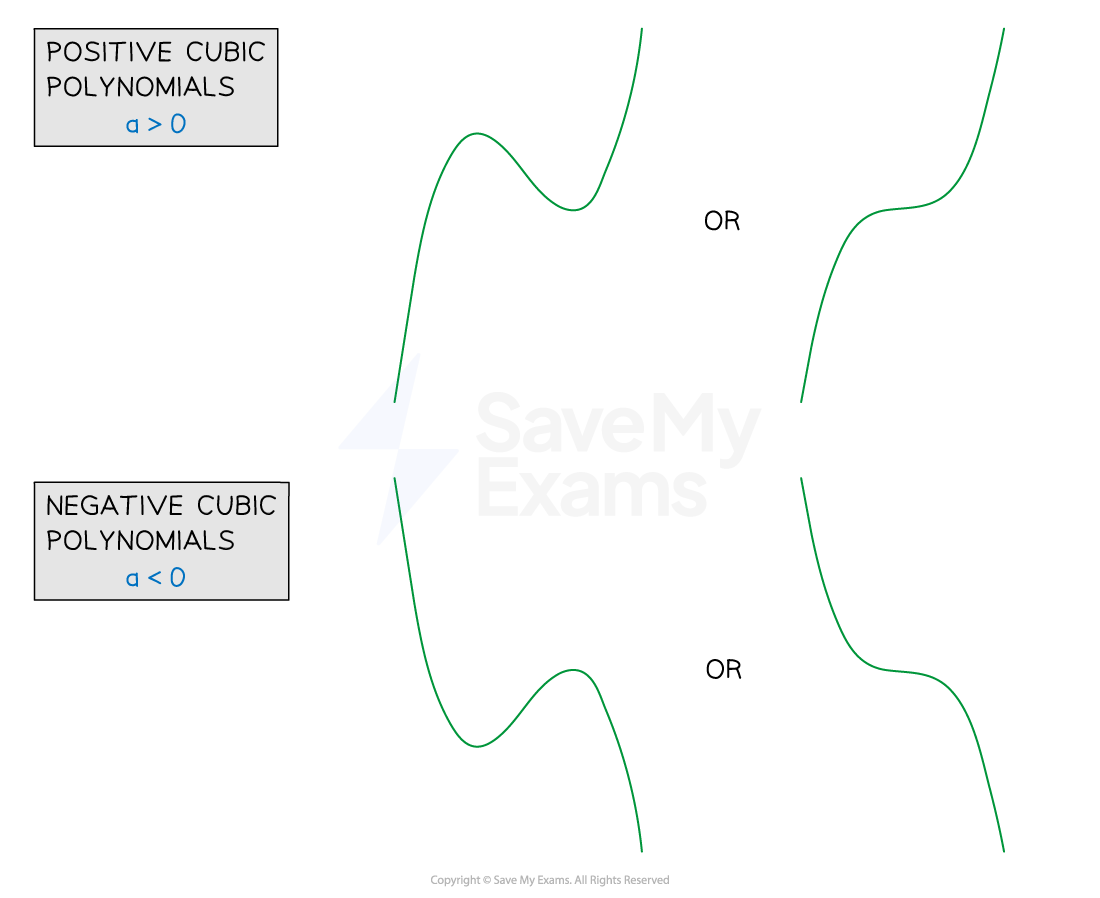
The exact form of a particular cubic will depend on:
The number (and value) of roots (-axis intercepts)
The -axis intercept
The sign of the coefficient of the term ()
If the graph is a positive cubic ('starts' in the bottom left, 'ends' in the top right)
If the graph is a negative cubic ('starts' in the top left, 'ends' in the bottom right)
The turning points
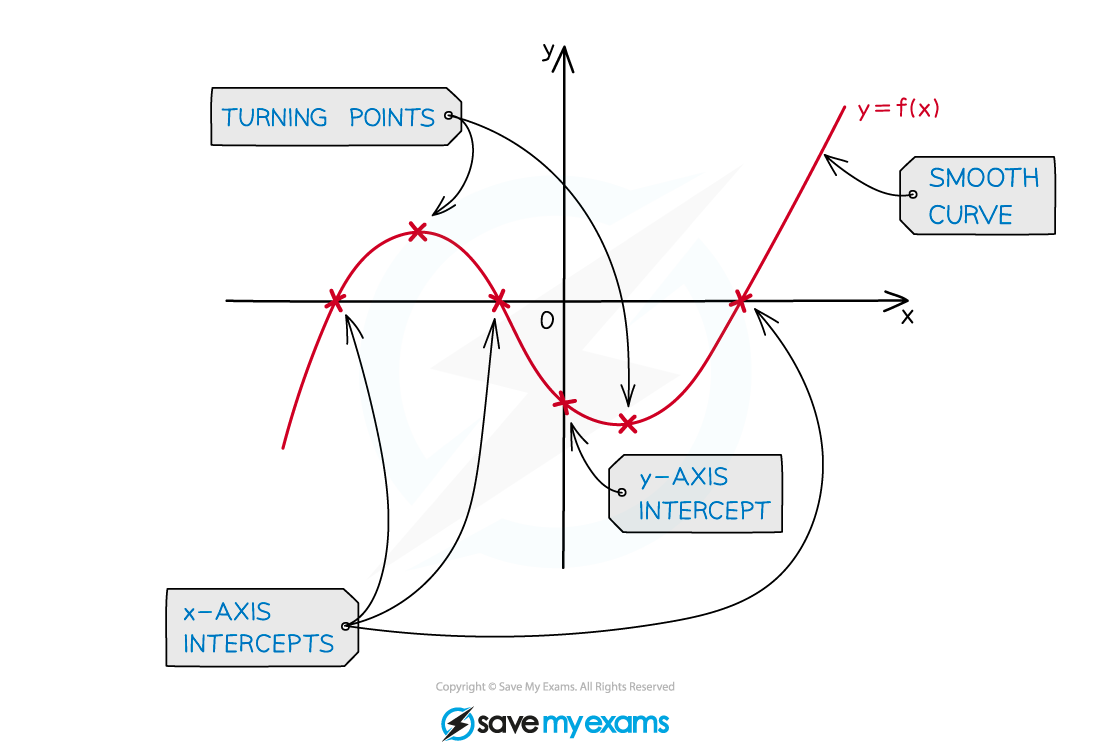
Cubics can have two turning points
a maximum point and a minimum point
However, note that the graphs of and :
Do not have a maximum or minimum (no turning points)
Only cross the -axis once, at
How do I sketch the graph of a cubic?
STEP 1
Find the -axis intercept by settingSTEP 2
Find the -axis intercepts (roots) by settingIn factorised form, this can be done by inspection
A cubic of the form has roots at and
E.g. has roots at 2, 3, and -5
Any repeated roots will mean the graph touches the -axis
The graph does not cross the -axis
E.g. touches the -axis at , and intersects the -axis at
STEP 3
Consider the shape of the graphIs it a positive cubic or a negative cubic?
Where does the graph 'start' and 'end'?
STEP 4
Consider where any turning points should goSTEP 5
Sketch the graph with a smooth curve
Label points where the graph intercepts the and axes
Worked Example
Sketch the graph of .
Answer:
STEP 1
Find the -axis intercept by substituting in
STEP 2
Find the -axis intercepts by solving
Either bracket can be equal to zero
(repeated solution, as there are two brackets
STEP 3
Consider the shape, and the 'start' and 'end' points:
so it is a positive cubic
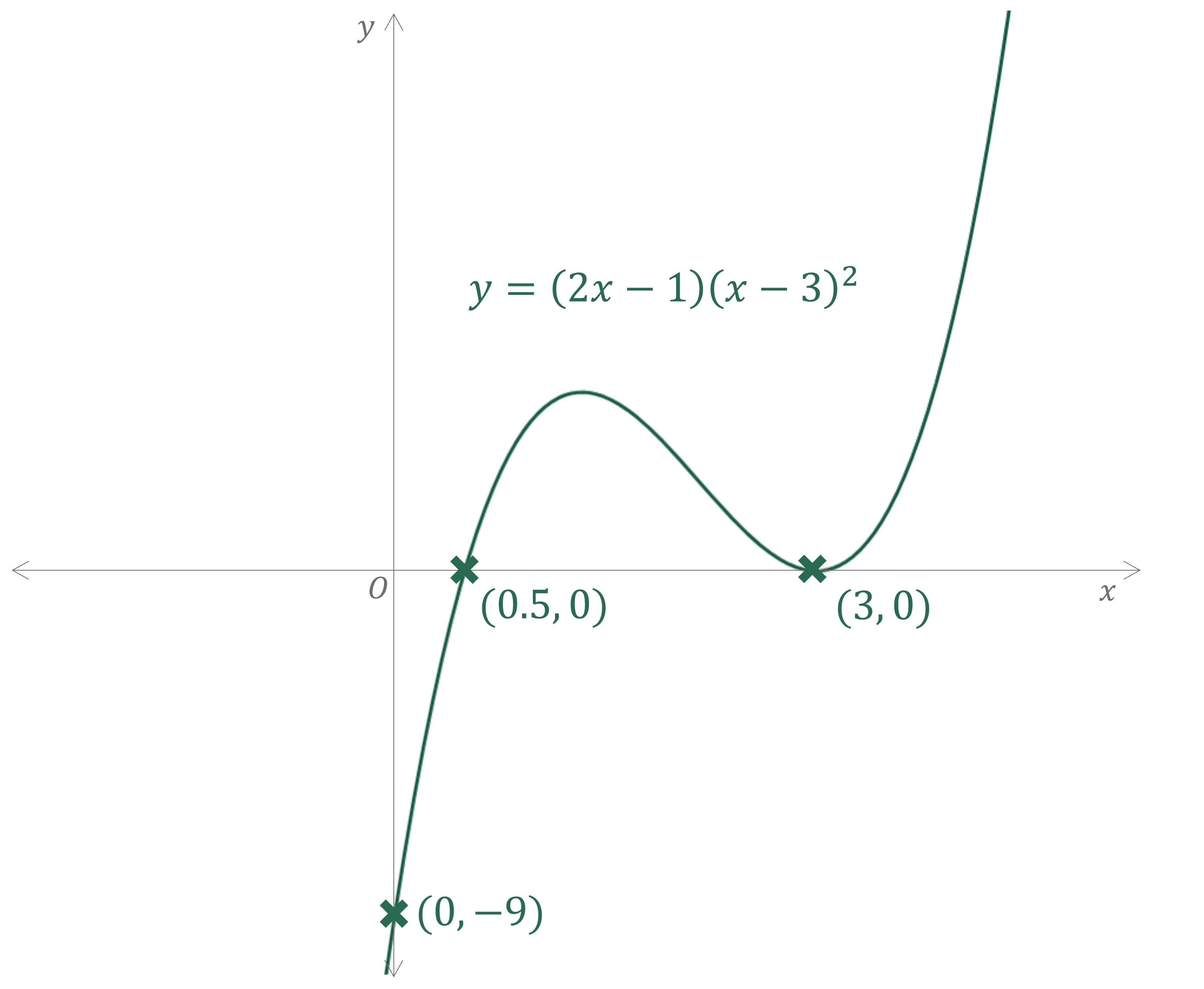
is a repeated root so the graph will touch the -axis at this point (but not cross it)
STEP 4
Consider the turning points
One turning point (minimum) will need to be where the curve touches the -axis
The other (maximum) will need to be between the two roots and
STEP 5
Sketch a smooth curve with labelled intercepts

Unlock more, it's free!
Join the 100,000+ Students that ❤️ Save My Exams
the (exam) results speak for themselves:

Was this revision note helpful?
Build on this topic