Plant Structure & Function (Edexcel International A Level (IAL) Biology): Exam Questions

Exam code: YBI11

1 hour9 questions
1a
3 marks

Plants contain starch and cellulose.

(i) Which part of a plant cell stores starch?

(1)

☐

A

amyloplast

☐

B

middle lamella

☐

C

plasmodesmata

☐

D

tonoplast 

(ii) How many of the following statements about starch are correct?

1. it has a compact shape
2. it contains 1,6 glycosidic bonds only
3. it is a polymer of β-glucose
4. it is a polypeptide

(1)

☐

A

one

☐

B

two 

☐

C

three 

☐

D

four 

(iii) How many of the following contain cellulose?

1. phloem
2. sclerenchyma
3. vacuole
4. xylem

(1)

☐

A

one

☐

B

two 

☐

C

three 

☐

D

four 

1b
3 marks

Microfibrils are composed of cellulose.

The image shows the arrangement of microfibrils in a plant cell wall, as seen using an electron microscope.

q1b-unit-2-oct-2020-edexcel-ial-biology

© Save My Exams Ltd

Explain how the structures of cellulose and microfibrils increase the strength of a plant cell wall.

Use the information in the image to support your answer.

2a
4 marks

The stem of a plant contains structures involved in transporting substances and supporting the plant.

The photograph shows a section through part of the stem of a plant, as seen using a light microscope.

q5-unit-2-january-2021-edexcel-ial-biology1

(i) Which of the labelled structures is sclerenchyma?

(1)

☐

A

W

☐

B

X

☐

C

Y

☐

D

Z

(ii) Which of the labelled structures is involved in transporting substances both up and down the plant stem?

(1)

☐

A

W

☐

B

X

☐

C

Y

☐

D

Z

(iii) Which of the labelled structures is involved in transporting calcium ions from the stem to the leaves?

(1)

☐

A

V

☐

B

W

☐

C

X

☐

D

Y

(iv) Which of the following may have secondary thickening in the cell walls?

(1)

☐ A Phloem sieve tubes only
☐ B Phloem sieve tubes and sclerenchyma fibres
☐ C Xylem vessels only
☐ D Xylem vessels and sclerenchyma fibres

2b
6 marks

Plants require inorganic ions for growth.

In an investigation, groups of plants were watered with the same volume of a nutrient solution.

The solution contained all the required inorganic ions, but with different concentrations of magnesium ions.

The table shows the results of this investigation.

Concentration of magnesium ions in nutrient solution / mmol dm-3

Mean dry mass of root / g

Mean dry mass of shoot / g

Mean total dry mass / g

0.01

2.38 ± 0.15

15.56 ± 1.22

17.94 ± 1.38

0.10

5.42 ± 0.43

33.36 ± 1.21

38.78 ± 1.63

0.40

7.08 ± 0.50

46.06 ± 0.59

53.14 ± 0.50

(i) Explain the importance of magnesium ions to plants.

(2)

(ii) Comment on the results of this investigation.

Use the information in the table to support your answer.

(4)

3a
3 marks

Plants contain many types of molecule.

(i) Which molecule is shown in the diagram?

screenshot-2022-11-30-09-27-28

(1)

☐

A

α-glucose

☐

B

β-glucose 

☐

C

starch 

☐

D

sucrose 

(ii) Which is a feature of cellulose molecules?

(1)

☐

A

contain peptide bonds

☐

B

contain α-glucose molecules 

☐

C

form microfibrils 

☐

D

are soluble 

(iii) Which molecule contains magnesium ions?

(1)

☐

A

calcium pectate

☐

B

chlorophyll 

☐

C

DNA 

☐

D

starch 

3b
2 marks

Plants contain tissues that have different functions.

(i) Name one tissue that gives the plant support and is also involved in the transport of water through the plant.

(1)

(ii) Name one fibre that gives the plant support but is not involved in the transport of water through the plant.

(1)

4a
3 marks

The Ulin tree (Eusideroxylon zwageri), is native to Brunei, Indonesia and the Philippines.

The photograph shows an Ulin tree.

q5-unit-2-oct-2021-edexcel-ial-biology

This species of tree is endangered and the export of wood from these trees is forbidden from some countries. Suggest three reasons why this species of tree is endangered.

1............................................

2............................................

3............................................

4b
6 marks

Trees, and other plants, contain phloem vessels and sclerenchyma fibres. The photograph shows sieve plates in the phloem of a plant.

q5b-unit-2-oct-2021-edexcel-ial-biology

magnification ×200

(i) Calculate the width of the phloem vessel along the line XY in micrometres. The line XY measures 3.8cm when the photograph is printed onto paper.

Give your answer in standard form.

(3)

(ii) Describe the role of phloem.

(2)

(iii) How many of the following statements about mature sclerenchyma fibres are correct?

  • they contain cellulose microfibrils

  • they contain pits

  • they contain cytoplasm

(1)

☐

A

none

☐

B

one

☐

C

two

☐

D

three

4c
3 marks

The roots of plants contain phloem and xylem vessels, as shown in the diagram.

q5c-unit-2-oct-2021-edexcel-ial-biology

Give three differences between the distribution of phloem and xylem in the root compared with their distribution in the stem.

1...............................................
2...............................................
3...............................................

5a
1 mark

Abaca plants are found in the Philippines.

The illustrations shows some mats made from abaca plant fibres.

edexcel-ial-unit-2-jan-2022-q2a
abaca-mats

Obsidi♠nSoul, Public domain, via Wikimedia Commons

Plant fibres include xylem vessels.

The photograph shows some xylem vessels, as seen using a light microscope. 

xylem

(biophotos), CC BY 2.0 <https://creativecommons.org/licenses/by/2.0>, via Wikimedia Commons

A stain was added to the xylem before viewing using a microscope.

Give a reason why it is usual to stain specimens in microscopy.

5b
4 marks

Explain how the arrangement of cellulose molecules and secondary thickening in xylem vessels contributes to the physical properties of the cell wall.

6a
3 marks

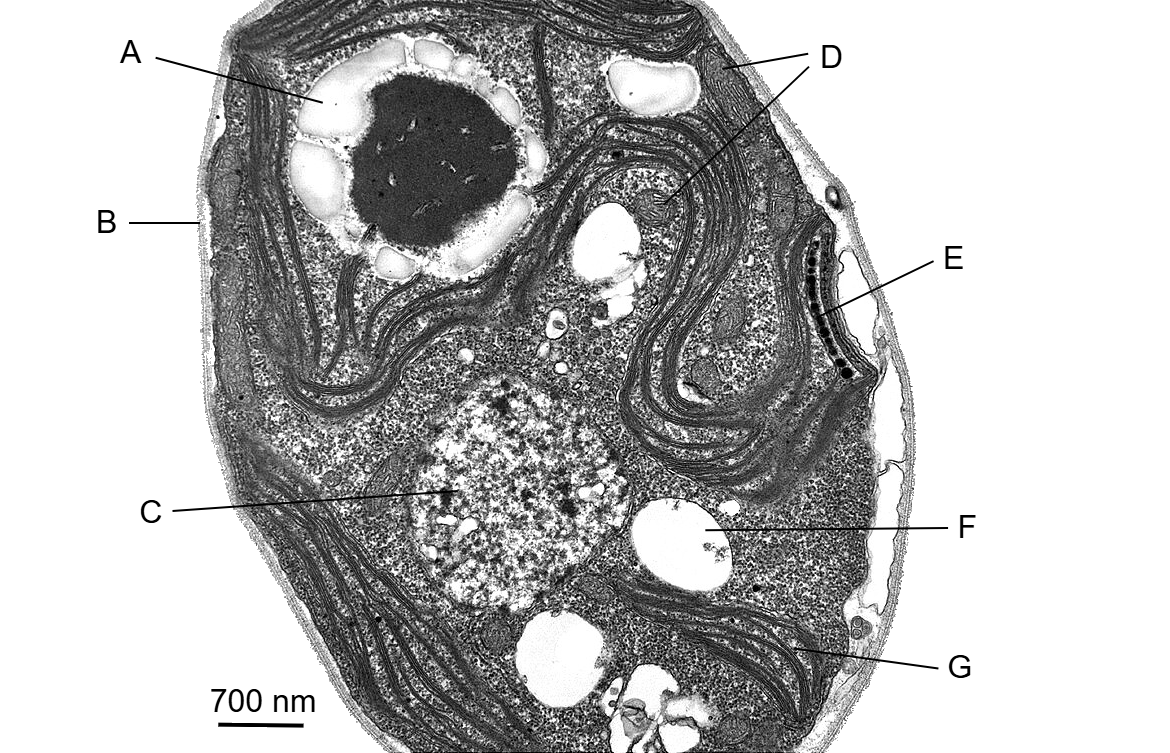
The micrograph shows an organism known as Chlamydomonas, a unicellular photosynthetic organism found in freshwater environments.

Electron micrograph of a cell cross-section, showing internal structures labelled A to G. Scale bar is 700 nanometres.

Dartmouth Electron Microscope Facility, via Wikimedia Commons (opens in a new tab)

Identify the structures labelled B, D and G.

6b
1 mark

The two structures labelled D are slightly different in size and shape.

Suggest why this is the case.

6c
1 mark

Structure A is an amyloplast.

Which of the following correctly describes the function of an amyloplast?

  • absorbs light energy for use in photosynthesis

  • connects neighbouring plant cells

  • provides a site for protein synthesis

  • stores starch as an energy reserve

6d
2 marks

The amyloplasts surround a darker structure known as the pyrenoid. The pyrenoid is a compartment that contains enzymes involved in photosynthesis.

Explain one possible advantage of these enzymes being contained within a compartment.

6e
2 marks

The scale bar shown in part (a) measures 1 cm and the diameter of the cell in the image measures 12.2 cm.

Calculate the actual diameter of the Chlamydomonas cell. Give your answer in μm.

7a
4 marks

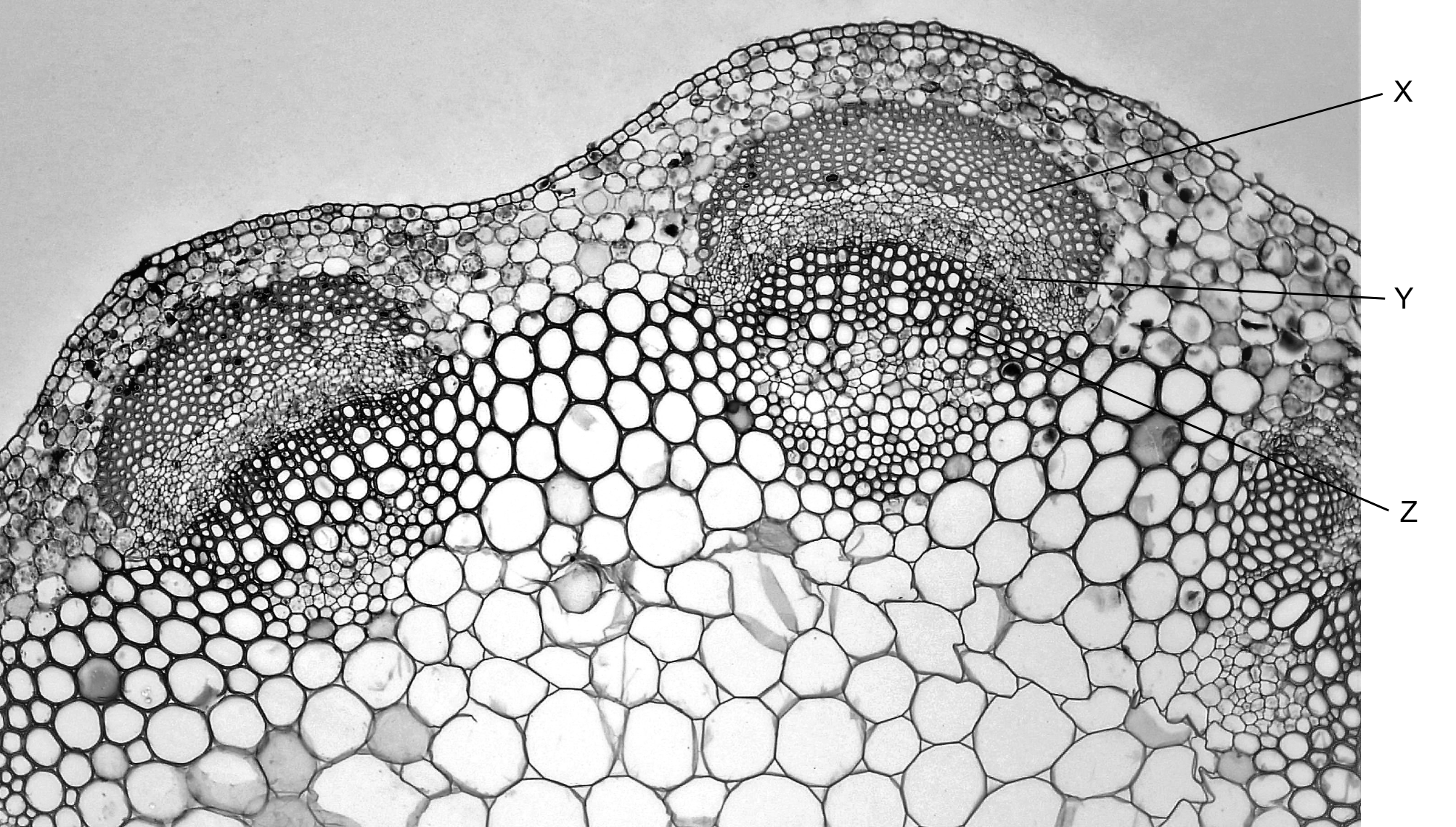
The micrograph shows a cross section through plant tissue.

A cross section showing a vascular bundle. The outermost layer of the bundle is labelled X, the layer underneath is labelled Y, and the inner layer, consisting of larger cells, is labelled Z.

Berkshire Community College Bioscience Image Library, via Flickr (opens in a new tab)

(i) Identify structures X, Y and Z.

[3]

(ii) Identify the region of the plant from which this cross-section has been taken.

[1]

7b
2 marks

The structure labelled X in part (a) can be used to produce materials for human use.

Explain how this contributes to sustainability.

7c
4 marks

Cellulose and starch are both polysaccharides found in plant cells.

Compare and contrast the structure of cellulose and starch.

8
2 marks

Describe the features of plant fibres that give them a high tensile strength.

9a
4 marks

The cassava root is an important food crop grown in the tropics.

The photograph shows organelles containing starch granules inside cassava root cells, as seen using an electron microscope.

q6-unit-2-oct-2021-edexcel-ial-biology

(i) Name these organelles found in cassava root cells.

(1)

(ii) Explain how the structure of starch relates to its function.

(3)

9b
2 marks

The graph shows the mass of five food crops grown in Africa. It also shows the world production of these crops.

q6b-unit-2-oct-2021-edexcel-ial-biology

(i) Which is the percentage of the world cassava crop that is grown in Africa?

(1)

☐ A 33%

☐ B 34% 

☐ C 66%

☐ D 67%

(ii) It is predicted that the world maize production will increase by 2.3% in the following year.

Calculate the world production of maize in the following year.

Give your answer to the nearest whole number.

(1)

Answer ............................ million tonnes

9c
6 marks

Some plants contain chemicals that protect them from being eaten by animals.

These chemicals taste bitter and can be converted by enzymes into hydrogen cyanide.

Hydrogen cyanide inhibits respiration and can cause death.

Cassava can be grouped into two main varieties: bitter cassava and sweet cassava.
These varieties differ in the concentration of the bitter-tasting chemicals.

Processing of the cassava removes most of these chemicals.

The graph shows the mean dry mass of these cassava varieties when grown in the same conditions.

q6c-unit-2-oct-2021-edexcel-ial-biology

The table gives information about three crop plants.

Crop plant

Water requirements

Minimum level of nutrients required in soil

Typical mass of bitter tasting chemicals /mg kg−1

Typical mass of carbohydrate /100g of dry plant matter

Typical mass of protein /100g of dry plant matter

Bitter cassava

low to medium

low

100 to 500

94.70

1.80

Sweet cassava

low to medium

low

10 to 50

94.62

1.84

Maize

medium to high

medium to high

1 to 2

77.46

8.75

Discuss the advantages and disadvantages of growing these three crop plants for human food.

Use the information in the question to support your answer.