Synoptic Exam Questions (Section C) (Edexcel International A Level (IAL) Biology): Exam Questions

Exam code: YBI11

3 hours11 questions
1a
2 marks

The scientific document (opens in a new tab) you have studied is adapted from an article in National Geographic: How personalized medicine is transforming your health care.

Use the information from the scientific document and your own knowledge to answer the following questions.

Explain what is meant by the phrase ‘gene variants’ (paragraph 4).

1b
4 marks

Explain why ‘tumours...riddled with different mutations’ are good candidates for immunotherapies (paragraph 6).

1c
2 marks

Explain why a CT scan was used to show that Judy Perkins was free of tumours (paragraph 10 and Figure 1).

1d
2 marks

Checkpoints are a type of protein that prevent the activation of immune cells.

Explain why a checkpoint inhibitor was given with the lymphocytes in the immunotherapy used to treat Judy Perkins (paragraph 10).

1e
4 marks

Explain how ‘a gene variant that produces a defective form of an enzyme’ reduces the effectiveness of clopidogrel (paragraph 16).

1f
3 marks

Researchers have used stem cells to produce spinal cord tissue from individuals with amyotrophic lateral sclerosis.

These functioning tissues contain motor neurones and blood vessels.

Suggest why blood vessels are required to form functioning spinal cord tissue (paragraph 31).

1g
3 marks

Suggest how ‘a brew of growth factors and other proteins’ can stimulate induced pluripotent stem cells to produce a functioning tissue (paragraph 33).

2a
4 marks

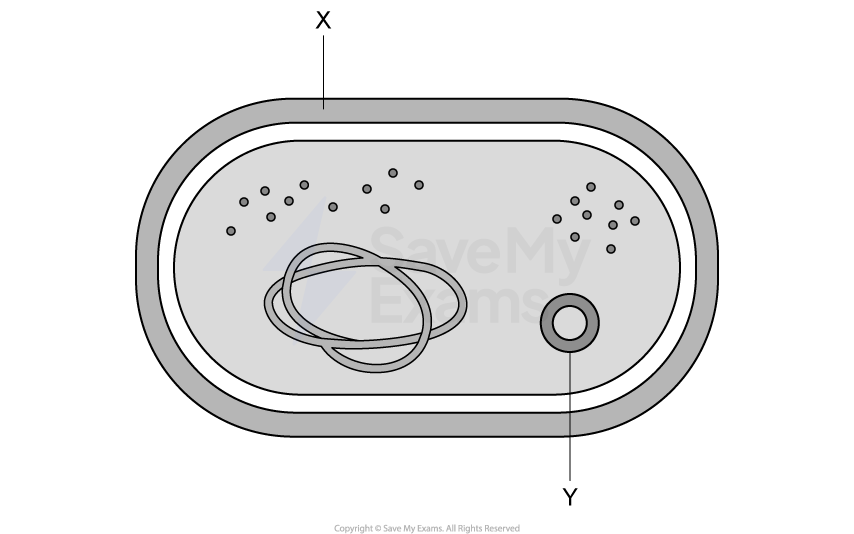
Mycobacterium tuberculosis is a pathogenic bacterium that infects the lungs, causing tuberculosis (TB).

The diagram shows a representation of an M. tuberculosis cell.

Diagram of a bacterial cell with the outermost layer labelled X and a small loop labelled Y.

(i) Identify structures X and Y.

[2]

(ii) The length of the cell in the diagram is 8.8 cm. The diagram is magnified 25 000 times.

Calculate the actual length of the M. tuberculosis cell shown. Give your answer in μm.

[2]

2b
2 marks

M. tuberculosis evades the host immune system by infecting and surviving inside macrophages.

A patient infected with M. tuberculosis was monitored over a four-week period. Blood tests showed sustained high concentrations of specific antibodies, but the number of bacteria in the patient's lungs continued to increase.

Suggest why the production of antibodies alone is not sufficient to clear a Mycobacterium tuberculosis infection.

2c
2 marks

Scientists extracted DNA from M. tuberculosis samples and used PCR followed by gel electrophoresis to compare the genomes of antibiotic resistant and non-resistant strains.

Explain why PCR was carried out on the DNA samples before gel electrophoresis.

2d
3 marks

Describe the process of gel electrophoresis used to compare the genomes.

2e
3 marks

Antibiotic resistance in M. tuberculosis is a growing problem worldwide, making some TB infections difficult to treat.

Explain how antibiotic-resistant strains of M. tuberculosis can develop.

3a
2 marks

The scientific document (opens in a new tab) you have studied is adapted from an article in Education in Chemistry: Developing vaccines, Self-defence classes for our immune system.

Use the information from the scientific document and your own knowledge to answer the following questions.

The Ebola virus can infect endothelial cells.

Describe how this virus can cause internal bleeding (paragraph 1).

3b
4 marks

Explain how ‘our immune systems learn to make another type of protein, called an antibody’ (paragraph 4).

3c
2 marks

One method of slowing the degradation of vaccine proteins is to dry a mixture of sugars and vaccine on a filter.

Explain why flushing with water releases the vaccine from the filter (paragraphs 8 and 9).

3d
3 marks

During the production of some vaccines, the virus is allowed to replicate in eggs (paragraph 13).

Explain how a vaccine produced in this way may become less effective.

3e
7 marks

Scientists are using genetically modified bacteria and insect cells to produce the antigens for Ebola vaccines (paragraph 13).

(i) Describe how insect cells could be genetically modified to produce the antigens for an Ebola vaccine. 

(4)

(ii) Suggest three benefits of using an insect cell to produce the Ebola virus antigen.

(3)

3f
2 marks

Suggest why the stems of the different versions of haemagglutinin molecules are the same but the heads can be different (paragraph 15).

4a
2 marks

A student investigated the nutritional content of two food products, A and B, sold as "healthy" snack bars.

Nutrient

Product A (g / 100 g)

Product B (g / 100 g)

Carbohydrate

62

44

Fat

8

18

Protein

6

14

The energy values of macronutrients are:

  • Carbohydrate: 17 kJ g⁻¹

  • Fat: 39 kJ g⁻¹

  • Protein: 17 kJ g⁻¹

Using the data in the table, calculate the expected energy content of product B per 100 g. Show your working.

4b
3 marks

A nutritionist advised that frequent consumption of product B could increase the risk of cardiovascular disease due to its high saturated fat content.

Explain how a diet high in saturated fat can lead to coronary heart disease.

4c
2 marks

Product A contains fat with a higher proportion of unsaturated fatty acids.

State two structural differences between a saturated and an unsaturated fatty acid.

4d
1 mark

Which of the following describes the bond formed between glycerol and a fatty acid in product B?

  • Glycosidic bond formed by hydrolysis

  • Ester bond formed by condensation

  • Peptide bond formed by condensation

  • Ester bond formed by hydrolysis

4e
2 marks

Sucrose was found in product A.

Describe the structure of a sucrose molecule.

5a
3 marks

The scientific document (opens in a new tab) you have studied is adapted from an article in Science Direct: Assessment of food toxicology by Alexander Gosslau.

Use the information from the scientific article and your own knowledge to answer the following questions.

Explain how toxicants in food could cause Parkinson’s disease (paragraph 3).

5b
2 marks

Suggest how the genes affected by toxicants can be identified (paragraph 4).

5c
3 marks

Explain how scientists could determine the high degree of homology of genes between humans and zebrafish (paragraph 5).

5d
3 marks

Suggest how electrophilic species (ES) of free radicals could be “involved in the modulation of gene expression” (paragraph 6).

5e
3 marks

Suggest how ES can damage mtDNA (paragraph 7).

5f
4 marks

In the MTT assay, reduced NAD converts an MTT solution from yellow to purple.

Describe how the MTT assay could be used to show which of two drugs is more toxic to cells (paragraph 10).

5g
2 marks

Explain the advantages of reprogramming ordinary somatic cells to behave like embryonic stem cells for use in stem cell‐based assays of toxicants (paragraph 11).

6a
2 marks

The scientific article (opens in a new tab) you have studied is adapted from Rethinking Alzheimer’s in New Scientist (February 2019).

Use the information from the scientific article and your own knowledge to answer the following questions.

Memory and cognitive function are two processes that occur in the brain (paragraphs 2 and 13).

Different parts of the brain are responsible for specific functions.

Complete the table showing which parts of the brain are responsible for different functions.

Part of brain

Function

 cerebellum


 interpretation of information from the retina

 medulla oblongata


 secretion of ADH

6b
4 marks

Some forms of dementia can be diagnosed using brain scans.

Compare and contrast the use of functional magnetic resonance imaging (fMRI) and computed tomography (CT) scans to identify structures like plaques in the brain (paragraph 6).

6c
4 marks

Suggest how the amyloid protein may prevent bacterial infection in the brain (paragraphs 7 and 22).

6d
4 marks

Explain how the bacterium Porphyromonas gingivalis that causes gum disease may invade the brain and cause inflammation in brain regions affected by Alzheimer’s disease (paragraphs 10, 20 and 21).

6e
3 marks

Suggest how gingipains may have a degrading effect on the memory of a person suffering from Alzheimer’s disease (paragraph 12).

6f
3 marks

The team found genetic material from P. gingivalis in the cerebral cortex (paragraph 13).

Describe how the team could show that this genetic material is active.

7a
3 marks

Some fungi infect plants and affect the expression of the plant genes.

A student drew and labelled a fungal cell.

q8a-unit-2-june-2021-edexcel-ial-biology

Compare and contrast the structure of this fungal cell and a plant cell.

7b
12 marks

The illustration shows darnel, a species of grass.

-m~CkT8__untitled

Raw Pixel, CC0 1.0 <https://creativecommons.org/publicdomain/zero/1.0/>, via Raw Pixel

The fungus Epichloë festucae lives within darnel for part of its life cycle.

The fungus influenced the expression of certain genes in the plant cells.

  • There was reduced expression of some genes involved in DNA synthesis.

  • There was reduced expression of some genes involved with the synthesis of phospholipids, starch and sucrose.

(i) Explain the effect of this fungal infection on the growth of the plant.

(4)

(ii) The fungus and the plant both benefit from this relationship.

The fungus absorbs nutrients from the plant.

The expression of certain genes in the plant cells is increased when infected with the fungus.

These genes are involved in the synthesis of tannin and flavonoids.

The graph shows the relationship between tannin concentration and the degree of darnel leaf damage by herbivores (grazing animals).

q8bii-unit-2-june-2021-edexcel-ial-biology

The table shows the antimicrobial effect of different concentrations of flavonoids on cultures of the bacterium Pseudomonas aeruginosa.

This bacterium causes disease in plants.

Flavonoid concentration / μgcm-3

Diameter of inhibition zone / mm

500

7.0

666

8.0

1 000

9.0

The fungus increases the expression of the genes involved in the synthesis of tannin and flavonoids.

Discuss the advantages and disadvantages of this for the fungus and for the infected plants.

(6)

(iii) The bacterium Pseudomonas aeruginosa causes lung infections in humans.

Describe how a drug containing flavonoids could be tested in a stage II drug trial.

(2)

8a
1 mark

The scientific article you have studied is about CRISPR gene therapy for sickle cell disease.

Use the information from the scientific documents and your own knowledge to answer the following questions.

State what is meant by a genetically modified organism (paragraph 1).

8b
3 marks

Explain how glutamic acid being replaced by valine results in the symptoms of SCD.

8c
4 marks

Compare and contrast traditional recombinant DNA technology with the CRISPR-Cas9 gene editing system described in the article (paragraph 3).

8d
3 marks

Describe how gel electrophoresis could be used to confirm that the gene editing was successful (paragraph 4).

8e
4 marks

Describe how expression of the corrected HBB gene leads to the production of functional haemoglobin (paragraph 5).

8f
1 mark

Calculate the mean change in haemoglobin concentration for the treatment group between baseline and 12 months (Table 1).

Give your answer to 2 significant figures.

8g
4 marks

Using information from the article, evaluate the use of CRISPR gene therapy for the treatment of sickle cell disease.

9a
1 mark

Cystic fibrosis (CF) is caused by a mutation in the gene encoding the CFTR protein. The mutation changes one base in the normal CFTR sequence from CCT to CGT.

Name the type of mutation that occurs.

9b
1 mark

The mutated CFTR gene contains the following DNA sequence:

TAC — GGA — CGT — ATG

Determine the amino acid sequence transcribed from this DNA.

Use the table below.

mRNA codon

Amino acid

AUG

Methionine

CCU

Proline

GGU

Glycine

GCA

Alanine

UAC

Tyrosine

ACG

Threonine

9c
4 marks

People with cystic fibrosis produce very thick, sticky mucus

Explain why a mutation in this gene results in the production of very thick, sticky mucus.

9d
1 mark

The thick mucus accumulates in the airways of the lungs.

Which of the following explains why thick mucus reduces gaseous exchange?

  • Increases concentration gradient

  • Increases effective thickness of the surface

  • Increases surface area

  • Decreases partial pressure of CO₂

9e
4 marks

A couple are both unaffected carriers of cystic fibrosis.

Construct a genetic cross and determine the probability of their next child being a carrier.

10a
2 marks

Whales are large mammals.

The photograph shows a humpback whale and a human diver.

humpback-whale

NOAA's National Ocean Service, CC BY 2.0 <https://creativecommons.org/licenses/by/2.0>, via Wikimedia Commons

(i) A humpback whale can become habituated to human divers.

How many of the following statements about habituation are correct?

(1)

  • Habituation is an example of anatomical adaptation

  • Habituation is only observed in mammals

  • Habituation only occurs after repeated exposure to the same stimulus

A

0

B

C

D

(ii) A humpback whale can respond to a stimulus using a spinal reflex arc.

Which row is correct?

(1)

Location of relay neurone

Location of cell body on the sensory neurone

A

 grey matter of spinal cord

 at the end of the axon

B

 grey matter of spinal cord 

 in the middle of the axon

C

 white matter of spinal cord 

 at the end of the axon

D

 white matter of spinal cord 

 in the middle of the axon

10b
6 marks

The heart rate of a whale changes when it is diving.

The graph shows the changes in heart rate that occur during dives of different durations.

The maximum heart rate at the surface is when the whale returns to the surface after a dive.

q3b-unit-5-january-2022-edexcel-ial-biology

(i) Comment on the changes in heart rate of the whale when it is diving.

(3)

(ii) Explain how the changes in heart rate are controlled when the whale returns to the surface immediately after the dive.

(3)

11a
2 marks

When activated, T lymphocytes can divide rapidly and secrete proteins called cytokines.

These cytokines will activate different types of lymphocyte.

(i) Which is the function of tRNA in cytokine synthesis?

(1)

A

identifies an amino acid and transports it to a ribosome

B

identifies a base and transports it to a ribosome 

C

forms a template for DNA polymerase 

D

forms a template for RNA polymerase 

(ii) Which organelle is involved in chemically modifying cytokine proteins before they are secreted?

(1)

A

Golgi apparatus

B

ribosome 

C

smooth endoplasmic reticulum 

D

vesicle 

11b
2 marks

Describe the role of DNA polymerase in DNA replication during cell proliferation.

11c
3 marks

Explain how cytokine genes can be expressed in an activated T lymphocyte.

11d
3 marks

CD45 is a protein found on the surface of lymphocytes. Different forms of the CD45 protein are found on the surface of different lymphocytes.

Describe how different forms of the CD45 protein can be produced from a single CD45 gene.