Volumes of Revolution (Edexcel International A Level (IAL) Maths: Pure 4): Revision Note
Exam code: YMA01

Volumes of revolution around the x-axis
What is a volume of revolution around the x-axis?
A solid of revolution is formed when an area bounded by a function (and other boundary equations) is rotated 360° around the x-axis
A volume of revolution is the volume of this solid formed
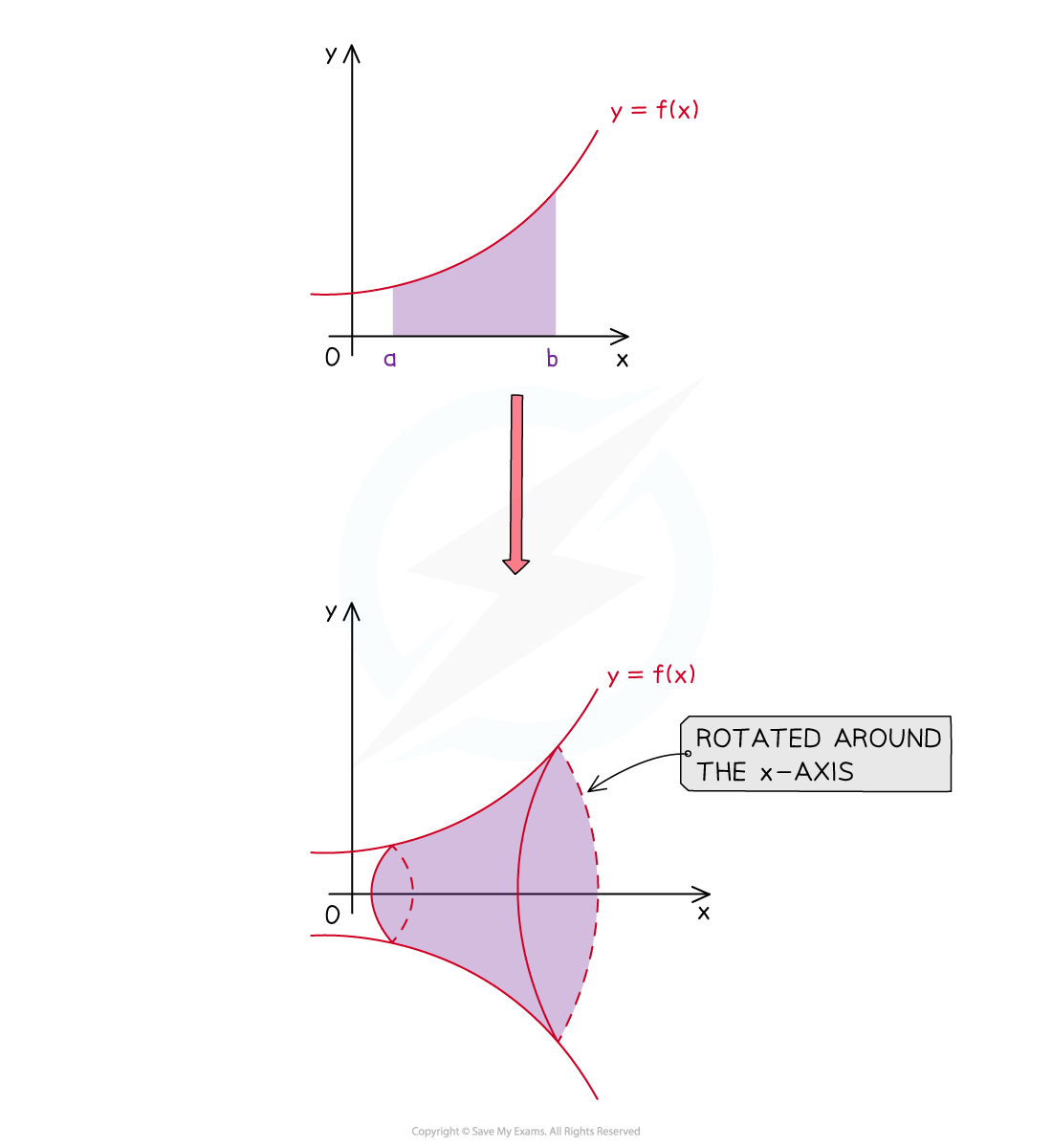
Example of a solid of revolution that is formed by rotating the area bounded by the function , the lines and and the -axis about the --axis
How do I find the volume of revolution around the x-axis?
To find the volume of revolution created when the area bounded by the function , the lines and , and the x-axis is rotated 360° about the x-axis use the formula
The formula may look complicated or confusing at first due to the y and dx
remember that y is a function of x
once the expression for y is substituted in, everything will be in terms of x
π is a constant so you may see this written either inside or outside the integral
This is not given in the formulae booklet
The formulae booklet does list the volume formulae for some common 3D solids – it may be possible to use these depending on what information about the solid is available
How do I solve problems involving volumes of revolution around the x-axis?
Visualising the solid created is helpful
Try sketching some functions and their solids of revolution to help
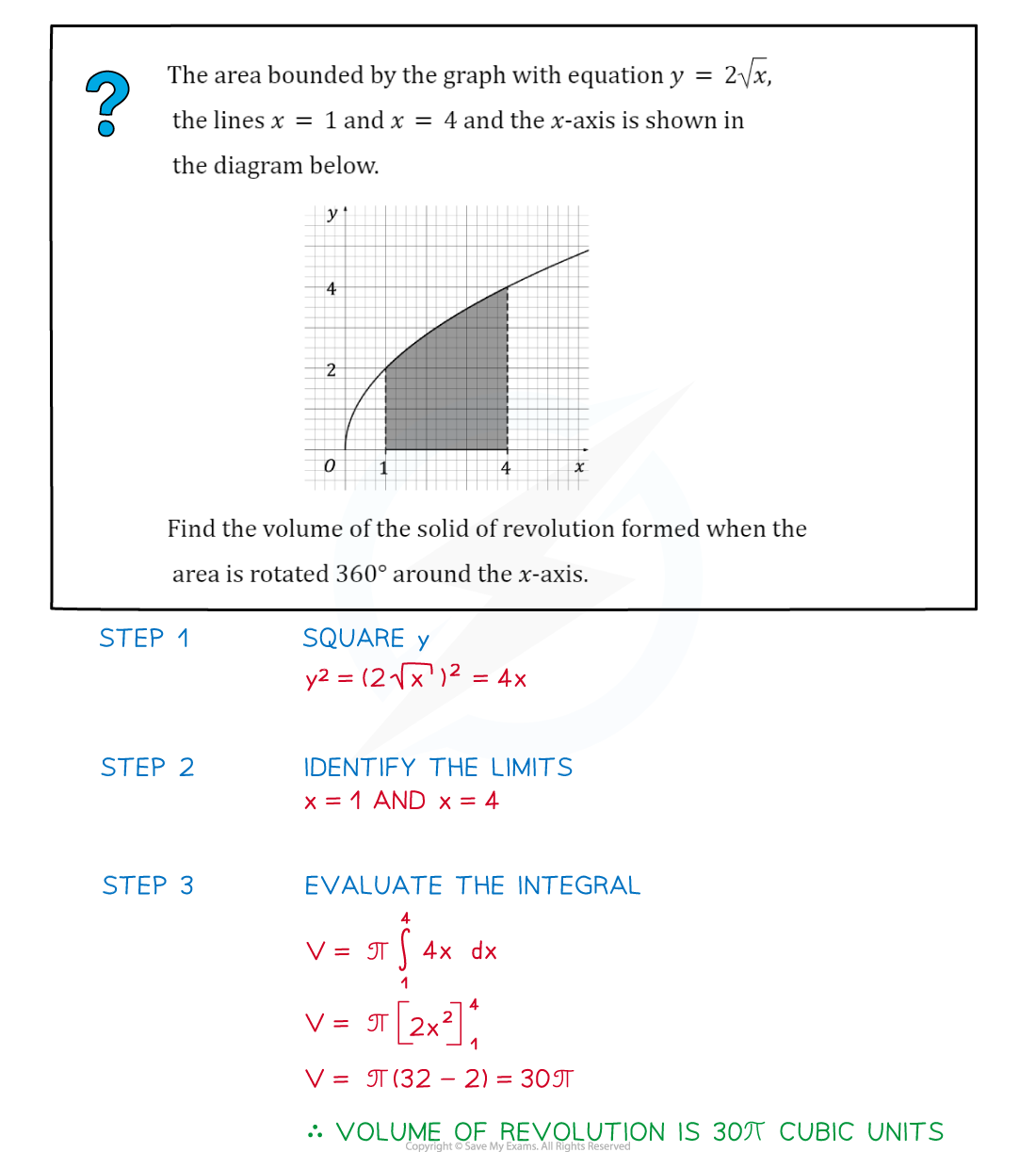
STEP 1 Square y
Do this first without worrying about π or the integration and limits
STEP 2 Identify the limits a and b (which could come from a graph)
STEP 3 Use the formula by evaluating the integral and multiplying by π
The answer may be required in exact form (leave in terms of π)
If not, round to three significant figures (unless told otherwise)
Trickier questions may give you the volume and ask for the value of an unknown constant elsewhere in the problem
Worked Example
Examiner Tips and Tricks
To help remember the formula note that it is only - volume is 3D so you may have expected a cubic expression
If rotating a single point around the x-axis a circle of radius would be formed
The area of that circle would then be
Integration then adds up the areas of all circles between a and b creating the third dimension and volume
(In 2D, integration creates area by adding up lots of 1D lines)

Unlock more, it's free!
Join the 100,000+ Students that ❤️ Save My Exams
the (exam) results speak for themselves:

Was this revision note helpful?
Build on this topic