Parametric Volumes of Revolution (Edexcel International A Level (IAL) Maths: Pure 4): Revision Note
Exam code: YMA01

Parametric volumes of revolution
What is a parametric volume of revolution?
Solids of revolution are formed by rotating functions about the x-axis
Here though, rather than given y in terms of x, both x and y are given in terms of a parameter, t
Depending on the nature of the functions f and g it may not be convenient or possible to find y in terms of x
How do I find parametric volumes of revolution?
The aim is to replace everything in the ‘original’ integral so that it is in terms of t
For the ‘original’ integral and parametric equations given in the form and use the following process
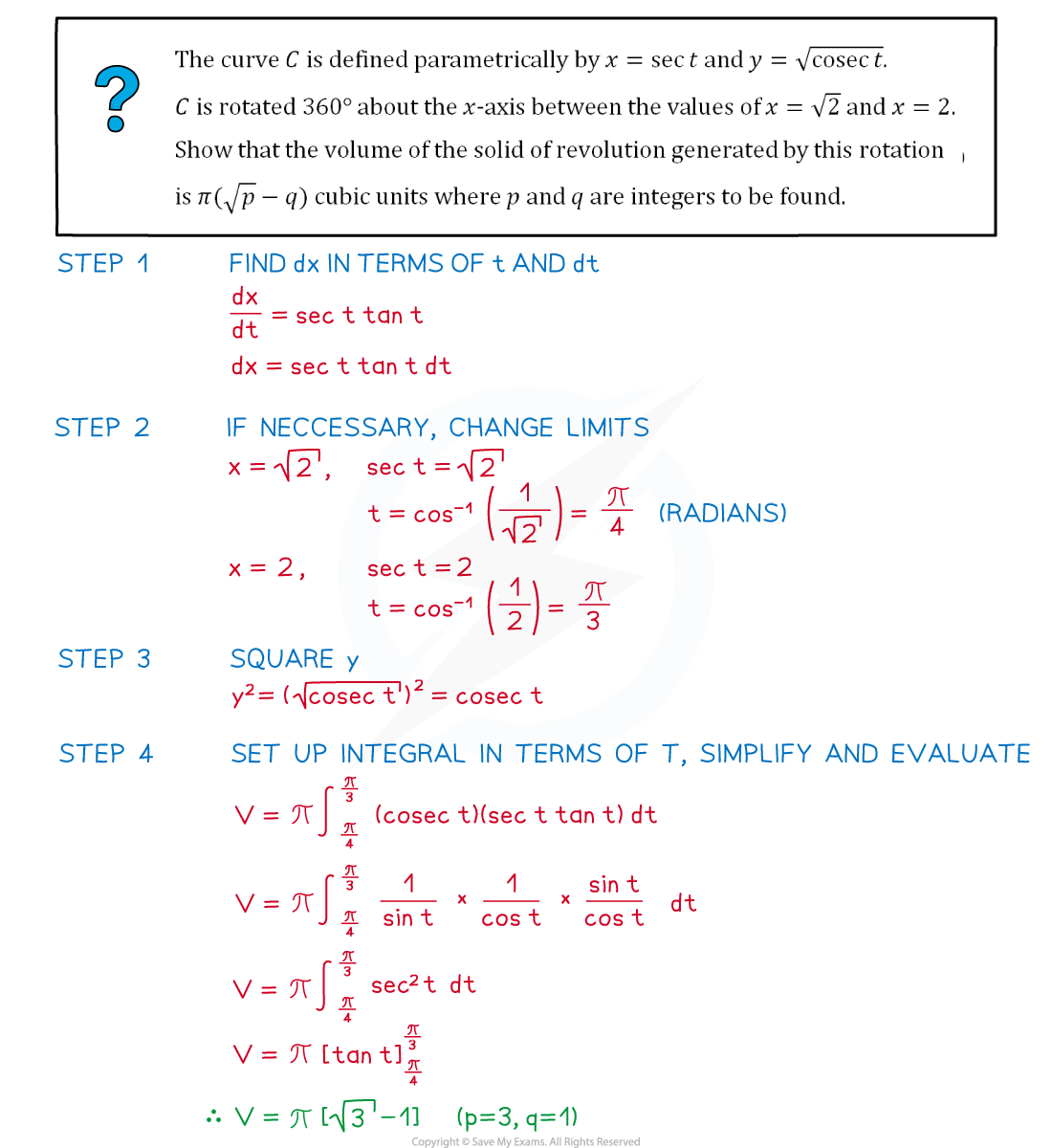
STEP 1: Find dx in terms of t and dt
STEP 2: If necessary, change the limits from x values to t values using
STEP 3: Square y
Do this separately to avoid confusing when putting the integral together
STEP 4: Set up the integral, so everything is now in terms of t, simplify where possible and evaluate the integral to find the volume of revolution
Worked Example
Examiner Tips and Tricks
Avoid the temptation to jump straight to STEP 4
There could be a lot to change and simplify in exam style problems
Doing each step carefully helps maintain high levels of accuracy

Unlock more, it's free!
Join the 100,000+ Students that ❤️ Save My Exams
the (exam) results speak for themselves:

Was this revision note helpful?
Build on this topic