Differentiating Other Functions (Cambridge (CIE) A Level Maths: Pure 3): Revision Note

Exam code: 9709

Amber

Written by: Amber

Reviewed by: Dan Finlay

Updated on

Differentiating other functions

How do I differentiate common functions?

  • These are the common results

    • fraction numerator d over denominator d x end fraction left parenthesis x to the power of n right parenthesis equals n x to the power of n minus 1 end exponent

    • fraction numerator d over denominator d x end fraction left parenthesis straight e to the power of x right parenthesis equals straight e to the power of x

    • fraction numerator d over denominator d x end fraction left parenthesis a to the power of x right parenthesis equals a to the power of x ln space a for a greater than 0

    • fraction numerator d over denominator d x end fraction left parenthesis ln space x right parenthesis equals 1 over x

    • fraction numerator d over denominator d x end fraction left parenthesis sin space x right parenthesis equals cos space x

    • fraction numerator d over denominator d x end fraction left parenthesis cos space x right parenthesis equals negative sin space x

    • fraction numerator d over denominator d x end fraction left parenthesis tan space x right parenthesis equals sec squared space x

    • fraction numerator d over denominator d x end fraction left parenthesis cot space x right parenthesis equals negative cos ec squared space x

    • fraction numerator d over denominator d x end fraction left parenthesis sec space x right parenthesis equals sec space x tan space x

    • fraction numerator d over denominator d x end fraction left parenthesis cos ec space x right parenthesis equals negative cos ec space x cot space x

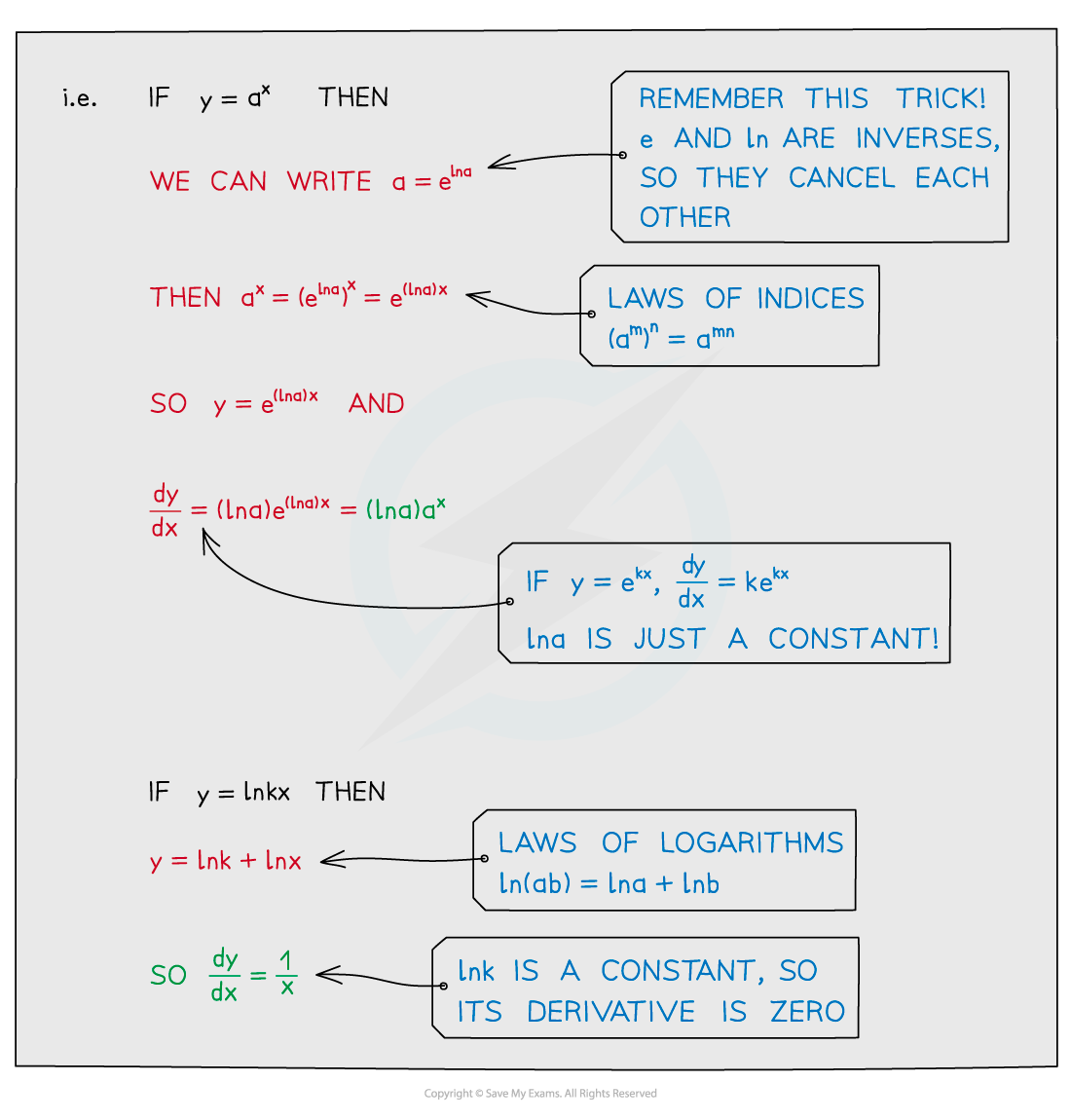
How do I differentiate ekx, ax, ln(kx) and akx?

Diff Other Funct Illustr 1, AS & A Level Maths revision notes
Diff Other Funct Illustr 2_forms, AS & A Level Maths revision notes
Diff Other Funct Illustr 2_derivs, AS & A Level Maths revision notes
  • And for akx:

Diff Other Funct Illustr 3, AS & A Level Maths revision notes
  • This last formula can be derived from Formula 3 by using the chain rule

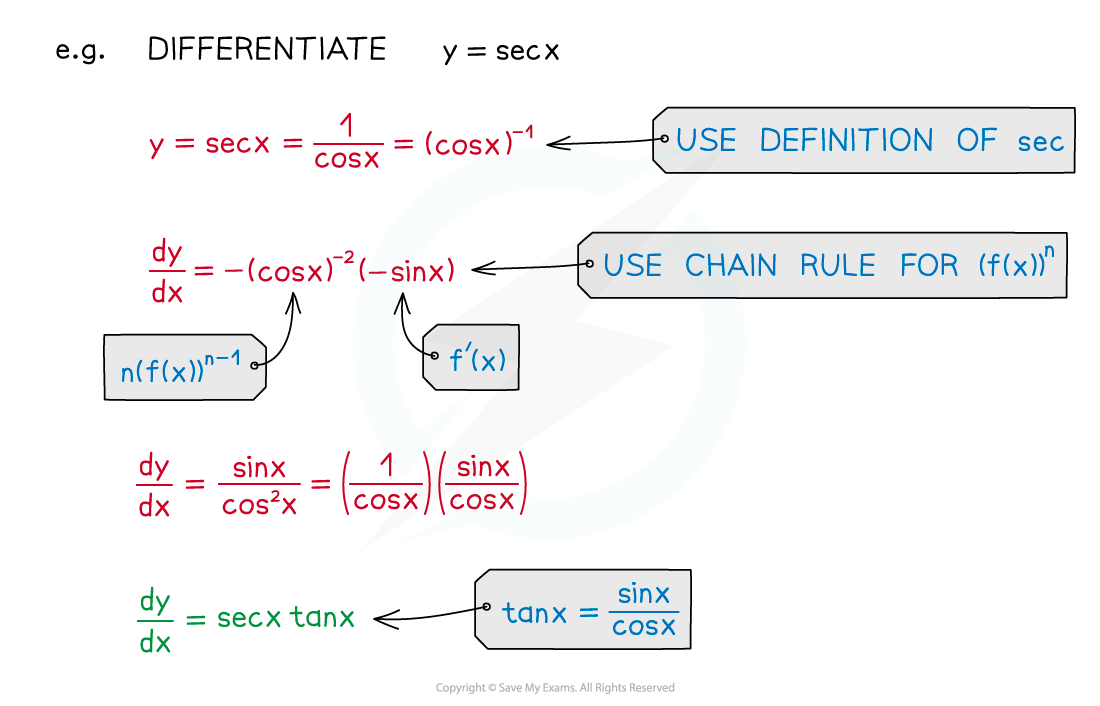
How do I differentiate reciprocal trigonometric functions?

  • The formulae for the derivatives of the reciprocal trigonometric functions are:

begin mathsize 22px style fraction numerator d over denominator d x end fraction left parenthesis sec x right parenthesis equals sec x tan x end style

fraction numerator size 22px d over denominator size 22px d size 22px x end fraction size 22px left parenthesis size 22px cosec size 22px x size 22px right parenthesis size 22px equals size 22px minus size 22px cosec size 22px x size 22px cot size 22px x

fraction numerator size 22px d over denominator size 22px d size 22px x end fraction size 22px left parenthesis size 22px cot size 22px x size 22px right parenthesis size 22px equals size 22px minus size 22px cosec to the power of size 22px 2 size 22px x

  • You can derive the derivatives for sec, cosec, and cot using the chain rule and the derivatives of the basic trigonometric functions 
 

Diff Rec Inv Trig Illustr 1, AS & A Level Maths revision notes

Examiner Tips and Tricks

All of the above are in the formula book, make sure you know how to find them. They will be particularly useful when working with identities and when integrating trigonometric functions.

Worked Example
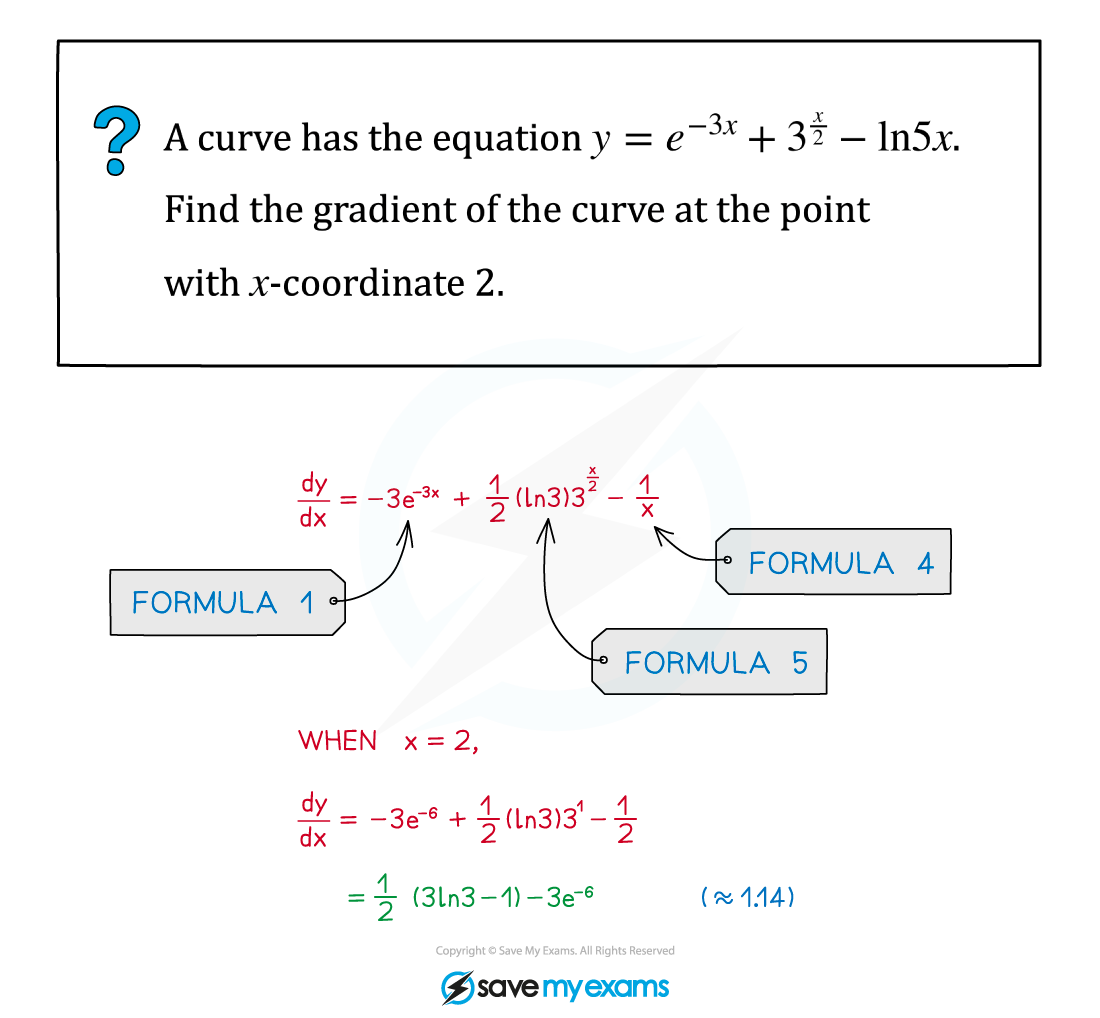
Diff Other Funct Example, AS & A Level Maths revision notes

Unlock more, it's free!

Join the 100,000+ Students that ❤️ Save My Exams

the (exam) results speak for themselves:

Build on this topic

Amber

Author: Amber

Expertise: Maths Content Creator

Amber gained a first class degree in Mathematics & Meteorology from the University of Reading before training to become a teacher. She is passionate about teaching, having spent 8 years teaching GCSE and A Level Mathematics both in the UK and internationally. Amber loves creating bright and informative resources to help students reach their potential.

Dan Finlay

Reviewer: Dan Finlay

Expertise: Portfolio Lead

Dan graduated from the University of Oxford with a First class degree in mathematics. As well as teaching maths for over 8 years, Dan has marked a range of exams for Edexcel, tutored students and taught A Level Accounting. Dan has a keen interest in statistics and probability and their real-life applications.