Modulus & Argument (Cambridge (CIE) A Level Maths: Pure 3): Revision Note
Exam code: 9709

Modulus & argument
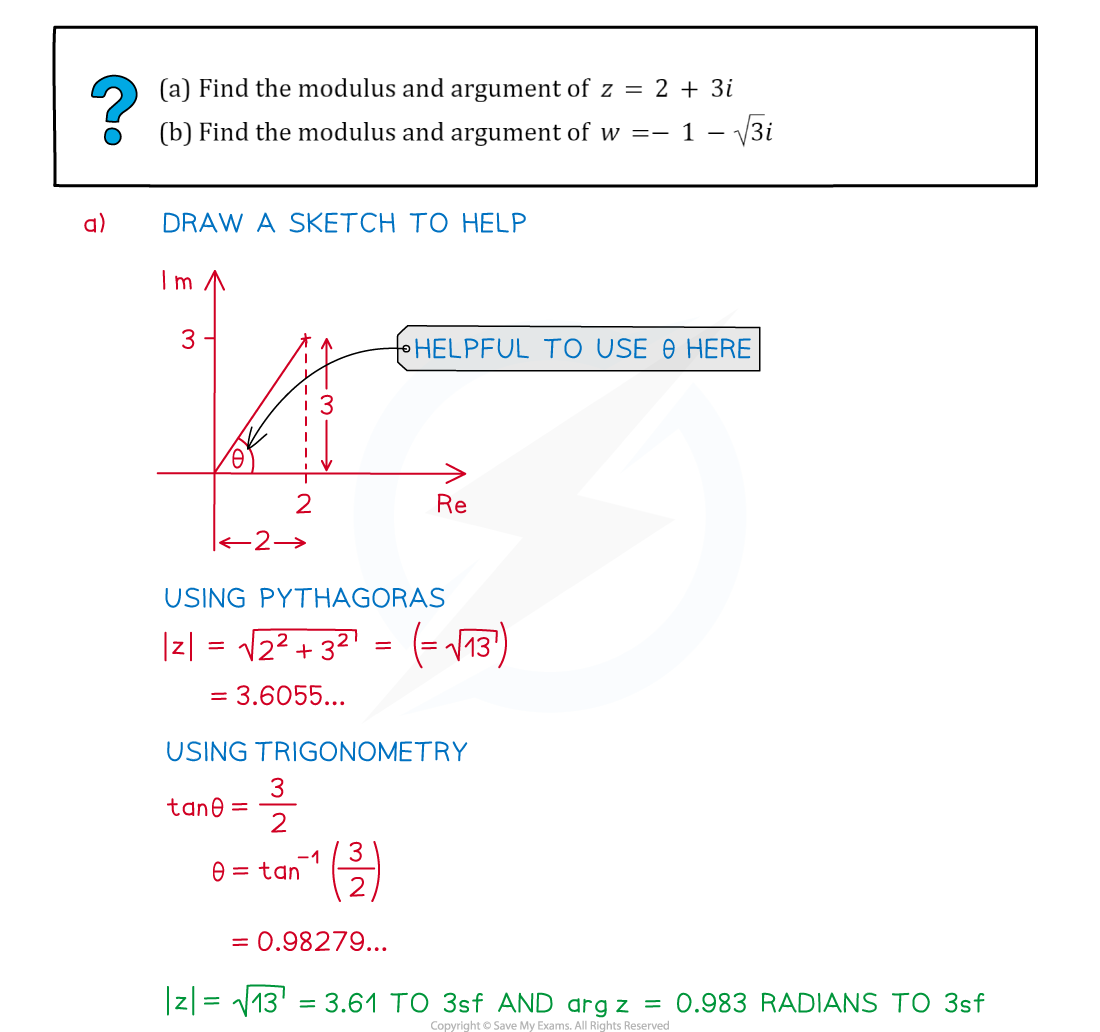
How do I find the modulus of a complex number?
The modulus of a complex number is its distance from the origin when plotted on an Argand diagram
The modulus of is written
If , then we can use Pythagoras to show…
A modulus is always positive
the modulus is related to the complex conjugate by…
This is because
In general,
e.g. both and have a modulus of 5, but simplifies to which has a modulus of 8

How do I find the argument of a complex number?
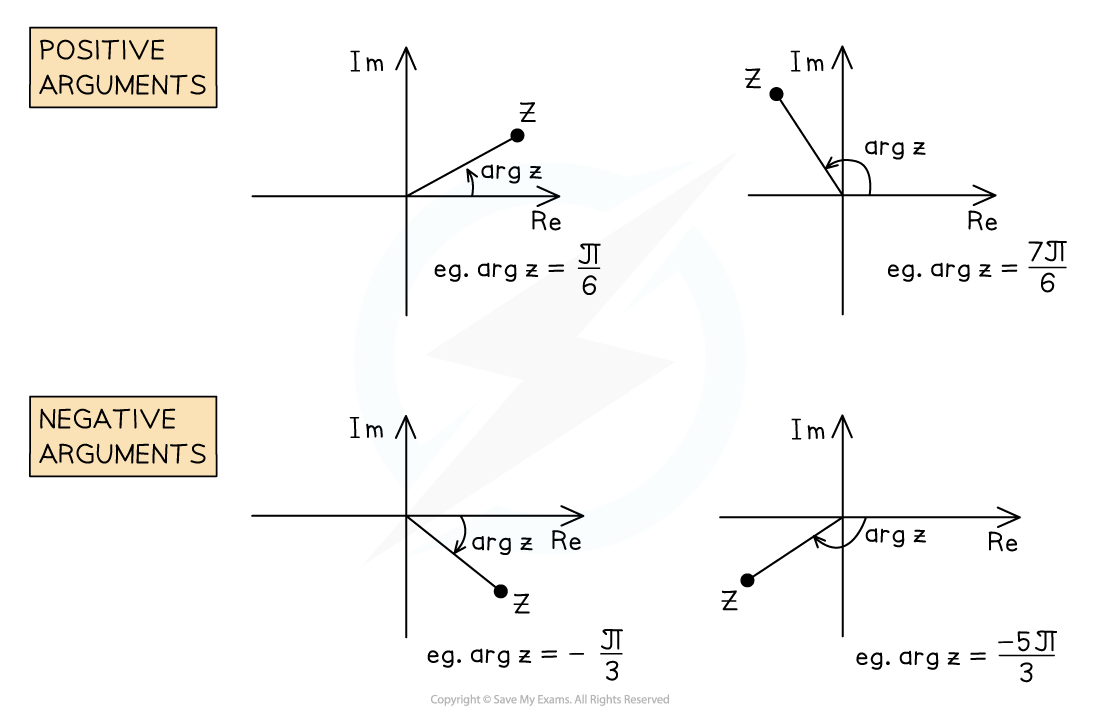
The argument of a complex number is the anti-clockwise angle that it makes when starting at the positive real axis on an Argand diagram
Arguments are measured in radians
Sometimes these can be given exact in terms of
The argument of is written
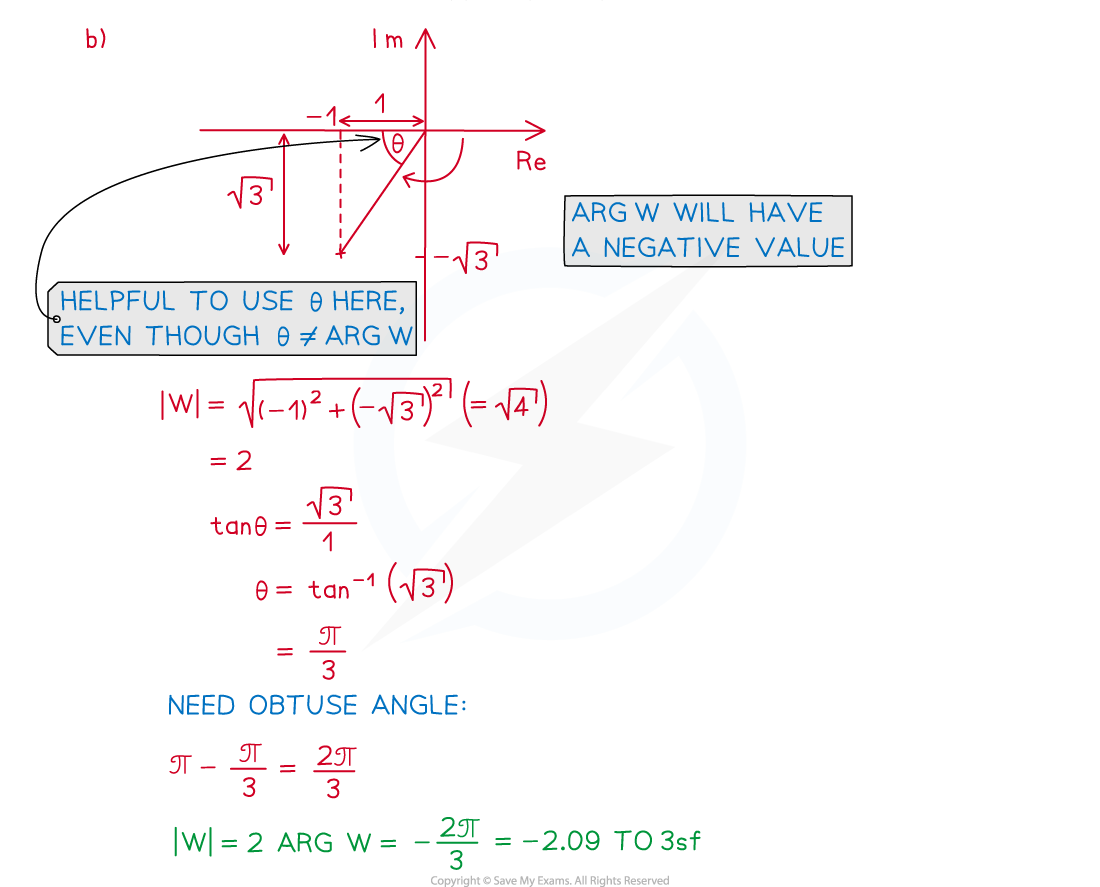
Arguments can be calculated using right-angled trigonometry
This involves using the tan ratio plus a sketch to decide whether it is positive/negative and acute/obtuse
Arguments are usually given in the range
Negative arguments are for complex numbers in the third and fourth quadrants
Occasionally you could be asked to give arguments in the range
The argument of zero, is undefined (no angle can be drawn)
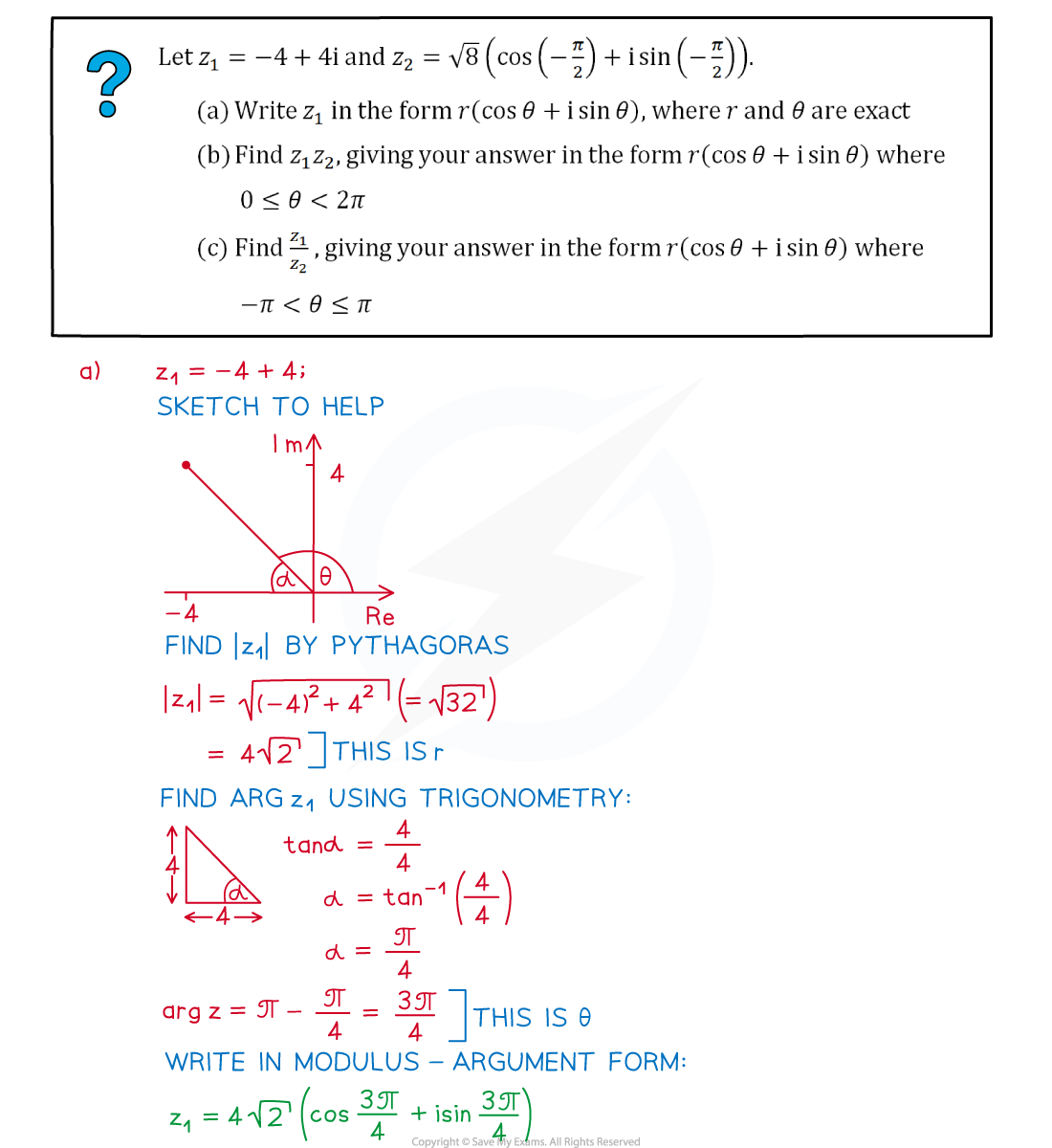
Worked Example
Examiner Tips and Tricks
Give non-exact arguments in radians to 3 significant figures.
Modulus-argument (polar) form
The complex number is said to be in Cartesian form. There are, however, other ways to write a complex number, such as in modulus-argument (polar) form.
How do I write a complex number in modulus-argument (polar) form?
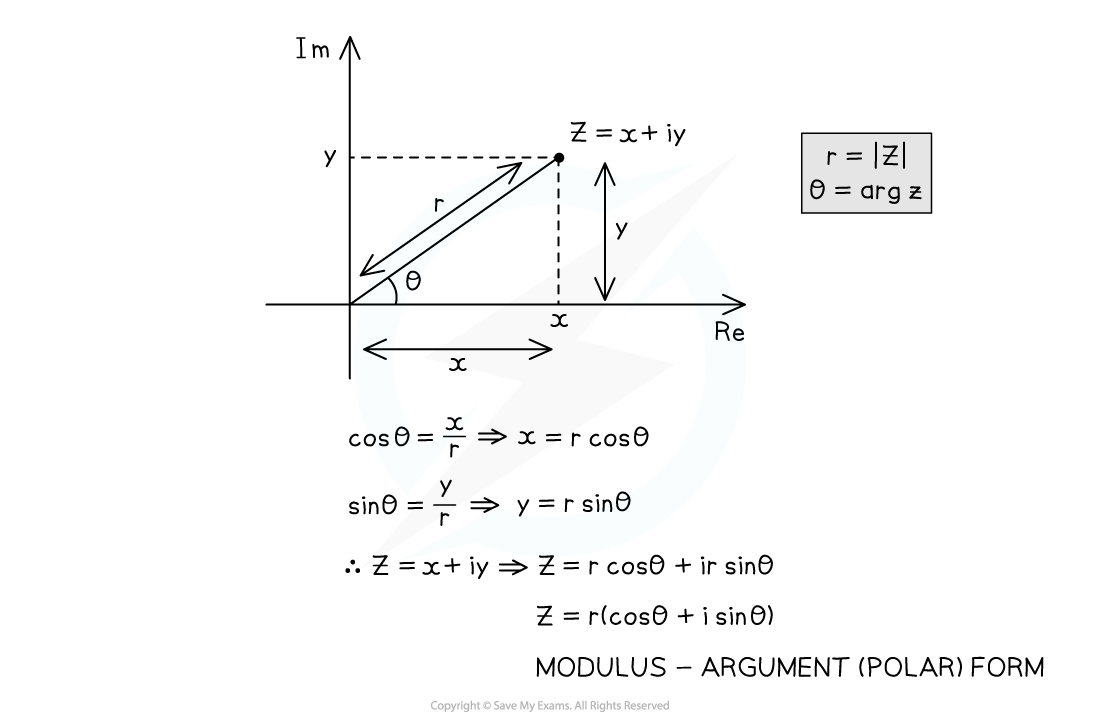
The Cartesian form of a complex number, , is written in terms of its real part, , and its imaginary part,
If we let and , then it is possible to write a complex number in terms of its modulus, , and its argument, , called the modulus-argument (polar) form, given by...
It is usual to give arguments in the range
Negative arguments should be shown clearly, e.g. without simplifying to either or
Occasionally you could be asked to give arguments in the range
If a complex number is given in the form , then it is not currently in modulus-argument (polar) form due to the minus sign, but can be converted as follows…
By considering transformations of trigonometric functions, we see that and
Therefore can be written as , now in the correct form and indicating an argument of
To convert from modulus-argument (polar) form back to Cartesian form, evaluate the real and imaginary parts
E.g. becomes
What are the rules for moduli and arguments under multiplication and division?
When two complex numbers, and , are multiplied to give , their moduli are also multiplied
When two complex numbers, and , are divided to give , their moduli are also divided
When two complex numbers, and , are multiplied to give , their arguments are added
When two complex numbers, and , are divided to give , their arguments are subtracted
How do I multiply complex numbers in modulus-argument (polar) form?
The main benefit of writing complex numbers in modulus-argument (polar) form is that they multiply and divide very easily (often quicker than when in Cartesian form)
To multiply two complex numbers, and , in modulus-argument (polar) form we use the rules from above to multiply their moduli and add their arguments
So if and then the rules above give…
Sometimes the new argument, , does not lie in the range (or if this is being used)
An out-of-range argument can be adjusted by either adding or subtracting
E.g. If and then
This is currently not in the range , but by subtracting from to give , a new argument is formed that lies in the correct range and represents the same angle on an Argand diagram
The rules of multiplying the moduli and adding the arguments can also be applied when…
…multiplying three complex numbers together, , or more
…finding powers of a complex number (e.g. can be written as )
Whilst not examinable, the rules for multiplication can be proved algebraically by multiplying by , expanding the brackets and using compound angle formulae
How do I divide complex numbers in modulus-argument (polar) form?
To divide two complex numbers, and in modulus-argument (polar) form, we use the rules from above to divide their moduli and subtract their arguments
So if and then the rules above give…
As with multiplication, sometimes the new argument, , can lie out of the range (or the range if this is being used)
You can add or subtract to bring out-of-range arguments back in range
Whilst not examinable, the rules for division can be proved algebraically by dividing by , using complex division and compound angle formulae
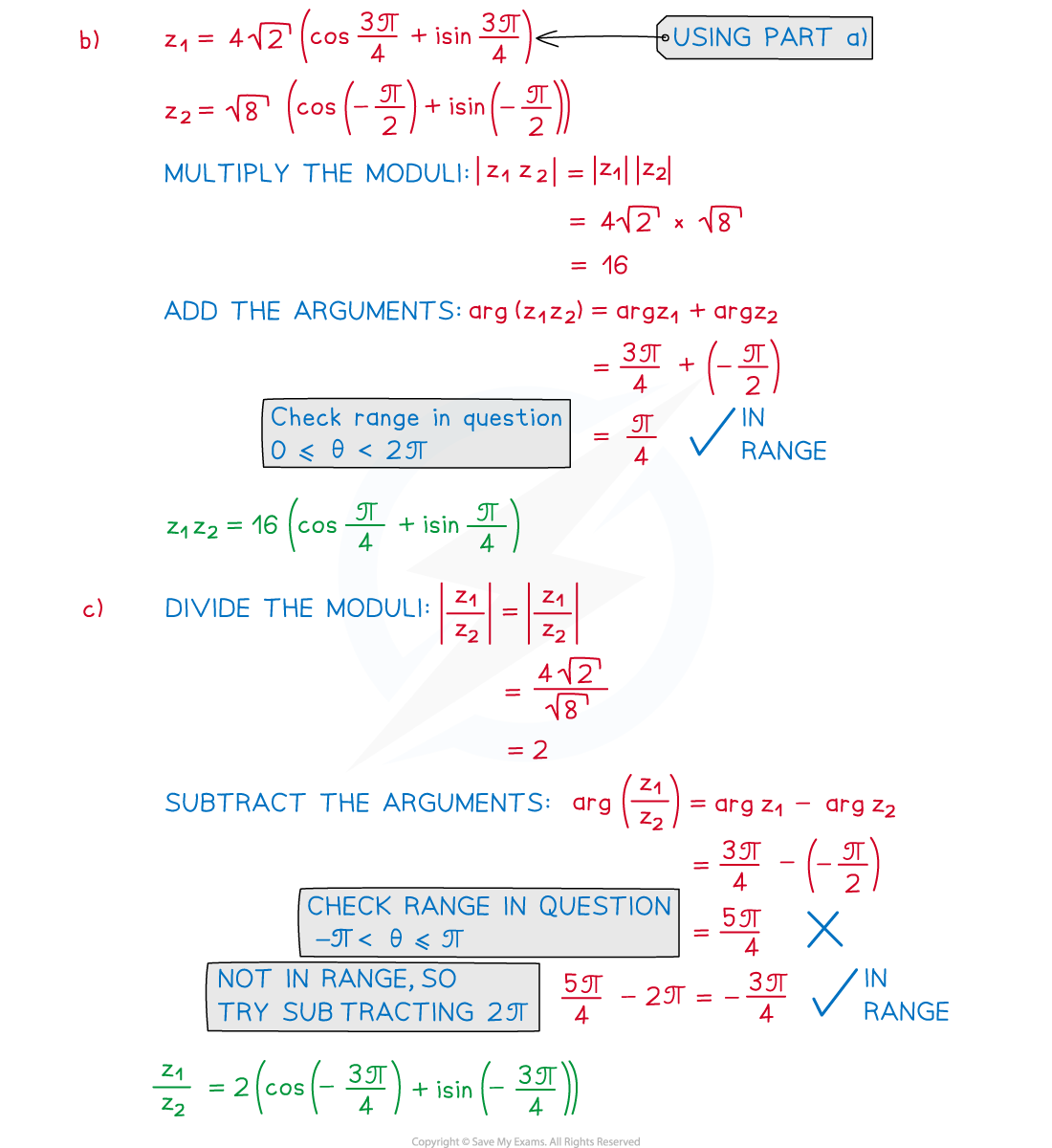
Worked Example
Examiner Tips and Tricks
The rules for multiplying and dividing in modulus-argument (polar) form must be learnt (they are not given in the formula booklet).
Remember to add or subtract to any out-of-range arguments to bring them back in range.
If a question does not give a clear range for arguments, then both or would be accepted.

Unlock more, it's free!
Join the 100,000+ Students that ❤️ Save My Exams
the (exam) results speak for themselves:

Was this revision note helpful?
Build on this topic
