Introduction to Synthesis (College Board AP® English Language & Composition): Revision Note

This study guide introduces you to synthesis in AP Lang. It explains how writers consider, explain and integrate ideas from multiple sources while developing their own position. It also shows how synthesis differs from summary, how sources can support, extend, qualify or challenge an argument, and why borrowed words and ideas must be clearly acknowledged.
What is synthesis in AP Lang?
Synthesis is the process of combining ideas from multiple sources to develop or refine your own argument.
When you synthesize, you:
Identify the claims and evidence presented by sources
Determine how the sources relate to one another
Select information relevant to your purpose
Integrate that information into your argument
Explain what the sources help you understand or prove
Synthesis can be understood as a combination of source ideas, relationships among sources and your reasoning.
Imagine that several sources either directly or indirectly discuss aspects of whether a city should convert a vacant lot into a community garden:
One source emphasizes environmental benefits
A different source focuses on access to fresh food
Another source warns about maintenance costs for a city garden
If you report what each source says, you have simply summarized them.
If you use the sources to argue that the city should create the garden only if it establishes a long-term maintenance plan, and you integrate the source material as support, you have synthesized them.
Ultimately, sources should enhance your argument rather than replace it. Think of synthesis as entering into an ongoing conversation. You listen to what others have said, you identify agreements and disagreements, and then you contribute your own informed position.
How synthesis differs from summary
A summary reports the main idea or main claim of a source. Synthesis combines source ideas and uses them to develop your reasoning.
Summary | Synthesis |
|---|---|
|
|
If a student writes a summary:
“Source A explains that community gardens can provide fresh produce in neighborhoods with limited grocery options.”
Notice that this sentence simply reports the likely main idea of the source.
If a student synthesizes two sources:
“Source A’s claim that community gardens improve access to fresh produce becomes more convincing when this perspective is considered alongside Source C’s evidence that vacant lots often remain unused for years. Together, these sources suggest that converting neglected land can address both food access and neighborhood development.”
Notice that the writer combines two sources, identifies a relationship, explains the significance of that relationship and draws a conclusion.
The four ways writers use sources in synthesis
Sources may perform four common functions within an argument.
Function | What the source does | Brief example |
|---|---|---|
Support | Reinforces the writer’s claim | A source provides evidence that gardens improve access to fresh food |
Extend | Adds a new implication or dimension | Another source explains that gardens can also create gathering spaces |
Qualify | Introduces a condition, limitation or exception | A source warns that gardens succeed only when maintenance is funded |
Challenge | Questions or disputes an idea | A source argues that the land would serve more residents as affordable housing |
To support a position
A source supports a position when it provides evidence or reasoning that reinforces the writer’s claim:
For example, a public-health report supports the garden proposal by showing that some neighborhoods lack convenient access to fresh produce
To extend an argument
A source extends an argument when it adds a new consequence, application or insight:
For example, a community organizer extends the argument by explaining that gardens can also provide meeting spaces and educational programs
To qualify a claim
A source qualifies an argument when it introduces a condition, exception or limitation:
For example, a city planner notes that gardens often fail without reliable funding and volunteer support, thereby calling for the creation of gardens only after a maintenance plan has been established
To challenge an idea
A source challenges an argument when it questions an assumption or presents an opposing conclusion:
For example, a housing advocate argues that the vacant land should be used for affordable apartments instead
Position vs. perspective in synthesis
A position is the claim or stance a source takes on an issue. A perspective is the viewpoint from which the source approaches the issue. Perspective may be shaped by a writer’s profession, experience, expertise, interest, values or responsibilities. Two sources may hold the same position but approach it from different perspectives. Note that both sources below support the same proposal, but their reasons and areas of concern differ.
Source | Position | Perspective |
|---|---|---|
Public-health official | Supports a community garden | Focuses on nutrition and access to fresh food |
Environmental organizer | Supports a community garden | Focuses on green space, soil and local ecosystems |
Why attribution and citation matter
When you use another person’s words, ideas, images or information, you must acknowledge the source. Attribution and citation give credit to the original source, distinguish the source’s ideas from your own, strengthen your credibility and prevent plagiarism.
You may do this through:
Attribution — naming the source in your sentence:
"According to the city planner, community gardens require reliable funding."
Citation — identifying the source in parentheses:
"Community gardens require reliable funding to remain successful (Source B)."
Attribution and citation together:
"The city planner explains that community gardens require reliable funding to remain successful (Source B)."
How to combine source material into your own argument
Begin with your own claim:
"A community garden could transform neglected land into a resource that serves nearby residents."
Introduce relevant source information:
"A public-health official explains that some neighborhoods have limited access to affordable fresh produce (Source A)."
Explain why the information matters:
"A nearby garden could provide residents with a local source of fruits and vegetables rather than leaving the lot unused."
Add another source:
"An environmental organization adds that replacing pavement and debris with plants could also reduce heat and improve the appearance of the area (Source C)."
Explain the relationship:
"Together, the sources show that the proposal could address both public-health and environmental concerns."
Return to your position:
"The city should therefore consider the garden, provided that it can establish reliable funding and maintenance."
How to start synthesizing: step-by-step
Understand the task:
Identify:
The subject
The question or decision
The type of position you must develop
Identify each source’s claim and perspective:
For each source, record:
What it claims
What evidence it provides
What perspective shapes the argument
Find relationships among sources:
Ask:
Which sources agree?
Which sources disagree?
Does one source add a new perspective?
Does one source introduce a limitation?
Can one source answer another?
Note the possible relationships:
Sources A and C support...
Source B qualifies their support...
Source D challenges the proposal...
Develop your own defensible thesis
Select and integrate relevant source material:
Choose evidence that helps you support, extend, qualify or challenge
Explain relationships and cite the sources:
After presenting source material, explain:
How it supports your claim
How it relates to another source
Whether it changes or limits your position
Worked example: annotated synthesis paragraph
Prompt:
Develop a position on whether a city should convert an unused lot into a community garden
Sources:
Source | Main idea |
|---|---|
Source A | A public-health official argues that the garden could improve access to fresh food |
Source B | A city planner warns that gardens often fail without reliable maintenance and funding |
Source C | An environmental group explains that gardens can add green space and reduce neighborhood heat |
Writer's position:
The city should convert the lot into a community garden, but only after securing a long-term maintenance partnership
Synthesis paragraph:
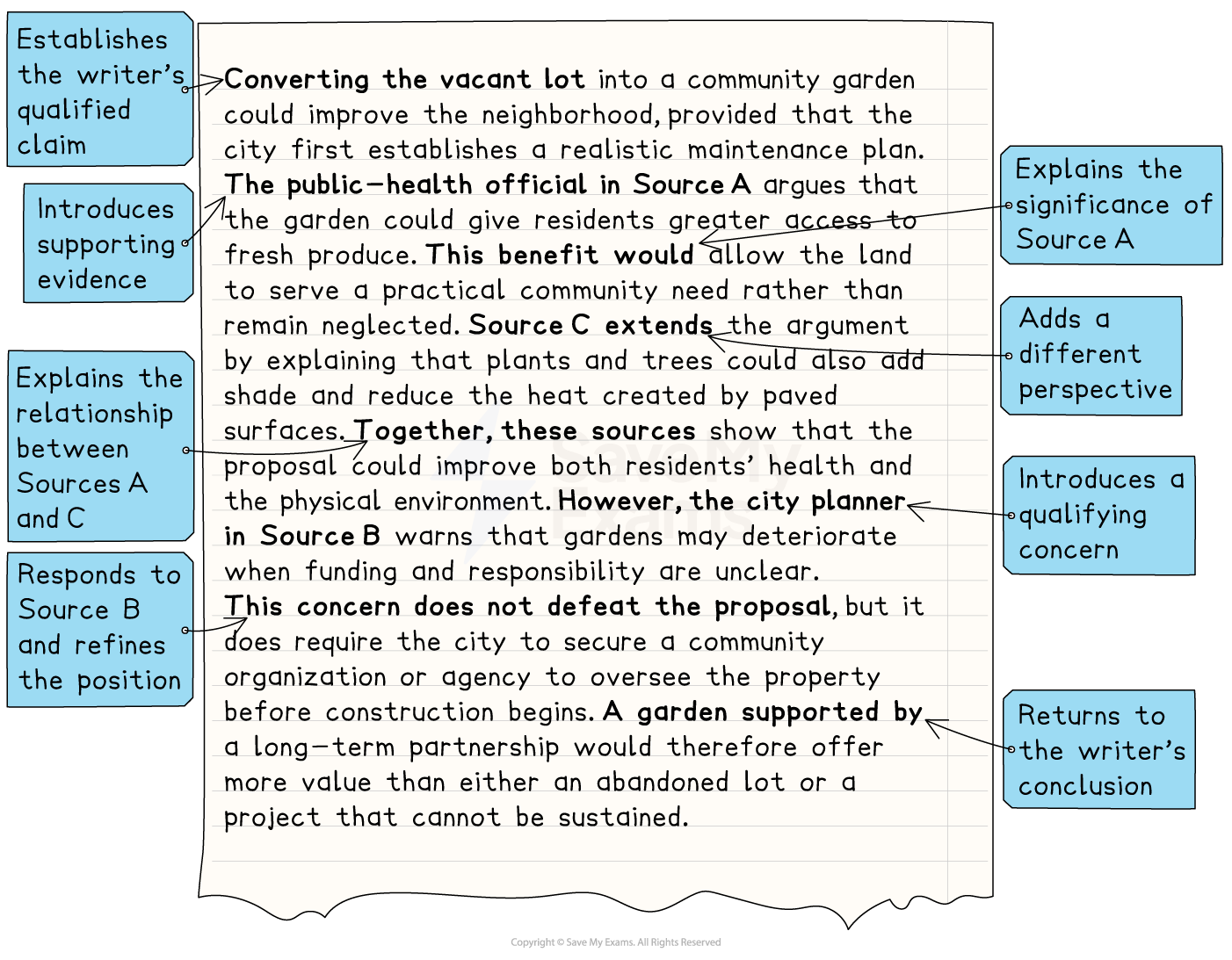
Tips for synthesizing
Keep your argument central:
Your position is the main argument
Sources provide evidence and perspective that help you develop it
Organize by ideas, not by sources:
Avoid writing one paragraph about Source A, one about Source B and one about Source C — this is what scorers call a “source tour”
Instead, group sources around the reasons supporting your thesis
Explain how sources relate:
Do not stop at “Source A agrees with Source C.”
Instead, explain the relationship
“Source C extends Source A’s concern about public health by showing that the garden could also improve the physical environment.”
Use only purposeful sources:
A source should support, extend, qualify or challenge an idea
When in doubt, cite — a citation is required whenever the information or ideas come from a source, even when no direct quotation appears
Remember that synthesis occurs in your explanation, not merely in the citation
Common mistakes when synthesizing
Summarizing sources separately
Allowing sources to replace your own reasoning
Announcing agreement or disagreement without explaining it
Failing to acknowledge paraphrased ideas
Frequently asked questions
What's the difference between synthesis and quoting?
Quoting reproduces a source’s exact words. Synthesis combines source ideas and explains how they contribute to the writer’s argument. Quoting alone is not synthesis.
How many sources do I need to synthesize?
Conceptually, synthesis occurs when a writer establishes a meaningful relationship between ideas from at least two sources and connects that relationship to an argument. For FRQ 1, the directions call for a minimum of three cited sources in your essay.
How is synthesis tested on FRQ 1?
In FRQ 1, you develop a position and use evidence from six provided sources to support your line of reasoning. Effective responses do more than mention or summarize sources; they integrate source material into their argument and explain its significance.
Can I synthesize without using a counterargument?
Yes. Sources can be synthesized because they:
Support the same claim from different perspectives
Extend one another
Explain different effects
Qualify a position
Challenge an assumption
A counterargument is one possible source relationship and is very common, but it is not required.
Key terms and glossary
Attribution: naming the writer, speaker or source responsible for borrowed words or ideas
Citation: a reference that identifies the source of quoted, paraphrased or summarized material
Integration: the process of incorporating source material purposefully into the writer's own argument
Paraphrase: an accurate restatement of a source's idea in your own words and sentence structure
Perspective: the lens through which a source approaches an issue, shaped by its background, experience, expertise, interests or values
Position: the claim or stance a source takes on an issue
Qualification: a condition, limitation or exception that makes a claim more precise
Source: a text, image, chart, speech, study or other material from which information or ideas are drawn
Summary: a condensed statement of a source's main ideas
Synthesis: the process of considering, explaining and integrating ideas from multiple sources into your own argument

Unlock more, it's free!
Join the 100,000+ Students that ❤️ Save My Exams
the (exam) results speak for themselves:

Was this revision note helpful?