Annotation & Close Reading Strategies (College Board AP® English Language & Composition): Revision Note
This study guide introduces you to close reading and purposeful annotation in AP Lang. You will learn how to identify important ideas, trace a writer’s reasoning, recognize meaningful rhetorical choices and shifts, and use annotations efficiently when reading AP Lang passages.
What is close reading in AP Lang?
Close reading means examining a text carefully to understand what a writer says and how and why a writer says it. In AP Lang, focus on relationships and development:
What does the writer want the audience to think, understand, feel or do?
How does the passage develop from beginning to end?
What do the topic sentences or paragraph openings reveal about the progression of ideas?
Which keywords or key concepts recur and seem to drive the passage?
Where does the writer shift, qualify or complicate an idea?
How do rhetorical choices contribute to the writer’s purpose or message?
A useful pattern is:
Notice:
What significant choice, detail, pattern or shift appears?
Connect:
How does it relate to surrounding ideas or the passage as a whole?
Interpret:
Why does it matter in this context or rhetorical situation?
Why annotation matters for the exam
The AP Lang exam is completed digitally, so you will highlight and annotate (make notes on) passages using the tools available in the Bluebook app rather than writing in paper margins. For example:
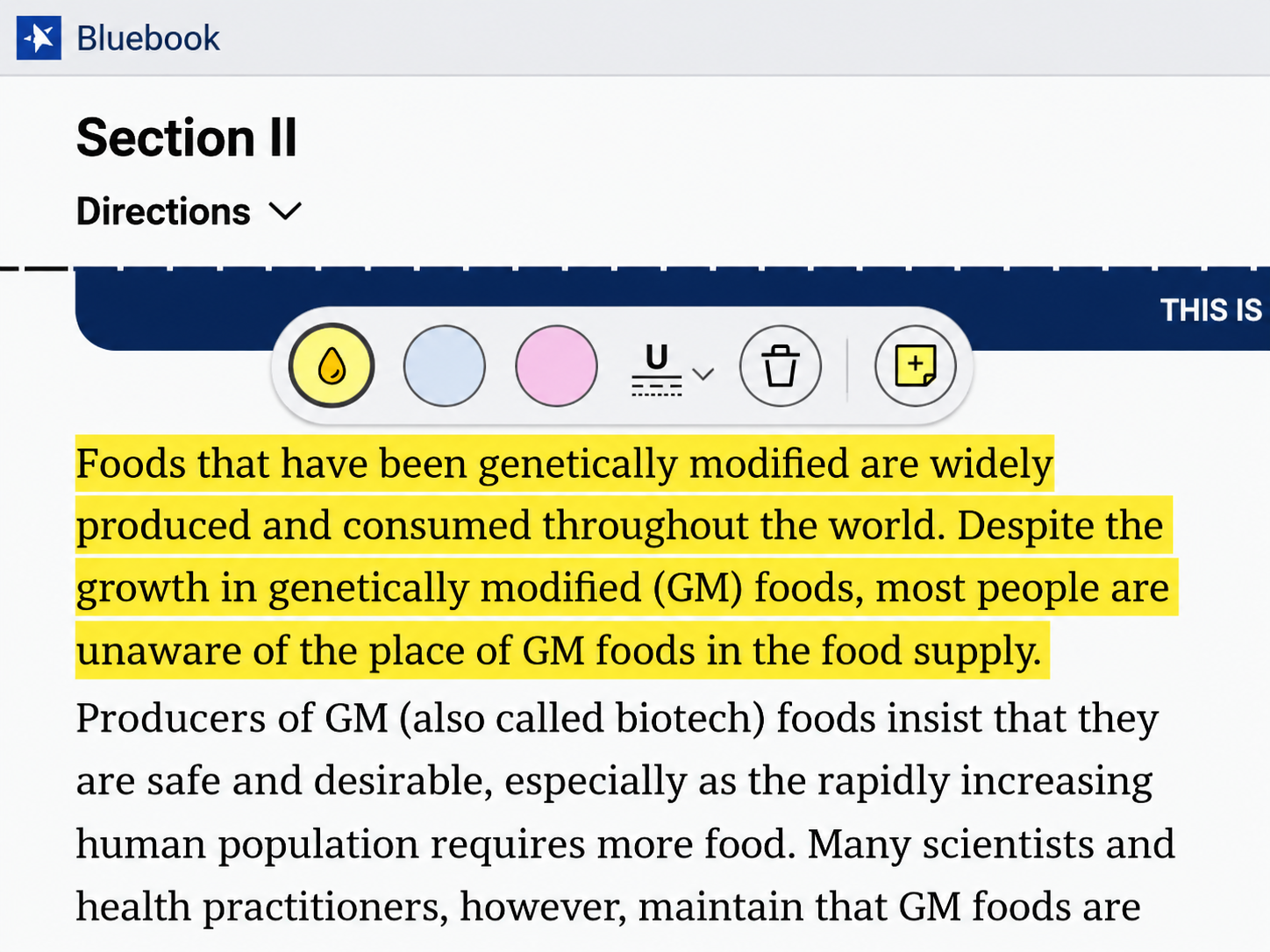
Highlight only what you will use: Bluebook lets you mark and annotate the passage on screen.
Purposeful annotation can help you:
Establish the rhetorical situation
Track important claims and concepts
Follow the writer’s reasoning
Recognize shifts in tone, focus or perspective
Identify significant rhetorical choices
Locate useful evidence quickly
The purpose of annotating is to help you understand the text more efficiently and accurately.
How to annotate an AP Lang passage
Begin with the introductory information and determine as much as possible about:
Writer: who is communicating?
Audience: who is being addressed?
Context: what circumstances surround the text?
Exigence: what prompted the writer to respond?
Purpose: what does the writer hope to accomplish?
Message: what larger idea does the writer develop?
Then, pay attention to how the passage moves. Look especially at:
What to look for | What it reveals |
|---|---|
The opening | May establish a problem, introduce a perspective, provide context, begin a narrative or create a relationship with the audience |
Topic sentences | Can reveal how paragraphs contribute to a line of reasoning |
Keywords and key concepts | May show which ideas the writer develops, refines or returns to |
Shifts | May signal qualification, reconsideration or a new stage in the passage |
The ending | Often clarifies what the writer ultimately wants the audience to understand, believe or do |
These features often reveal what drives the passage and how the writer develops an argument or message.
In passages, topic sentences may be less obvious. Pay greater attention to:
Recurring ideas or images
Contrasts
Changes in perspective
Shifts from personal experience to broader meaning
What the writer gradually comes to reveal, reconsider or emphasize
The relationship between beginning and ending
What to mark in the passage
Prioritize details that reveal function, relationships and development.
The beginning
Consider what the writer establishes immediately.
Ask yourself, what does the opening prepare the audience to think about?
The beginning may introduce:
A problem
A personal experience
An important idea
A conflict or tension
An attitude
A relationship with the audience
Topic sentences and paragraph openings
Pay attention to topic sentences when they are present, but do not assume every paragraph will announce its function directly.
A traditional argument paragraph may move in this way:
Establish problem → provide example → qualify claim → propose response
A more narrative or reflective paragraph may instead move in this way:
Introduce memory → deepen reflection → broaden meaning → reconsider earlier idea
Ask yourself, what does this paragraph contribute to what the writer is developing?
Taken together, these functions can reveal the passage’s line of reasoning or broader progression.
Claims and central idea
Mark language that reveals an important claim or develops the writer’s message. Ask how each idea connects to what comes before and after it. This is a key strategy.
Keywords and central concepts
Sometimes a keyword or central concept emerges and helps drive the passage. A writer may repeat the same word, return to related key terms or develop one idea in increasingly complex ways.
Look for:
Repeated or closely related words
Concepts that appear across several paragraphs
Words with meanings that become more specific or complicated
Ideas introduced near the beginning and revisited near the end
Clusters of language that connect to a larger concept such as freedom, responsibility, progress, sacrifice, or belonging
Ask:
What idea keeps resurfacing?
How does the writer develop or redefine it as the passage progresses?
Shifts
Notice meaningful changes in:
Tone
Focus
Perspective
Reasoning
Level of certainty
Relationship with the audience
Words such as "however", "yet","instead", "although", "but" and "ultimately" typically often signal a shift. Words such as "therefore" signal a conclusion or consequence instead.
Ask yourself, what actually changes here?
A writer might move from:
Problem → solution
Personal experience → broader meaning
Opposing view → response
Criticism → recommendation
Concern → reassurance
Past → present
Individual experience → social significance
Reflection → call to action
Significant diction
Notice words with revealing connotations.
Ask yourself, why this word rather than a more neutral alternative?
Consider what the word suggests about the writer's attitude, subject or audience.
Patterns, imagery and contrasts
Look for:
Repeated words or ideas
Recurring images
Parallel structures
Comparisons
Contrasts
Changes in pronouns or perspectives
In more literary nonfiction, imagery or recurring descriptions may help develop the message just as strongly as an explicit claim.
Rhetorical choices
Notice choices that clearly contribute to the writer’s purpose, such as:
Anecdotes
Examples
Imagery
Comparisons
Direct address
Concessions
Repetition
Changes in syntax
Shifts in tone, focus or perspective
The ending
Pay close attention to the final paragraph and especially the final sentences.
Ask:
Does the writer return to an earlier idea, image or keyword?
Does the tone change?
Does the writer broaden or narrow the message?
Is there a recommendation or call to action?
Does the ending reveal a new understanding?
Does it clarify the significance of an earlier story or idea?
Comparing the beginning and the end can be especially useful because their relationship may reveal how the writer’s thinking, tone or purpose develops across the passage.
Annotation symbols and shorthand
Keep notes brief and functional:
Shorthand | Meaning |
|---|---|
CL | Important claim |
TS | Important topic sentence or idea |
KEY | Keyword or key concept |
SHIFT | Change in tone, focus or perspective |
LR | Important step in line of reasoning |
A | Audience |
P | Purpose |
CON | Contrast or concession |
REP | Meaningful repetition |
→ | Develops or leads to |
Close reading for the multiple-choice section
For multiple choice questions, close reading should be efficient and targeted:
Read the introductory information carefully
Pay particular attention to the beginning and end of the passage
Track paragraph openings, recurring concepts and major shifts
Identify the passage’s general purpose and direction
Read each question stem precisely
Return to the relevant portion of the passage before choosing an answer
Your first reading should give you a mental map of the writer’s message.
Common multiple-choice question types
Rhetorical situation:
Purpose, audience, context or attitude
Function:
Why a writer includes a particular word, sentence, example or paragraph
Organization:
How ideas, paragraphs or sections relate
Tone:
How diction and style reveal attitude
Shifts:
How the writer’s focus, reasoning or perspective changes
Diction and syntax:
How particular language contributes to meaning
Claims and evidence:
How evidence supports or develops an argument
For more on the multiple choice questions, see The Multiple Choice Section.
Close reading for the rhetorical analysis essay
For rhetorical analysis, close reading helps you build an interpretation of how the passage works as a whole. Begin by establishing the broader rhetorical situation through MSCAPE (message, subject, context, audience, purpose and exigence); understanding these components gives you the context needed to interpret the writer’s individual choices accurately. Then trace the passage's development.
Ask:
What does the writer establish at the beginning?
What do topic sentences or paragraph openings reveal about the progression?
Which keywords, images or concepts continue to emerge?
Where do significant shifts occur?
How are ideas changed, refined or complicated?
What has changed by the end?
Which rhetorical choices help produce that development?
A rhetorical choice does not need an impressive technical label. Writers make choices when they:
Tell an anecdote
Describe an experience
Create imagery
Define or refine an idea
Acknowledge another perspective
Compare situations
Repeat significant language
Develop a recurring concept
Change tone or focus
Address the audience directly
Move from personal story to broader message
For more on the rhetorical analysis essay, see FRQ 2: The Rhetorical Analysis Essay.
For the FRQ 1 synthesis essay, use the 15-minute reading period at the start of Section II to annotate each source for its usefulness:
Mark the claim it makes
Mark the evidence you could quote
Mark how it agrees with, extends or challenges another source
For more on the synthesis essay, see FRQ 1: The Synthesis Essay.
Annotations in Bluebook are not part of your answer, so keep them brief.
Tips for annotating and close reading
Not every AP Lang passage develops like a traditional argument:
Some passages are more narrative, reflective or descriptive and may rely on the writer’s personal experience, imagery or recurring ideas to develop a larger message
Do not assume that every reading passage will present a straightforward argument
Read for movement and recurring concepts:
Pay particular attention to the beginning, paragraph openings, major shifts, keywords or key concepts and the ending
In more narrative or reflective passages, also watch for recurring images and changes in perspective
Common mistakes when annotating and close reading
Highlighting too much:
If nearly everything is marked, little stands out
Instead, prioritize important claims, paragraph ideas, recurring concepts, shifts and key rhetorical choices
Ignoring the beginning and the end:
Do not concentrate only on isolated details or details found only in the middle of the passage
Compare the beginning and the ending, because their relationship often reveals how the writer's thinking or purpose develops
Assuming every paragraph has an obvious topic sentence:
Some argumentative passages do; most narrative and reflective passages do not
Missing keywords and concepts:
Look for recurring words, related terms and concepts
Frequently asked questions
How much should I annotate under time pressure?
There is no required amount. Annotate only when doing so helps you understand or navigate the passage.
Prioritize the beginning, paragraph openings, key concepts, major shifts, important choices and the ending rather than trying to mark everything.
What is the difference between annotating and close reading?
Close reading is the thinking.
Annotating records that thinking.
Simply marking a sentence does not demonstrate analysis or understanding. You must understand why the sentence matters and how it relates to the larger passage.
Should I annotate differently for the multiple-choice and free-response sections?
Yes. For multiple choice, annotations should mainly help you navigate the passage, track relationships and return to relevant evidence efficiently.
For rhetorical analysis, annotations should help you recognize patterns, trace recurring concepts and the passage’s development and identify rhetorical choices that can support your analytical claims.
How does annotation improve my exam score?
Annotation does not directly earn points. Annotating can help you understand the rhetorical situation, follow the writer’s reasoning, recognize important concepts and shifts, locate evidence and identify rhetorical choices. Those skills often lead to stronger responses on both the multiple-choice questions and rhetorical analysis portions of the exam.
Key terms and glossary
Anecdote: a brief story used to illustrate a larger point
Annotation: brief, purposeful notes or marks made while reading to track claims, key concepts, shifts and rhetorical choices
Audience: the person or group a writer addresses or seeks to influence
Claim: a statement that presents a writer's position and requires proof or defense
Close reading: examining a text carefully to understand what a writer says and how and why the writer says it
Connotation: the feeling, attitude or association connected to a word
Context: the time, place, occasion and broader circumstances that surround a text
Diction: a writer's word choice
Exigence: the issue, event, problem or situation that prompts a writer to create a text
Imagery: descriptive language that appeals to the senses to help readers picture or experience a subject
Keyword: a word or concept that recurs across a passage and helps drive its development
Line of reasoning: the logical progression of reasons, evidence and commentary that explains how the thesis is supported
Message: the central idea a writer communicates
MSCAPE: the rhetorical situation tool that considers Message, Subject, Context, Audience, Purpose and Exigence
Purpose: what a writer hopes to accomplish
Qualification: a condition, limitation or exception that makes a claim more precise
Reconsideration: reevaluating an earlier perspective
Refinement: making a claim or perspective more precise while keeping its central position
Rhetorical choice: a decision a writer makes to influence an audience and achieve a purpose
Rhetorical situation: the circumstances that shape a text, including the exigence, audience, writer, purpose, context and message
Shift: a meaningful change in tone, perspective, focus or rhetorical approach
Tone: the writer's attitude toward the subject, audience or situation
Topic sentence: a sentence that states the main claim or reason developed in a body paragraph

Unlock more, it's free!
Join the 100,000+ Students that ❤️ Save My Exams
the (exam) results speak for themselves:

Was this revision note helpful?