Integrating & Citing Sources (College Board AP® English Language & Composition): Revision Note
This study guide introduces you to ways of incorporating source material into an argument, including selecting, integrating, attributing and citing evidence effectively.
What does it mean to integrate sources in AP Lang?
Source integration means bringing another writer’s words or ideas into your essay so they support your claim without taking over your paragraph. Your voice and the source’s voice should both remain clear, but they should work together within the same line of reasoning.
Think of your essay as a conversation. You are leading the conversation. The sources are the experts you invite into that conversation when they strengthen your position or offer an idea that you would like to contend with. Your voice remains dominant throughout the essay.
Quoting, paraphrasing and summarizing: what's the difference?
Quoting uses the author’s exact words and is best used when the wording itself is especially powerful or precise
Paraphrasing restates a specific idea entirely in your own words and is best used when the author’s idea matters more than the exact wording
Summarizing condenses an entire passage or larger argument into a brief overview and is best used when providing context or introducing a broader perspective
Quoting
Use quotations purposefully and sparingly.
Example:
"According to Source B, volunteer work helps students develop “leadership skills that extend beyond the classroom."
Paraphrasing
Paraphrasing allows you to maintain your own voice while still using another author’s ideas.
Example:
"Source B argues that volunteer experiences help students develop leadership skills that prepare them for future careers."
Summarizing
Summaries communicate the overall point of a source.
Example:
"Source B suggests that extracurricular experiences prepare students for adulthood by developing responsibility and independence."
Which should you use and when?
Quote when you need to use the author’s powerful wording
Paraphrase when you want to maintain your voice and use an author’s specific idea
Summarize when you need to convey the author’s overall argument
How to embed quotes effectively
Quotes are embedded most effectively when the source’s words remain clearly attributed, but they are still part of the writer’s sentence.
Example:
"Workplace expectations, according to Source B, help teenagers become 'more responsible' because they must independently manage schedules, meet deadlines and solve problems."
Signal phrases and attribution tags
Before readers can evaluate evidence, they need to know who is speaking and why that source deserves attention. Skilled writers introduce sources in ways that establish credibility, distinguish their own ideas from the source’s ideas and maintain a smooth flow through the paragraph.
On FRQ 1, when the source provides the author’s name, it is generally best to identify both the author and source letter. If the author’s name is not provided, simply referring to the source (for example, Source B) is appropriate.
Ways to identify the source
By the author’s name and source letter:
"Jessica Smith argues that part-time employment provides teenagers with valuable workplace experience (Source D)."
By the author’s expertise and source letter:
"Economist Jessica Smith argues that part-time employment provides teenagers with valuable workplace experience (Source D)."
By the source label:
"Source B argues that workplace experience helps students develop leadership skills."
Examiner Tips and Tricks
When identifying a source, choose the method that best establishes the source’s credibility while keeping your writing concise and natural.
Citing sources
Whether you quote, paraphrase or summarize, every use of source material should be clearly attributed.
In-text citation conventions
Synthesis prompts identify sources by letter.
Example:
(Source A)
(Source C)
If the author’s name is provided, you may also identify the source by the author’s last name.
Why source attribution matters for your score
Readers should always be able to distinguish your ideas from the ideas of your sources. Clear attribution demonstrates that you understand where information originates and how evidence contributes to your own line of reasoning.
Failing to attribute evidence will likely weaken the effectiveness of your argument and make it difficult for readers to evaluate your use of source materials.
For FRQ 1, a minimum of three sources properly integrated is called for.
Worked example: integrating a quote, paraphrase and summary in one paragraph
Prompt:
Should high schools require students to complete community service before graduation?
Claim:
"Community service should be a graduation requirement because it helps students develop practical skills and civic responsibility."
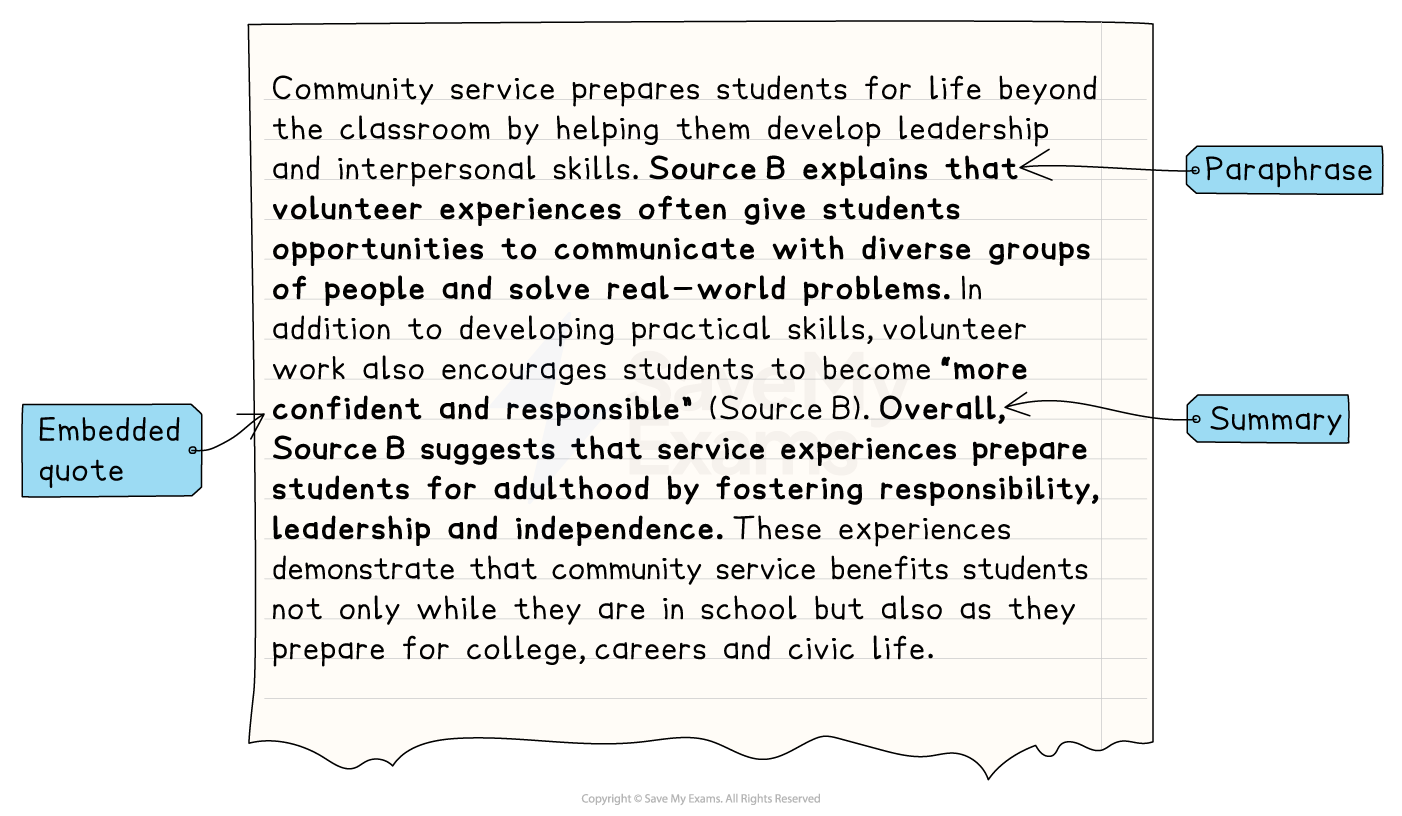
This example demonstrates three different methods of incorporating source material into one paragraph for instructional purposes. On the AP Lang exam, effective writers choose the method or the combination of methods that best supports their argument. A strong paragraph may rely primarily on paraphrase, quotation, summary or a combination of the three.
Tips on integrating and citing sources
Read every source before deciding which evidence to use
Introduce every source before presenting evidence
Blend quotations into your own sentences
Attribute every quotation, paraphrase and summary
Use commentary to explain why the evidence matters
Let your voice remain the dominant voice throughout the essay
Common mistakes when using sources
Avoid the following:
Integrating quotations without explanation
Letting quotations overwhelm your own voice
Summarizing sources instead of integrating them into your line of reasoning
Forgetting to cite sources
Using evidence without commentary
Organizing the essay source-by-source rather than claim-by-claim
Frequently asked questions
Do I need a works cited page in AP Lang essays?
No. Timed AP Lang essays do not require a works cited page. Simply identify sources as you write the FRQ 1 using the format provided in the prompt (Source A or the author’s name).
What counts as 'syntactically embedding' a source?
A source is syntactically embedded when it becomes part of your own sentence structure rather than standing alone as a separate quotation. The sentence should remain grammatically correct while clearly attributing the ideas to the original source.
What's the penalty for missing citations?
In FRQ 1 (the synthesis essay), you are expected to identify the source of any ideas you quote, paraphrase or summarize. The directions call for you to use a minimum of three sources. Therefore, failing to attribute source material can weaken your credibility and may affect how readers evaluate your use of evidence, which will likely result in a lower score.
Can I add my own commentary to a quoted source?
Absolutely. In fact, you are expected to do so. Your commentary explains why the evidence matters and how it advances your line of reasoning.
Key terms and glossary
Attribution: naming the writer, speaker or source responsible for borrowed words or ideas
Claim: a statement that presents a writer's position and requires proof or defense
Commentary: explanation that shows how evidence supports a reason, how the reason supports the thesis and why the evidence matters
Evidence: information used to support a claim or reason
Paraphrase: an accurate restatement of a source's idea in your own words and sentence structure
Quote: the author's exact words
Signal phrase: words used to introduce a source and distinguish it from the writer's ideas
Source integration: incorporating another writer's words or ideas into your own writing so that they support your argument
Summary: a condensed statement of a source's main ideas
Syntactic embedding: incorporating quotations, paraphrases or summaries into your own sentence structure so that they fit naturally within your line of reasoning

Unlock more, it's free!
Join the 100,000+ Students that ❤️ Save My Exams
the (exam) results speak for themselves:

Was this revision note helpful?