Analyzing Audience (College Board AP® English Language & Composition): Revision Note

This study guide introduces you to audience analysis in AP Lang. It explains how writers make choices based on what an audience believes, values, needs, feels and already understands. It also shows how the audience affects a writer’s rhetorical choices, including tone, evidence, examples, word choice, structure, appeals and credibility.
In AP Lang, identifying the audience is only the first step. Strong analysis explains how a writer demonstrates an understanding of that audience and adapts the argument in response. Most arguments are written for a specific person or group, and their effectiveness depends greatly on how well the writer’s strategies, content, tone and language meet the expectations of that audience.
What is audience in AP Lang?
Audience is the person or group a writer addresses or attempts to influence.
In AP Lang, audience means more than the person reading the text or listening to the speech. To analyze audience well, you must think about what the audience likely believes, values, feels and already knows. A writer’s choices are shaped by the audience the writer hopes to reach.
For example, a writer may ask:
What does this audience already know about the subject?
How does this audience likely feel about the issue?
What values or beliefs does this audience hold?
What additional information does this audience need?
What is the writer’s relationship to the audience?
What does the audience already know about the writer?
Consider the following audience statements:
"The audience is students."
This audience statement is weak because it is too vague.
"The audience is students who want more independence, but may need to prove to adults that they can act responsibly."
This audience statement is much stronger because it does more than name the group: it identifies what the audience likely wants, values and needs.
Why understanding audience matters for rhetoric
Understanding audience matters because rhetorical choices are not random. Writers choose their evidence, tone, examples, appeals, word choice and structure based on what they believe will persuade or connect with a particular audience.
For example, imagine that you want your parent or guardian to extend your curfew after prom. You have a goal to get permission to stay out later. Your choices will depend on your audience:
If your parent values responsibility, you might remind them that you have followed curfew in the past
If your parent worries about safety, you might explain where you will be, who will be driving and when you will check in
If your parent values fairness, you might explain that other students are attending the same supervised event
This everyday situation shows how audience affects rhetoric. The same request may require different evidence, tone and appeals depending on who is being addressed.
Examiner Tips and Tricks
Writers make specific choices to achieve a goal depending on the audience. Ask the following to better understand audience:
What does the writer understand about this audience?
How does the writer use that understanding to shape the argument?
What choices does the writer make because of the audience’s beliefs, values, needs or background?
The four dimensions of audience
Beliefs: what an audience thinks is true
An audience may have beliefs about a person, issue, tradition, policy, group or problem. A writer may agree with those beliefs, challenge them or use them as a starting point.
To identify beliefs, ask:
What does this audience likely believe about the subject?
Does the writer reinforce or challenge those beliefs?
Does the writer assume the audience already agrees with part of the argument?
Does the writer need to correct a mistaken or incomplete belief?
For example, if an audience believes that success depends only on individual work, a writer discussing poverty may need to challenge that belief by showing how education, housing, employment or discrimination can also affect opportunity.
Values: the principles, ideals or priorities an audience considers important
An audience may value freedom, fairness, safety, family, faith, patriotism, individual choice, community responsibility, honesty, progress, tradition or justice.
Writers often appeal to audience values because people are more likely to listen when an argument connects to something they already care about.
To identify values, ask:
What does this audience care about?
What moral, cultural or social values does the writer appeal to?
Does the writer use shared values to build common ground?
Does the writer show that the audience is failing to live up to its own values?
For example, if an audience values patriotism, a writer might argue that protecting civil rights is not anti-American, but rather deeply American, because it fulfills the nation’s stated ideals.
Needs: what the audience requires in order to understand, accept or respond to the argument
An audience may need background information, definitions, credible evidence, emotional connection, reassurance, urgency, a reason to care, a clear action step or a challenge to its assumptions.
To identify needs, ask:
What does the audience need in order to understand the issue?
Does the audience need proof?
Does the audience need to trust the writer?
Does the audience need to feel emotionally connected?
Does the audience need to be moved toward action?
For example, if a writer addresses an audience unfamiliar with artificial intelligence, the audience may need definitions and examples before the writer can make a complex argument about AI ethics.
Background: the audience’s prior knowledge, experience, culture, social position or relationship to the issue
Background affects how an audience receives an argument. For example, a speech about sacrifice is likely to affect soldiers differently than students. An argument about school policy may affect parents, teachers, administrators and students differently because each group brings different experiences and concerns.
To identify background, ask:
What does the audience already know?
What experiences shape the audience’s response?
What cultural or historical context matters?
What assumptions might the audience bring?
What relationship does the audience have to the writer or subject?
For example, a writer addressing medical professionals may use technical terms and research-based evidence. A writer addressing the general public on the same issue may need simpler language, familiar examples and clear explanations.
How audience shapes a writer's rhetorical choices
Audience affects nearly every major rhetorical choice a writer makes.
Appeals
Writers choose appeals based on their audience:
Ethos builds credibility
Logos appeals to the audience’s reasoning
Pathos appeals to the audience’s emotions and values
A writer may build the following by:
Appeal | How to build |
|---|---|
Ethos | Showing fairness, experience, sincerity or respect for the audience |
Logos | Presenting facts, examples, analogies or expert testimony |
Pathos | Presenting stories, imagery, personal testimony or emotionally charged examples |
For more on appeals, see Unit 2: Rhetorical Appeals.
Evidence
Writers choose evidence based on what the audience will find convincing.
Audience | Evidence |
|---|---|
Skeptical audience | May need credible research, expert testimony, facts or concessions |
Audience lacking background knowledge | May need definitions, examples and historical context |
Emotionally distant audience | May need anecdotes, vivid examples or personal testimony |
Audience that values logic | May need statistics, cause-and-effect reasoning and clear evidence |
For more on evidence, see Unit 1: Choosing Effective Evidence.
Pronouns
Pronouns can reveal the relationship between writer and audience.
Pronouns | Relationship |
|---|---|
“we” or “us” | The writer may be trying to associate themselves with the audience and create a shared responsibility |
“you” | The writer may be directly addressing, challenging, confronting or separating themselves from the audience |
Structure
Audience can shape the structure of the argument.
Audience | Structure |
|---|---|
If the audience is unfamiliar with the topic | The writer may begin with background information |
If the audience is skeptical | The writer may begin by acknowledging concerns |
If the audience already agrees | The writer may move quickly toward a call to action |
If the issue is complex | The writer may explain why the issue matters |
Tone
Tone is the writer’s attitude toward the subject or audience. The tone should fit the audience and purpose.
Audience | Tone |
|---|---|
A writer addressing a grieving audience | May use a solemn, respectful tone |
A writer addressing a complacent audience | May use a sharper, more urgent tone |
A writer addressing a skeptical audience | May use a measured, reasonable tone |
Word choice
Word choice affects how an audience understands and feels about an issue.
Word choice | Effect |
|---|---|
Calling a problem a “crisis” | Creates urgency |
Calling a policy “responsible” | Creates practicality |
Calling an action “unjust” | Appeals to morality |
Calling a proposal “unreasonable” | Helps the writer appeal to values of moderation |
How to analyze audience in an AP Lang passage: step-by-step
Identify the immediate audience
Identify the broader audience
Determine what the audience likely believes
Determine what the audience values
Determine what the audience needs
Consider the audience’s background
Connect the audience to rhetorical choices
Explain the effect
Worked example: audience analysis
Context:
Frederick Douglass was a formerly enslaved American writer, speaker and abolitionist. In 1852, he was invited to speak at an event connected to Independence Day, the American holiday celebrating freedom from British rule. In his speech, Douglass challenged the audience to consider the contradiction between America’s celebration of liberty and the continued existence of slavery.
Directions:
Read the following excerpt from Douglass’ speech
Analyze the audience (for rhetorical situation analysis, see Unit 1: Introduction to the Rhetorical Situation, and for rhetorical choices analysis, see Unit 1: Introduction to Rhetorical Choices)
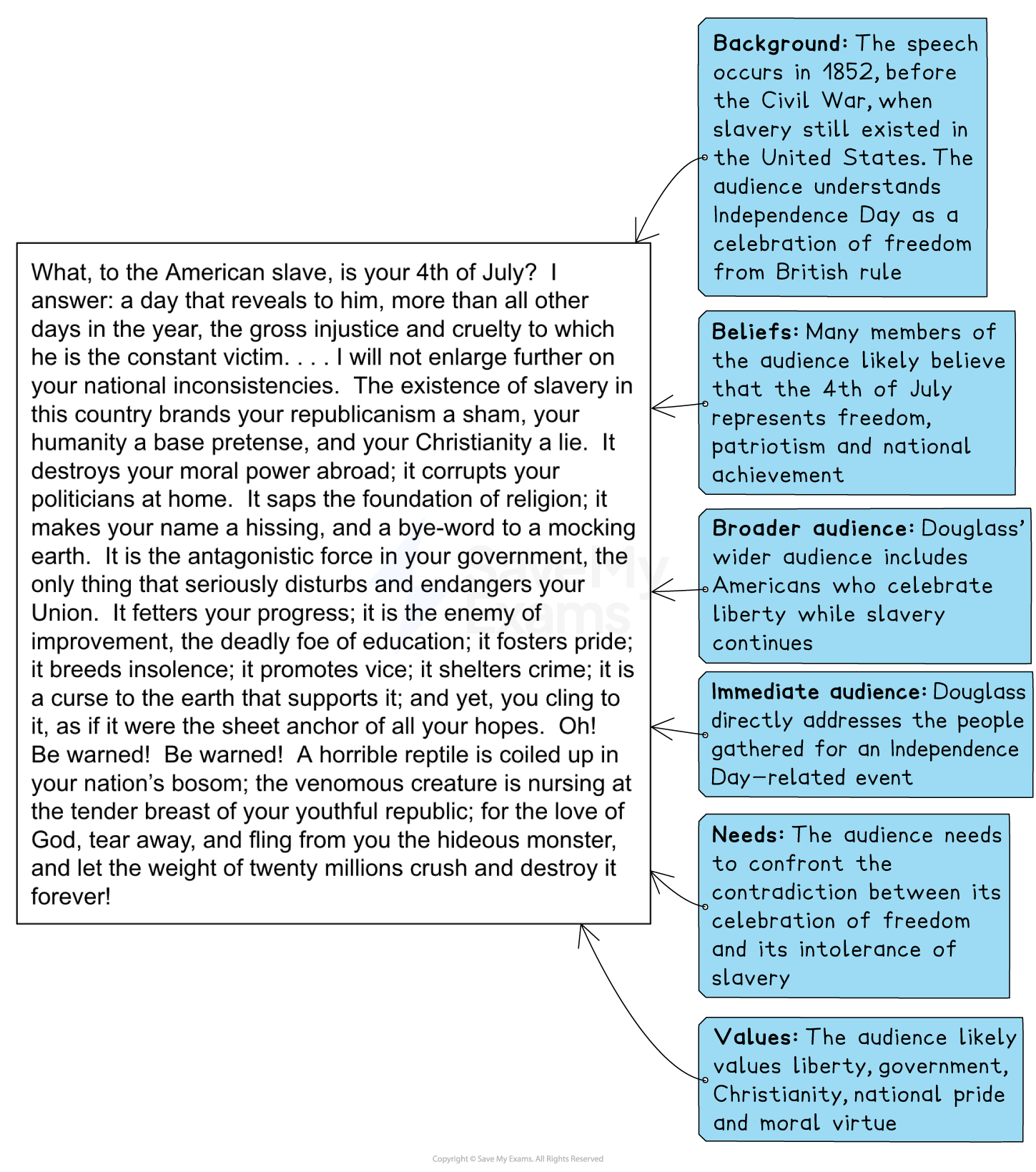
Examiner Tips and Tricks
You should not identify the audience only as a group. Explain what the audience likely believes, values, needs or understands. Then connect that audience insight to a specific rhetorical choice.
Common mistakes when analyzing audience
Try to avoid the following when analyzing audience:
Identifying the audience too broadly
Confusing audience with subject
Assuming the audience agrees with the writer
Ignoring audience values
Treating the audience as completely unified
Listing audience traits without connecting them to choices
Overusing the word “relatable,” which is too vague
Frequently asked questions
What's the difference between audience and reader?
The reader is anyone who reads the text. The audience is the person or group the writer intends to address or influence.
For example, a modern student may read Frederick Douglass’ speech, but the original audience included people gathered for an Independence Day-related event and a wider American audience living in a nation where slavery existed.
Can a text have multiple audiences?
Yes. Many texts have an immediate audience and a broader audience. A speech may be delivered to people in a room, but it may also be published, circulated or remembered by a wider public audience. Writers often make choices that speak to both groups.
How is audience tested on the AP Lang exam?
Audience can be tested in multiple choice questions, synthesis essays, rhetorical analysis essays and argument essays. In reading tasks, you may need to explain how a writer’s choices demonstrate an understanding of the audience’s beliefs, values, needs or background. In writing tasks, you will need to make your own choices based on the audience you are trying to persuade.
How is analyzing audience different from adapting to an audience?
Analyzing audience means studying how another writer responds to an audience. Adapting to an audience means making your own choices as a writer based on what your audience believes, values, needs or understands.
Key terms and glossary
Audience: the person or group a writer addresses or seeks to influence
Audience analysis: the process of identifying what an audience believes, values, needs, feels and understands in order to explain a writer's rhetorical choices
Background: the experiences, knowledge, culture, history or social position an audience brings to a text
Beliefs: what an audience thinks is true about a subject or issue
Broader audience: the larger group a writer may hope to reach beyond the immediate audience
Credibility: the degree to which a writer or source deserves confidence for a particular claim
Ethos: an appeal based on credibility, character and trust
Immediate audience: the person or group directly addressed by the writer or speaker
Intended audience: the specific audience a writer appears to target
Logos: an appeal based on logic, evidence and reasoning
Multiple audiences: two or more groups a writer addresses, either directly or indirectly
Needs: what an audience requires in order to understand, accept or respond to an argument
Pathos: an appeal to an audience's emotions, values or senses
Reader: anyone who reads a text, whether or not that person was the writer's intended audience
Rhetorical choice: a decision a writer makes to influence an audience and achieve a purpose
Shared values: principles or ideals that the writer and audience both recognize or claim to respect
Skeptical audience: an audience that may doubt, resist or question the writer's argument
Tone: the writer's attitude toward the subject, audience or situation
Values: the principles, ideals or priorities an audience considers important

Unlock more, it's free!
Join the 100,000+ Students that ❤️ Save My Exams
the (exam) results speak for themselves:

Was this revision note helpful?