Writing & Elaborating on Commentary (College Board AP® English Language & Composition): Revision Note

This study guide introduces you to commentary, the explanation that connects evidence to a claim and develops a line of reasoning. Commentary answers the following important questions:
How does this evidence support the claim?
Why does it matter?
What should the reader understand from it?
What is commentary?
Commentary is the writer’s explanation of how evidence supports a claim.
Evidence gives the reader information. Commentary explains what that information proves.
In addition to claim and evidence, a body paragraph needs explanation that shows how the evidence supports the paragraph’s reason and how that reason supports the thesis.
Why commentary matters: explaining the how and why
Commentary matters because evidence does not speak for itself. A writer may choose strong evidence, but the reader still needs to understand how the evidence supports the writer’s argument from their perspective. Strong commentary answers questions such as:
What does this evidence show?
How does it support the reason?
Why is it significant?
How does it connect to the thesis?
How does it develop the line of reasoning?
What larger insight should the reader understand?
Note: in rhetorical analysis, commentary also explains why a writer’s choices matter for a particular audience, context and purpose.
What is the difference between commentary and evidence?
Evidence and commentary do different jobs:
Evidence | Commentary |
|---|---|
Provides support | Explains the support |
Gives facts, examples, observations, quotations or source material | Explains how those details prove the claim |
Answers “What happened?” or “What does the source say?” | Answers “So what?” and “Why does this matter?” |
Can be quoted, paraphrased or summarized | Must come from the writer’s reasoning |
Evidence shows what happened. The commentary explains why it matters.
For example:
Claim:
"Students should be allowed to revise major writing assignments after receiving feedback."
Evidence:
"A teacher may write on a student’s essay, 'You have evidence here, but you need to explain how it proves your claim.'"
Commentary:
"That comment identifies the problem, but revision requires the student to solve it. By returning to the paragraph and adding explanation, the student turns feedback into practice rather than simply accepting a lower grade."
How to elaborate and develop your commentary
Elaboration means developing your explanation instead of stopping after one basic sentence. Strong commentary shows the reader the thinking that connects the evidence to the claim. Develop it by asking better questions about your evidence — these teach the thinking behind commentary without making every paragraph sound too similar:
Purpose | Question to ask |
|---|---|
Explain what the evidence shows | What idea, problem or pattern does this evidence reveal? |
Explain why it matters | Why is this evidence significant to the argument? |
Connect to the reason | How does this evidence support the paragraph’s main point? |
Connect to the thesis | How does this point help prove the larger claim? |
Add complexity | What limitations, tension or complication does this evidence suggest? |
Link to another example | How does this evidence connect to another piece of evidence? |
Explain implication | What broader conclusion should the reader draw? |
How much commentary should follow each piece of evidence?
There is no exact number of words every time, but a useful rule of thumb is that the explanation should usually be longer than the evidence. This does not mean that every paragraph must follow the same formula. Some evidence needs only a brief explanation. Complex evidence may need more. However, if a paragraph has more evidence than explanation, it may start to feel like listed evidence rather than a convincing argument.
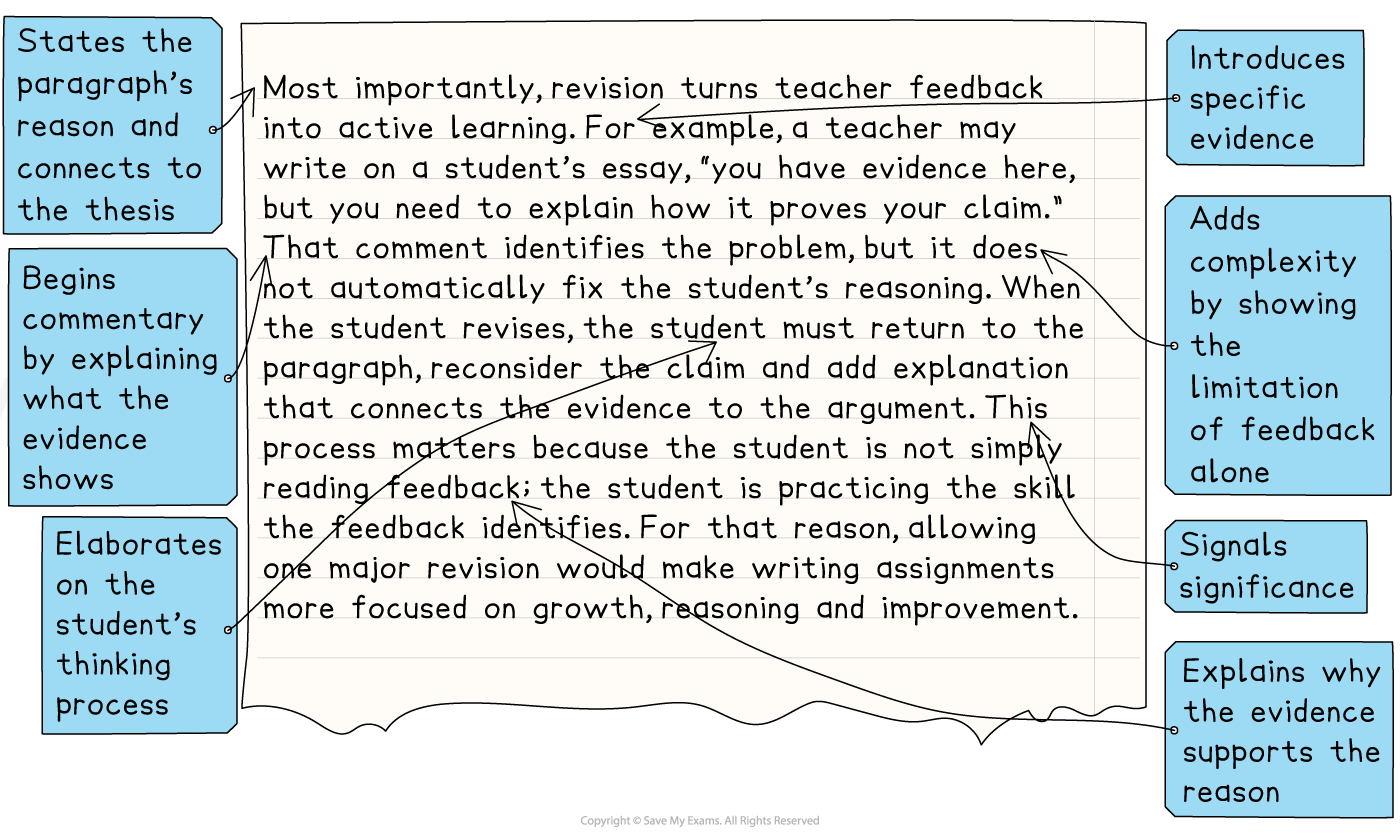
Worked example: paragraph with commentary
Prompt:
Develop a position on whether high schools should allow students to revise one major writing assignment after receiving teacher feedback
Thesis:
"High schools should allow students to revise one major writing assignment after feedback because revision turns feedback into practice, encourages deeper thinking and helps students see writing as a process rather than a single attempt."
Model paragraph:
Examiner Tips and Tricks
Do not end your idea after presenting your evidence. The strongest commentary explains:
How the evidence works
Why the evidence matters
How the evidence supports the line of reasoning
Common mistakes when writing commentary
Summarizing instead of explaining
Repeating the evidence
Using empty phrases
Forgetting to connect back to the claim
Writing commentary that is too short
Integrating evidence without explanation
Frequently asked questions
What is the difference between commentary and analysis?
Commentary is the written explanation of thinking in the essay. Analysis is the thinking that interprets evidence. In many AP Lang contexts, the terms overlap. When students write commentary, they are usually doing analysis by explaining how evidence supports a claim or how a writer’s choice affects an audience.
How do I avoid simply summarizing my evidence?
After presenting evidence, explain what the evidence proves rather than restating it. The questions listed under Why commentary matters above give you what to answer: summary stops at what the source said, while commentary explains why it supports the claim.
How is commentary scored on the AP Lang FRQs?
On AP Lang free-response rubrics, commentary is part of Row B: Evidence and Commentary, which is worth up to 4 points. Stronger responses explain how evidence supports a line of reasoning, while weaker responses may summarize evidence without explaining how it supports the argument.
Key terms and glossary
Analysis: interpretation that explains the meaning, function or significance of evidence
Claim: a statement that presents a writer's position and requires proof or defense
Commentary: explanation that shows how evidence supports a reason, how the reason supports the thesis and why the evidence matters
Evidence: information used to support a claim or reason
Line of reasoning: the logical progression of reasons, evidence and commentary that explains how the thesis is supported
Paraphrase: an accurate restatement of a source's idea in your own words and sentence structure
Reason: an explanation of why a claim or thesis is valid
Relevance: the degree to which evidence directly supports the claim or reason being developed
Rhetorical situation: the circumstances that shape a text, including the exigence, audience, writer, purpose, context and message
Summary: a condensed statement of a source's main ideas
Thesis: the main, overarching claim a writer seeks to defend or prove by using reasoning supported by evidence
Topic sentence: a sentence that states the main claim or reason developed in a body paragraph
Unity: the quality of an argument in which all reasons, evidence and commentary support the same central claim

Unlock more, it's free!
Join the 100,000+ Students that ❤️ Save My Exams
the (exam) results speak for themselves:

Was this revision note helpful?