Constructing an Evidence-Based Argument (College Board AP® English Language & Composition): Revision Note
This study guide introduces you to constructing an evidence-based argument in AP Lang. You will learn how a defensible thesis, supporting reasons, evidence, reasoning and commentary work together to create an evidence-based argument.
What is an evidence-based argument?
An evidence-based argument is an argument in which a writer supports a defensible thesis with relevant, specific and sufficient evidence.
In an evidence-based argument, the writer must provide:
A thesis that presents the main position
Supporting reasons that explain why the thesis is valid
Evidence that supports those reasons
Commentary that explains how the evidence advances the argument
How evidence supports a thesis
Evidence usually supports a thesis by supporting one of the reasons contained within it.
Consider the following thesis:
"Schools should allow students to use generative AI for brainstorming, feedback and revision, but students should not use it to replace their own reading, reasoning or writing because AI supports learning only when students remain intellectually engaged."
This thesis contains three main ideas:
AI can support brainstorming, feedback and revision
AI should not replace independent reading, reasoning or writing
Responsible use requires students to remain intellectually engaged
Each idea requires appropriate evidence:
Supporting reason | Possible evidence |
|---|---|
AI can support brainstorming and revision | A student asks an AI tool to suggest several possible approaches to a topic, chooses one and develops the argument independently |
AI should not replace independent thinking | A student submits an AI-generated paragraph but cannot explain its reasoning or answer questions about its claims |
Responsible use requires clear limits | A teacher permits AI-assisted brainstorming but requires students to draft the final response and explain how they used AI as a tool |
How to align evidence with your thesis
Evidence is aligned when it supports the exact idea expressed in the supporting reason.
Ask:
What does this evidence demonstrate?
Which supporting reason does it develop?
How does that reason support my thesis?
Can I explain the relationship clearly?
Combining different types of evidence in one argument
Evidence may come from many areas, which can be remembered through the following mnemonic: THE SPECS:
T = Technology
H = Humanities and the arts
E = Entertainment and popular culture
S = Science
P = Politics and history
E = Experience
C = Current events
S = Sports
THE SPECS is a brainstorming tool, not a checklist. You can use other categories and lenses to brainstorm for evidence. You should choose the evidence that best supports your claim. Different evidence may perform different functions:
Purpose | Possible evidence |
|---|---|
Illustrate a benefit | Anecdote, observation or example |
Demonstrate a risk | Example, consequence or counterexample |
Establish a pattern | Second example, fact or historical parallel |
Explain a cause and effect | Analogy or cause-and-effect example |
Address a limitation | Exception, counterexample or qualification |
Increase credibility | Accurate fact, expert opinion or representative example |
How to structure an evidence-based paragraph
An evidence-based paragraph should develop one clear supporting reason.
A useful structure is:
Supporting reason (claim)
Context
Evidence
Commentary
Connection to the thesis
Structure | Example |
|---|---|
Supporting reason (claim): state the paragraph’s main point | "Generative AI can improve student writing when it provides feedback on work the student has already created." |
Context: provide the information needed to understand the evidence | "Students often recognize that a paragraph is not working but may have difficulty identifying the exact source of the problem." |
Evidence: present a specific example, fact, observation or analogy | "After drafting a paragraph, a student might ask an AI tool to identify unclear transitions or places where the evidence needs more explanation." |
Commentary: explain how and why the evidence supports the reason | "The student remains responsible for judging the suggestions and deciding how to revise the paragraph. The tool provides a perspective, but the student performs the reasoning required to improve the work." |
Connection to the thesis: show how the reason advances the argument | "Used in this limited way, AI supports the writing process without replacing the student’s intellectual effort." |
How many pieces of evidence per paragraph?
There is no fixed number of pieces of evidence required per paragraph. The amount of evidence depends entirely on the claim, the quality of the evidence and how thoroughly the writer explains it. One strong example may be sufficient to support a claim, while a different claim may require two or more examples.
One piece of evidence may be enough when the supporting claim is narrow and the evidence directly supports it. More than one piece of evidence may be necessary when the claim is broad or complex.
Ask the following to help you determine if more evidence might be needed:
Does this evidence give the audience enough reason to accept my claim?
Would another example strengthen the argument or merely repeat the same point?
Building credibility through varied, relevant evidence
Evidence affects a writer’s credibility. Readers are more likely to trust a writer who:
Uses specific rather than vague evidence
Represents information accurately
Chooses examples appropriate to the claim
Avoids inventing studies, experts or statistics
Acknowledges reasonable limitations
Explains evidence without exaggerating it
For example, this statement lacks credibility:
"Research proves that AI is destroying education."
The statement is broad. The research is unidentified. The word "destroying" exaggerates the claim.
A more credible statement would be:
"A student who submits an AI-generated response without reading it closely may be unable to explain the response's reasoning or verify whether its information is accurate."
This statement is specific in that the writer can explain how it supports the claim.
Step-by-step: how to construct an evidence-based argument
Establish a defensible thesis:
State a clear position and identify the controlling ideas
Divide the thesis into supporting reasons:
Each reason should develop one part of the thesis
Determine what each reason requires you to prove:
Ask yourself what must be demonstrated before the audience can reasonably accept the supporting reason
Brainstorm and evaluate evidence:
Remove evidence that is vague, repetitive, extreme or only loosely connected to the claim
Arrange, contextualize and explain the evidence:
Place the evidence in an order that helps the reader follow the reasoning, introduce each example clearly and explain what it demonstrates with relevant commentary
Review for alignment and sufficiency
Worked example: evidence-based paragraph
Prompt:
Should students be permitted to use generative AI when completing school assignments?
Thesis:
"Schools should allow students to use generative AI for brainstorming, feedback and revision, but students should not use it to replace their own reading, reasoning or writing because AI supports learning only when students remain intellectually engaged."
Supporting reason:
"Generative AI can improve student writing when it provides feedback on work the student has already created."
Possible evidence | Should be used? | Reason |
|---|---|---|
"AI is helpful" | No | Opinion rather than evidence |
A student asks an AI tool to identify unclear reasoning in a completed draft | Yes | This is a specific example of AI supporting revision |
"Everyone uses AI now" | No | This is an unsupported generalization |
A student evaluates the AI's suggestions and rejects those that do not fit the argument | Yes | This shows that the student remains intellectually responsible |
Evidence-based paragraph:
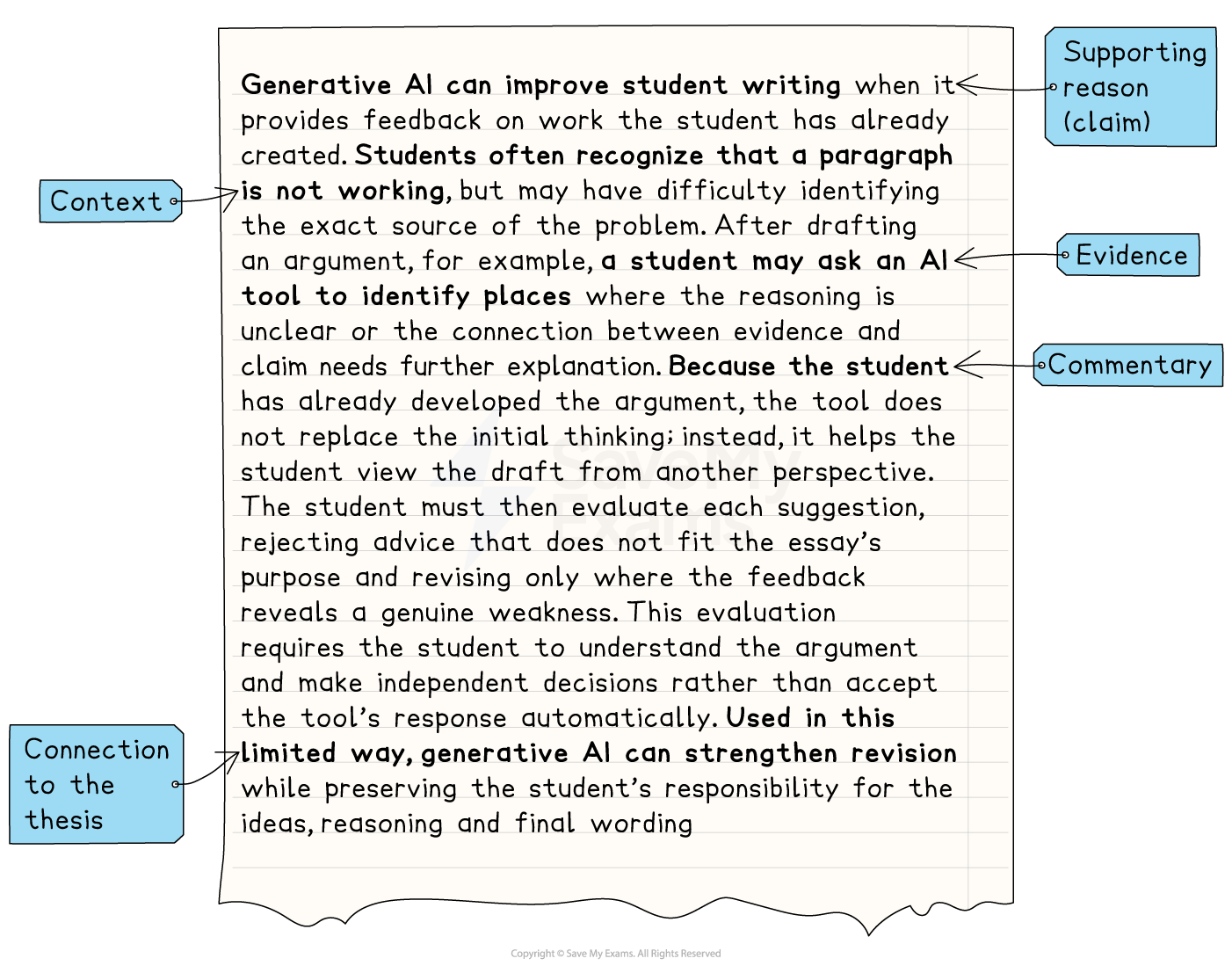
Why this paragraph is effective:
Although you may disagree with the writer’s argument, the paragraph and its line of reasoning are still effective because they do the following:
Begins with a reason connected directly to the thesis
Focuses on a specific use of AI rather than AI in general
Explains how the student remains intellectually engaged and responsible
Distinguishes assistance from replacement
Reconnects the evidence to the thesis
Examiner Tips and Tricks
Choose evidence that performs a clear function in the argument. After selecting evidence, complete these statements:
This evidence supports my reason because…
This reason supports my thesis because…
Common mistakes when building an evidence-based argument
Choosing evidence that only relates to the topic
Listing evidence without commentary
Using evidence that is too general
Repeating the same minor point
Using one unusual example to prove a broad claim
Inventing students or statistics
Treating evidence as commentary
Ignoring complications
Frequently asked questions
What's the difference between evidence and reasoning?
Evidence is the information used to support a claim. Reasoning is the logical relationship that makes the evidence relevant.
Can one piece of evidence support multiple claims?
Yes, but the writer must explain each connection separately. For example:
An AI-generated paragraph containing inaccurate information could support a claim about reliability because the tool produced an error
The same example could support a claim about student responsibility because the student failed to verify the information before submitting it
How does building an argument differ from writing the FRQ 3?
Building an argument is a general writing skill that can be used for multiple purposes and within multiple settings. FRQ 3 is one specific task on the AP Lang exam in which students have 40 minutes set aside for them to build an argument using evidence from their own knowledge and experience.
What if my evidence doesn't fully support my thesis?
Do not force a connection. Instead you could:
Replace the evidence
Qualify the thesis
Use the evidence as a counterexample
Reconsider your original position
Key terms and glossary
Alignment: the clear relationship among a thesis, supporting reason, evidence and commentary
Analogy: a comparison used to explain or clarify an idea by relating it to something more familiar
Anecdote: a brief story used to illustrate a larger point
Appropriate evidence: evidence that is well matched to the claim it supports and to the audience being persuaded
Arrangement: the purposeful order in which reasons and evidence are presented
Claim: a statement that presents a writer's position and requires proof or defense
Commentary: explanation that shows how evidence supports a reason, how the reason supports the thesis and why the evidence matters
Controlling idea: the central idea that unifies an argument
Credibility: the degree to which a writer or source deserves confidence for a particular claim
Evidence: information used to support a claim or reason
Evidence-based argument: an argument supported by relevant, specific and sufficient evidence
Line of reasoning: the logical progression of reasons, evidence and commentary that explains how the thesis is supported
Qualification: a condition, limitation or exception that makes a claim more precise
Relevant evidence: evidence that directly supports the claim or reason being developed
Specific evidence: precise information, details or examples that can be clearly identified and explained
Thesis: the main, overarching claim a writer seeks to defend or prove by using reasoning supported by evidence

Unlock more, it's free!
Join the 100,000+ Students that ❤️ Save My Exams
the (exam) results speak for themselves:

Was this revision note helpful?