Writing Effective Introductions & Conclusions (College Board AP® English Language & Composition): Revision Note

This study guide introduces you to writing introductions and conclusions in AP Lang. In the previous study guide, How to Frame an Argument, you learned what to establish. This study guide explains how introductions engage the audience, frame the issue, provide necessary context and lead into a defensible thesis. It also explains how conclusions bring an argument to a unified end by showing the significance, implications or broader relevance to the argument.
What makes an effective AP Lang introduction?
An effective AP Lang introduction prepares the reader to understand the argument. Ideally the introduction:
Engages the audience
Introduces the subject
Provides necessary context
Establishes the issue or tension
Leads smoothly into the thesis
The introduction should create a clear path from the opening idea to the writer’s claim.
The elements of a strong AP Lang introduction
Using a hook to engage the audience
A hook is an opening move that draws the reader into the issue. A hook may be:
A brief scenario
An intriguing statement
A question
A relevant statistic
A quotation
A short anecdote
A surprising contrast
A hook should be connected to the argument. It needs to lead to the thesis; otherwise, even the most dramatic of hooks could distract the reader instead of helping them understand the direction of the argument.
For example:
"For some students, the quietest place to study is not a bedroom or kitchen table, but a public library, even if that library closes before they can finish their work."
Notice how this hook prepares the reader for an argument about library access.
Necessary contextualization
Contextualization gives readers the background they need to understand the issue.
Context may explain:
What problem exists
Who is affected
Why the issue matters
What debate surrounds the topic
What limitation or tension complicates the issue
For example:
"Many students rely on public libraries for internet access, quiet workspaces, and research help, but evening hours are often limited. For students with after-school activities, family responsibilities or crowded homes, closing times can make the library difficult to use."
You can read more on necessary contextualization in How to Frame an Argument.
The thesis statement
The thesis is the main claim the writer will defend. A strong thesis should:
Respond to the prompt
Take a defensible position
Give the essay a clear focus
Possibly preview the line of reasoning
For example:
"Public libraries should extend evening hours at least two nights a week because later access would give students a safe place to study, support families without reliable quiet space at home and make better use of a public resource the community already funds."
You can read more on thesis statements in How to Write a Defensible Thesis Statement in Unit 2.
What makes an effective AP Lang conclusion?
An effective conclusion brings the argument to a unified end. It should do more than repeat the introduction. A conclusion may:
Restate the thesis in fresh language
Bring together the main reasons
Explain the broader significance of the argument
Call the audience to act
Suggest a change in behavior or attitude
Propose a solution
Explain implications
Return to an image, question, or idea from the introduction
Strategies for AP Lang conclusions
Calling the audience to action
A call to action urges the audience to do, support, reconsider or change something.
For example:
"City leaders should treat extended library hours not as an extra service, but as a practical investment in students who need a reliable place to work."
Connecting to a broader context
A conclusion may explain why the argument matters beyond the immediate topic.
For example:
"The question is not only whether a library stays open a few extra hours; it is whether public resources are available when working families and students can actually use them."
Returning to the introduction
A conclusion may return to an opening image or idea.
For example:
Opening idea
"A student sits outside a closed library with a backpack and an unfinished assignment."
Closing idea
"A community that leaves its library locked and dark during the hours students need it most should not be surprised when opportunity feels locked away, too."
Where does the thesis go?
In most AP Lang essays, the thesis should appear near the beginning, often as the final sentence of the introduction. This placement helps readers understand the argument before they read the body paragraphs.
However, the thesis can technically appear anywhere in an AP free-response essay, as long as it presents a defensible position that responds to the prompt.
The AP English Language free-response rubrics note that a thesis may be more than one sentence if the sentences are close together, and that the thesis may appear anywhere in the response.
Still, for student writing, the safest habit is to put the thesis at the end of the introduction.
A conclusion may restate or sharpen the thesis, but students should not usually wait until the conclusion to reveal the main claim in a timed AP essay.
Step-by-step: writing introductions and conclusions
Step 1: understand the prompt and rhetorical situation:
Identify the task, the topic, the context and the type of support required
Before writing an introduction, know what kind of essay the prompt is asking for
Step 2: choose an opening move:
Begin with an opening that connects directly to the issue
Consider the following:
A brief scenario
A focused question
A meaningful contrast
A relevant statistic or fact
A concise statement of the problem
Step 3: frame the issue with necessary context:
Help the readers understand the situation or tension that leads to the thesis
Ask:
What problem does the argument respond to?
Who is affected?
What makes the issue complicated?
What does the audience need to understand before the thesis?
Step 4: present a defensible thesis:
State the main claim clearly
Step 5: draft the body paragraphs:
The body paragraphs should develop the reasons suggested by the thesis
For the library-hours example, the body paragraphs might address:
Safe study space
Support for families and students with limited resources
Responsible use of public resources
Step 6: know what the conclusion must unify:
Before writing the conclusion, identify what the body paragraphs have proved
The conclusion should bring these ideas together:
What did the argument prove?
Why does the issue matter?
What should the audience understand, reconsider or do?
Can the conclusion return to the opening idea?
Step 7: end with significance, implication or return:
A conclusion should show why the argument matters
A closing move might include:
Explaining the broader context
Suggesting a practical solution
Calling the audience to act
Explaining an implication
Returning to an image or idea from the introduction
Step 8: check that the introduction and the conclusion match:
After drafting, ask:
Does the introduction prepare the reader for the thesis?
Does the conclusion bring together the main line of reasoning?
Does the ending sound complete rather than repetitive?
Do the opening and closing fit the same argument?
Worked example: introduction and conclusion
Prompt:
Develop a position on whether public libraries should extend evening hours for students and families
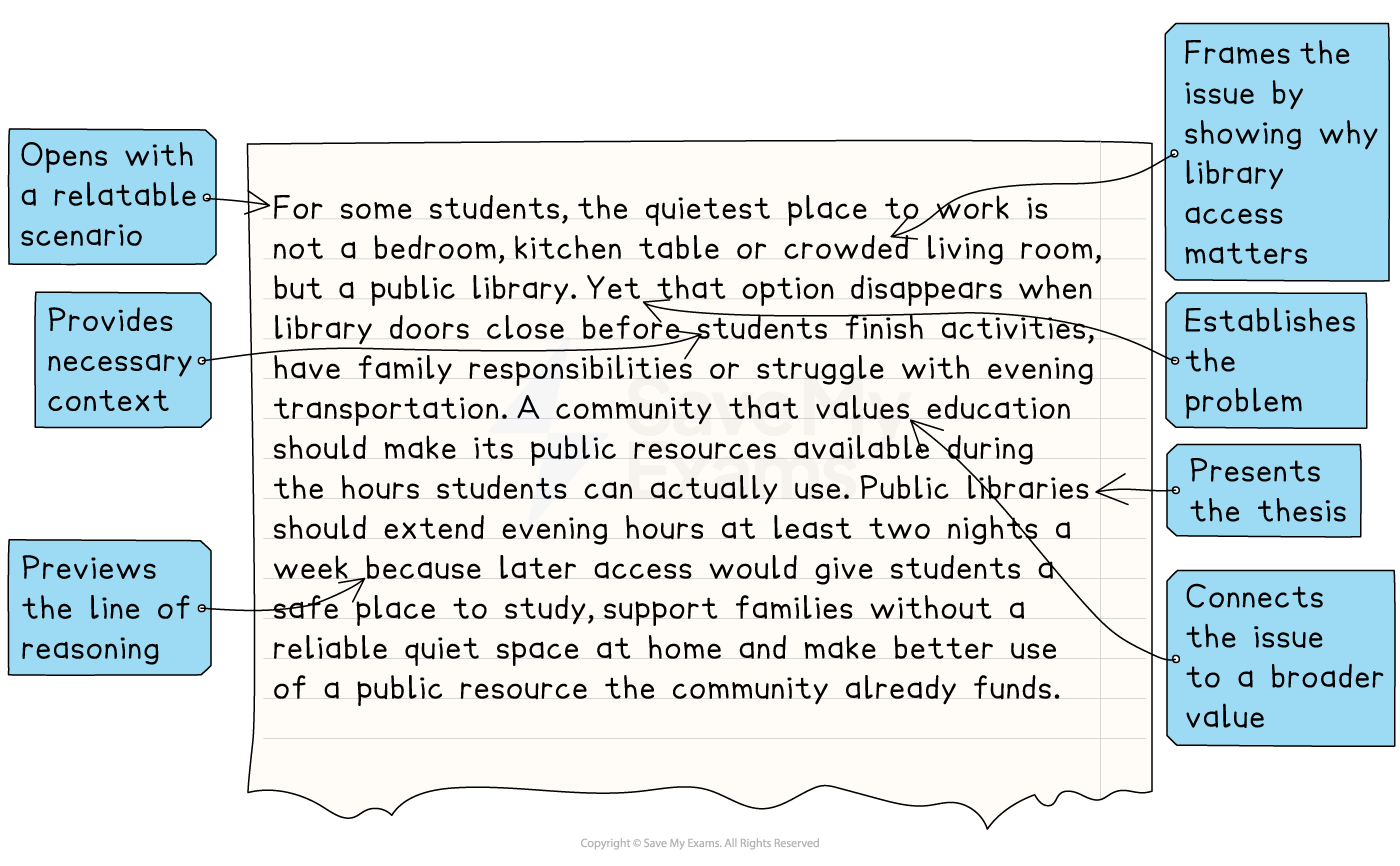
Introduction:
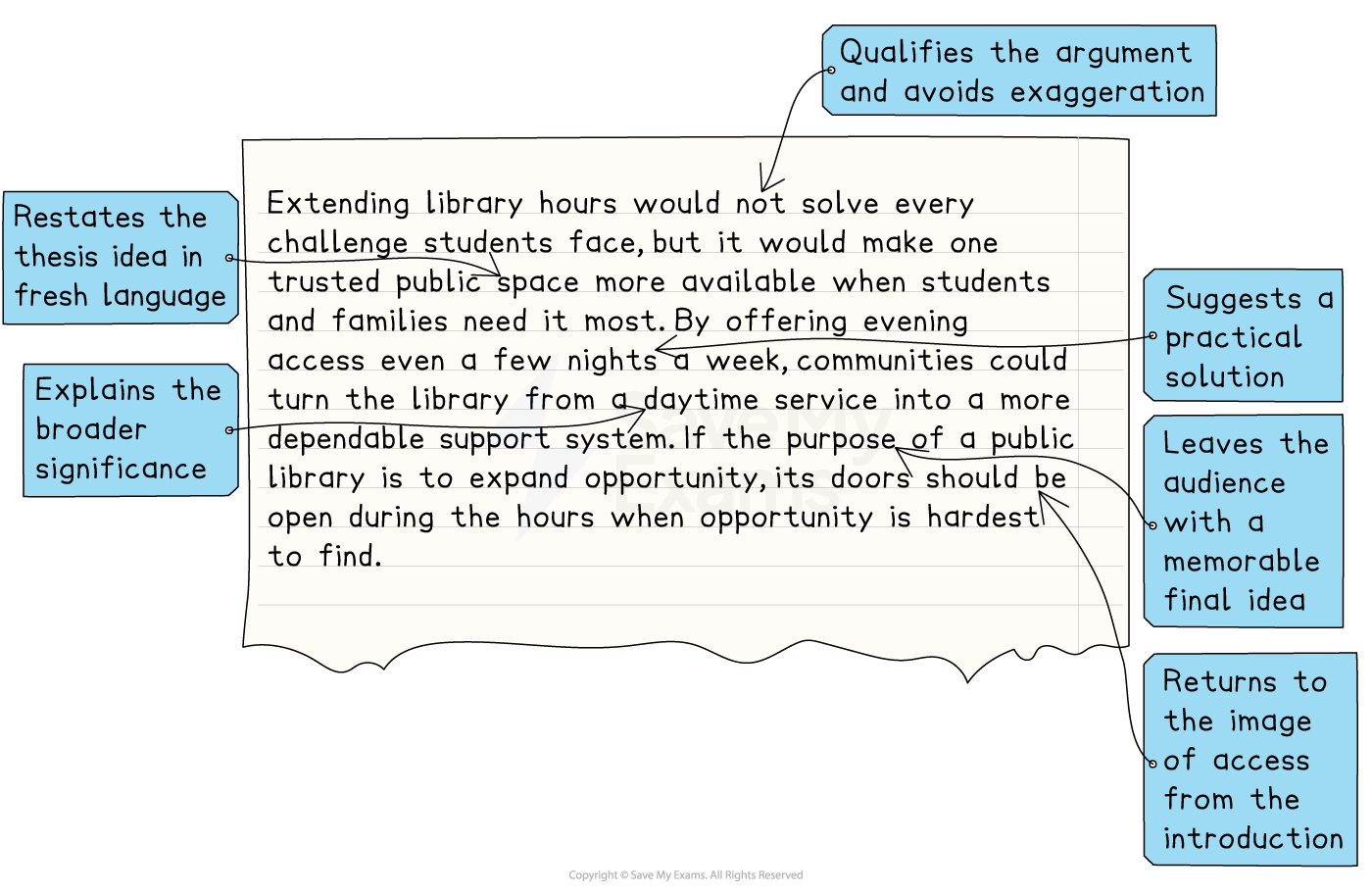
Conclusion:
Why these are effective:
The introduction begins with a student needing a place to work. The conclusion returns to the idea of library doors being open when opportunity is hardest to find. Together they identify the issue, frame why it matters, present a defensible thesis, bring the argument to a unified end and connect the specific policy to a broader value.
Tips for writing effective introductions and conclusions
Match the introduction to the FRQ type:
FRQ 1 and FRQ 3 introductions usually frame an issue and lead to the student’s position or thesis
FRQ 2 introductions usually frame the rhetorical situation and lead to a thesis about how a writer or speaker achieves a purpose
Make the introduction serve the argument:
The opening should present the reader with the issue, context and thesis:
Write the hook with this in mind rather than writing a hook just to have a hook
You should give your reader enough context through framing
End by showing why the argument matters:
A conclusion should bring the argument together and explain the argument’s significance
Common mistakes when writing introductions and conclusions
Using a hook that doesn’t connect to the thesis
Providing too much background
Stating the thesis too vaguely
Saving the thesis until too late
Adding a new argument in the conclusion
Ending with a weak phrase or idea
Frequently asked questions
How long should an AP Lang introduction be?
In timed writing, an introduction is usually brief. Often, three to five sentences are sufficient: an opening move, a sentence or two of context, and a thesis.
Can I write the conclusion before the introduction?
Usually, the introduction is written first because it frames the argument and presents the thesis. However, you may think about the conclusion early and during the writing process by asking what larger idea should my essay leave the reader considering. Your conclusion should be written or revised after the body paragraphs so it matches the argument the essay actually made.
What if I run out of time for the conclusion?
Do not sacrifice body paragraphs just to write a long conclusion. A strong essay needs claims, evidence and commentary. Supporting paragraphs greatly affect your score. Conclusions likely do not. Still, you should compose the best conclusion you can within the time given while not sacrificing your supporting paragraphs.
How are introductions and conclusions scored on the FRQs?
Introductions and conclusions are not scored as separate categories. They matter, though, because they help establish a defensible thesis, clarify a line of reasoning and show control of the rhetorical situation. A strong conclusion can support the overall quality of the essay when it explains the significance or broader relevance of the argument rather than repeating the thesis.
How are FRQ 1, FRQ 2 and FRQ 3 introductions different?
FRQ 1 and FRQ 3 introductions usually introduce and frame an issue before presenting the student’s own position. FRQ 2 introductions usually introduce the rhetorical situation before presenting a thesis about how a writer or speaker makes rhetorical choices. A helpful approach for FRQ 2 is to consider MSCAPE or SPACE CAT.
For more on MSCAPE and SPACE CAT, see Introduction to the Rhetorical Situation.
Key terms and glossary
Anecdote: a brief story used to illustrate a larger point
Audience: the person or group a writer addresses or seeks to influence
Broader context: the larger issue, situation or significance connected to an argument
Call to action: a statement that urges an audience to think, feel or act in a particular way
Clincher sentence: a memorable final sentence or idea that gives the conclusion a sense of closure
Closed thesis: a thesis statement that states the writer's position and previews the reasons or rhetorical choices that will structure the argument
Conclusion: the final section of an argument that brings the thesis and line of reasoning to a unified end
Contextualization: necessary background that helps the audience understand the issue and claim
Counterargument thesis: a thesis statement that acknowledges an opposing view before presenting the writer's position
Framing: the process of orienting the audience to the issue, context, stakes and position of an argument
Hook: an opening strategy that engages the reader's attention and leads toward the argument
Implication: what follows from an argument or what the argument suggests beyond the immediate topic
Introduction: the opening section of an argument that orients, engages and focuses the audience
MSCAPE: the rhetorical situation tool that considers Message, Subject, Context, Audience, Purpose and Exigence
Open thesis: a thesis statement that states the writer's overall position without listing the supporting reasons or rhetorical choices the essay will develop
Rhetorical analysis: analysis of how a writer or speaker uses rhetorical choices to achieve a purpose for a particular audience
Scenario: a brief imagined or real situation used to help readers understand an issue
Significance: the importance or meaning of an argument beyond the immediate claim
Thesis: the main, overarching claim a writer seeks to defend or prove by using reasoning supported by evidence
Unified end: a conclusion that brings together the main claim, reasoning and significance of the argument

Unlock more, it's free!
Join the 100,000+ Students that ❤️ Save My Exams
the (exam) results speak for themselves:

Was this revision note helpful?