Creating Unity & Coherence Using Transitions (College Board AP® English Language & Composition): Revision Note

This study guide introduces you to unity, coherence, and transitions in AP Lang. It explains how writers guide readers through a line of reasoning by connecting ideas within sentences, between sentences, across paragraphs and throughout a whole argument. It also shows how repetition, synonyms, pronoun references, parallel structure and transitional elements help make an argument easier to follow and help readers understand how ideas relate to one another.
What are unity and coherence in AP Lang?
Unity means the parts of an argument that belong together. A unified argument has:
A clear thesis
Reasons that support the thesis
Evidence that supports the reasons
Commentary that connects evidence back to the argument
Coherence means the parts of an argument that connect logically and are easy to follow. A coherent argument helps the reader understand:
How one idea leads to the next
Why evidence appears where it does
How each paragraph connects to the thesis
How the line of reasoning develops
Why coherence matters in your argument
AP Lang essays should feel like a connected line of reasoning. Without coherence, a reader would likely not be able to follow the writer’s ideas and may ask:
Why is this evidence here?
How does this example support the reason?
How does this paragraph connect to the previous one?
How does this point develop the thesis?
Transitions help readers follow the writer’s thinking. They show whether a new idea adds, contrasts, qualifies, explains, proves or concludes.
The three levels of coherence: sentence, paragraph and text
Coherence happens at all three of the following levels.
Sentence-level coherence
At the sentence level, phrases and clauses should connect logically.
Weak:
"Students miss announcements; the school has many clubs."
The relationship here is not clear. What connection does the writer wish to make?
Strong:
"Because students often miss announcements, many clubs struggle to reach the people who would want to join."
This version shows a clear cause-and-effect relationship.
Paragraph-level coherence
At the paragraph level, one sentence should lead naturally to the next.
Weak:
"Students are busy. Schools have announcements. Clubs meet after school. A bulletin would help."
Strong:
"Students often receive school information from several different places. When announcements are scattered across classrooms, posters and conversations, even responsible students can miss important details. A weekly bulletin would give students one reliable place to check for deadlines, meetings and events."
The stronger version shows a clear movement from problem to solution.
Text-level coherence
At the text level, paragraphs should connect across the entire essay. All paragraphs should support the same thesis. For example, an essay calling for the creation of a weekly student bulletin might move in this way:
Paragraph | Purpose |
|---|---|
1 | Explains how a bulletin reduces confusion |
2 | Explains how clearer communication improves participation |
3 | Explains how the bulletin helps families plan around school responsibilities |
How to create coherence: repetition, synonyms and parallel structure
Transitions are important, but they are not the only way to create coherence. Writers also create coherence through repetition, synonyms, pronoun reference and parallel structure.
Repetition
Repetition is repeating an important word or phrase to keep the reader focused on a central idea. However, simplistic or over-use of repetition can weaken your argument.
Weak:
"The bulletin would help students. Students need a bulletin because a bulletin would help students."
Strong:
"A weekly bulletin would give students one reliable place to find information. That reliability matters because students are more likely to act on announcements when they know where to find them."
While “students” is repeated necessarily, the emphasis is on the idea “reliable,” which keeps the paragraph focused while moving the reasoning forward.
Synonyms and pronoun references
Writers can also create coherence by using synonyms and pronouns to refer back to earlier ideas.
Example:
"A weekly bulletin would gather school announcements in one place. This resource would help students find deadlines, club meetings and events without searching through several different channels."
The phrase "this resource" refers back to "a weekly bulletin". The connection keeps the paragraph moving without repeating the same words awkwardly.
Other synonyms that could be used are "update", "document"," announcement page", "communication tool" and "weekly guide".
Pronouns can also help:
Example:
"The bulletin would be posted every Monday. It would give students a predictable place to find important information."
Here, the pronoun "it" clearly refers to the bulletin.
Parallel structure
Parallel structure uses similar grammatical patterns to show that ideas are related or balanced.
Example:
"A weekly bulletin would help students find deadlines, help clubs advertise meetings and help families plan ahead."
The repeated structure makes the sentence clearer and sound more balanced.
What are transitional elements in AP Lang?
Transitional elements are words, phrases, clauses, sentences or even paragraphs that help readers understand the relationship between ideas.
A transition may show:
Addition
Cause and effect
Conclusion
Contrast
Emphasis
Example
Qualification
Sequence
A transition’s real job is to show the reader how ideas relate.
Transitional words and phrases
Transitions should be chosen based on the relationship between ideas:
Relationship | Useful transitions |
|---|---|
Addition | Also, another reason, in addition, furthermore, more importantly |
Cause and effect | Because, therefore, as a result, for this reason |
Conclusion | Ultimately, as a result, in the end, therefore |
Contrast | However, although, yet, on the other hand, by contrast |
Emphasis | Most importantly, especially, above all, more significantly |
Example | For example, for instance, to illustrate |
Qualification | Even though, while, despite, in some cases |
Sequence | First, next, later, finally |
Signposting: using whole sentences to guide the reader
A signpost is a phrase or sentence that tells the reader where the argument is going. Signposting usually gives a broad guidance and tells the reader what the paragraph will focus on and how to understand the reason.
Examples:
The strongest reason to create a weekly bulletin is not convenience, but consistency
The point matters because communication problems affect students differently
The next concern is whether students can act on information once they receive it
Before considering participation, it is important to understand the confusion created by scattered announcements
How to use transitions to guide your line of reasoning
A line of reasoning is the path an argument follows to prove its thesis. Transitions guide that path by showing whether a new idea:
Adds to the previous point
Contrasts with it
Qualifies it
Gives an example
Explains a cause
Shows an effect
Moves to a more important reason
Example thesis:
"High schools should publish a single weekly student bulletin because it would reduce confusion, improve participation and help families plan around school responsibilities."
Possible paragraph transitions:
Movement in essay | Transition or signpost |
|---|---|
Thesis to reason 1 | To begin, a weekly bulletin would reduce confusion by giving students one reliable place to find information |
Reason 1 to reason 2 | Once students know where to find information, they are more likely to participate in the opportunities available to them |
Reason 2 to reason 3 | Beyond helping students, a weekly bulletin would also help families plan around school responsibilities |
Conclusion | Ultimately, clear communication is not a small convenience; it is part of making school opportunities accessible |
How to use transitions to introduce and connect evidence
Transitions can introduce evidence, but they should also show the purpose of that evidence. Strong uses of transitions often give context and help your reader understand why the evidence matters. Transitions can also show how pieces of evidence relate:
Purpose | Transition example |
|---|---|
Add similar evidence | Similarly, students may miss deadline reminders when those reminders appear in different places |
Contrast evidence | However, a weekly bulletin would not replace personal reminders from teachers or sponsors |
Explain result | As a result, students would have fewer excuses for missing information and more opportunity to plan ahead |
Qualify the point | Even if some students ignore the bulletin, the school would still have one consistent place where information is available |
Connect to thesis | This consistency supports the larger argument because communication only helps students when it is predictable and easy to find |
Worked example: unity and coherence
Prompt:
Develop a position on whether high schools should publish a single weekly student bulletin for announcements, deadlines, club meetings and school events
Thesis:
"High schools should publish a single weekly student bulletin because it would reduce confusion, improve participation and help families plan around school responsibilities."
Model paragraph:
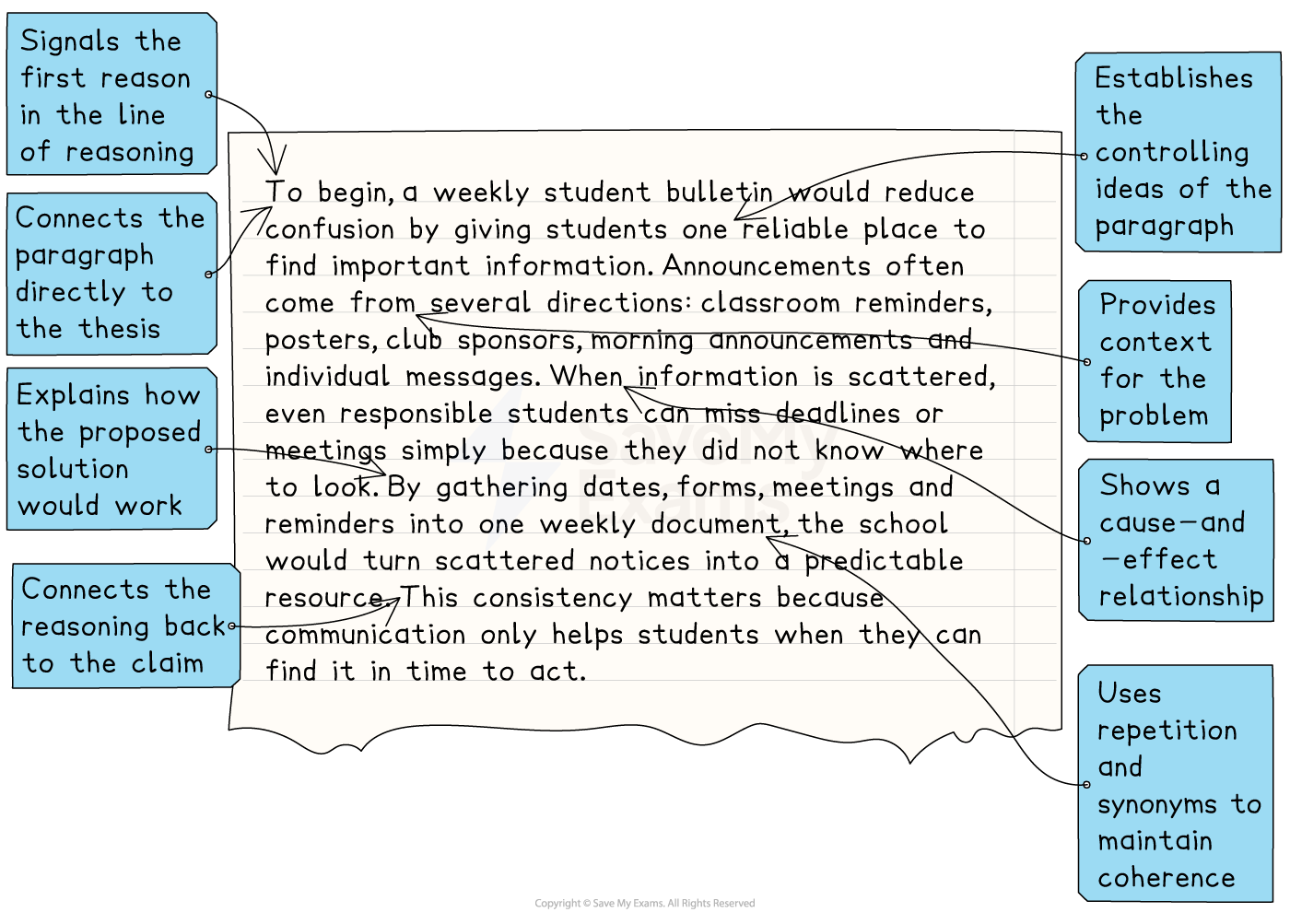
This paragraph is unified because every sentence supports the main reason of a weekly bulletin reducing confusion, and uses several coherence strategies to reveal the author's reasoning.
Examiner Tips and Tricks
Do not add transitions after the essay is already written and hope they will fix a faulty line of reasoning. In AP Lang, the best transitions do not simply move the reader forward; they show the reader how to think about the relationship between ideas.
Common mistakes when using transitions
Using transitions that do not match the relationship:
The transition should match the logic
Using too many transitions:
Transitions should not crowd the paragraph
Treating transitions as decoration:
A transition should be purposefully used
Frequently asked questions
What is the difference between a transition and signposting?
A transition is a word, phrase or clause that shows the relationship between ideas.
Example:
As a result, students would have more time to plan
Signposting is broader. It often uses a whole sentence to guide the reader through the argument.
Example:
The issue is not whether schools have announcements, but whether students know where to find them
How many transitions should I use in an essay?
There is no required number. Use transitions strategically to guide your reader. Your reader might need help understanding:
How one reason connects to another
How evidence supports a reason
How one example relates to another
Whether the argument is adding, contrasting, qualifying or concluding
Can transitions improve my line of reasoning?
Yes, but only if the reasoning is already logical. Transitions point out the reason or make it more explicit. Transitions can clarify the line of reasoning by showing how ideas connect. They cannot fix an essay whose reasons do not support the thesis.
What are the best transitions for AP Lang essays?
The best transition depends on the relationship between ideas. Transitions are chosen because they match the logic of the argument.
Key terms and glossary
Coherence: the logical connection among ideas within a sentence, a paragraph and a whole essay
Evidence: information used to support a claim or reason
Line of reasoning: the logical progression of reasons, evidence and commentary that explains how the thesis is supported
Parallel structure: the use of similar grammatical patterns to show that ideas are related or balanced
Pronoun reference: the use of a pronoun, such as it, this, they or these, to refer clearly to an earlier noun or idea
Repetition: the purposeful reuse of a word, phrase or idea to create emphasis or connection
Signposting: a phrase or sentence that guides the reader by explaining where the argument is going or how a point should be understood
Synonym: a word or phrase with a similar meaning that helps writers refer to the same idea without awkward repetition
Text-level coherence: the logical connection among paragraphs or sections of a whole essay
Transition: a word, phrase, clause, sentence or paragraph that shows the relationship between ideas
Unity: the quality of an argument in which all reasons, evidence and commentary support the same central claim

Unlock more, it's free!
Join the 100,000+ Students that ❤️ Save My Exams
the (exam) results speak for themselves:

Was this revision note helpful?